Section: UGI Sub-section: Bariatrics Curriculum: Curriculum, page 83
Laparoscopic Gastric Band
Principles
- Restrictive procedure
- Limit volume of the proximal part of the stomach
- Tight, adjustable locking silicone ring placed around upper stomach
- Infusion port placed in subcutaneous tissue
- High volume (9mL), low pressure bands preferred
- ? Some compression on Vagus Nerve leading to early satiety
- NB: Pure restrictive procedures, may lead patients away from bulky, healthy fibrous food to high calorie food such as simple sugars/ high energy liquids (maladaptive eating)
- Contraindications
- Hiatal Hernia
- Portal Hypertension
- Previous PUD
- Procedure of choice for women with subfertility
- Band can be deflated for pregnancy
- Expected weight loss
- 50-60% EWL at 2 years
- 40% cure in T2DM (improved in 80%)
Procedure
- Peritoneum from Angle of His (where cardia meets oesophagus) to top of spleen divided
- Band placed via lesser omentum
- Pars flaccida approach
- Gastric fundus sutured over the band securing it 1cm below GOJ
- Suturing carried as far posterolaterally as possible
- This is the most common site of fundal herniation
- Aim for 15ml pouch
- Learning curve ≈ 15
Post-op Management
- Diet
- NBM 1/7
- Then Liquids 1/52
- Puree diet 1/52
- Soft 1/52
- Then E+D
- Balloon
- Inflate initially with 4mL
- Then wait at least 6 weeks (or until weight plateaus)
- Next inflation = 1 mL
- Delay further inflation as long as possible
- To minimize erosion risk
Pros and Cons
- Pros
- Relatively easy surgery
- Adjustable
- Reversible/removable
- No risk of nutritional defects
- Can easily be converted to Roux-en-y/Sleeve
- Cons
- Failure of weight reduction in up to 50% at 3 yrs
- High complication rate (up to 20%)
- Regular follow-up needed
- Popularity declining due to modest weight loss and high revision rates
Complications
- Early
- Port site infection
- Food bolus obstruction
- Late
- High rate of reoperation ~ 20%
- Band Slippage
- Band Erosion ~ 1%
- Oesophageal Dilation (Pseudoachalasia)
- Oesophagitis
- Tubing and port complications
- Leakage of access tubing 10%
- Port rotation 5%
- 5% morbidity
- 0.02-0.1% mortality
Roux–en–Y Gastric bypass
Principles
- Both malabsorptive & restrictive procedure
- Prophylactic Cholecystectomy recommended if gallstones
- ERCP post-op is impossible in these patients; gallstone risk is high
- Roux-limb should be at least 75cm-150cm in length (length debated)
- BP limb should be 50cm from DJ flexure
- Fobi Pouch Principles
- < 30mL vertical pouch (usually 5-10mL)
- Vertical orientation – less liable to distension
- Divided stomach
- Reinforced staple line by patching Roux limb along staple line
- 1-2cm outlet/anastomosis
- 6.5cm Silastic ring
- Prevents outlet widening with time
- Ring requires removal in 2%
- After Gastric Bypass
- All patients started on
- Multivitamins
- B12 / Folate / Iron regularly tested and supplemented as required
- All patients started on
Mechanism of Weight Loss
- Primarily restrictive due to small pouch
- Malabsorptive component adds to weight loss
- Gastrojejunostomy anatomy
- Leads to dumping physiology
- Has negative conditioning response against high-sugar diet
- Roux-limb (Alimentary) length
- Optimal length disputed
- Balance between weight reduction and malabsorption
- Increased length = Malabsorption due to decreasing length of common channel
- Should not be > 150cm
- Ghrelin
- Normal pulsatile release inhibited in RYGB due to the foregut bypass configuration
- Also seen in Sleeve Gastrectomy
- May contribute to appetite suppression
- NB: Over time Ghrelin levels may increase back to normal
- Normal pulsatile release inhibited in RYGB due to the foregut bypass configuration
- Other Hormones
- GLP-1 and CCK may also promote anorectic state
- Fixed ring to gastric pouch can help reduced rates of weight regain - Fobi Gastric bypass
- Some increased risk with foreign body
Procedure
- Trochar placement
- Creation of small lesser curve gastric pouch
- Blunt dissection 4-6cm from GOJ to enter lesser sac
- 45mm stapler fired obliquely
- Blunt dissect the retrogastric attachments aiming to the angle of His
- Pass Bugie
- 2-3x 60cm stapler firing towards Angle of His to complete 20cc pouch
- Measure BP limb
- Lift transverse colon up to identify DJ flexure
- Measure 50cm
- Fire 60cm stapler
- Take a small amount of mesentery in-between
- Mark BP limb - stitch or clip or burn
- Measure Roux limb
- Measure 90-150cm
- Create jejunpjejunostomy
- Create a stapled or hand sewn JJ
- Place anti-obstruction stitch
- Close mesenteric defect by continuing running this stitch down
- Create gastrojejunostomy
- Pass the Roux limb retro- or anti-colic
- Create the GJ - stapled or hand-sewen
- Trim Candy Cane limb if required
- Close mesenteric defects
Pros and Cons
- Pros
- Effective for weight loss and comorbidities
- 50-60% EWL at 3 yrs
- T2DM in remission in 70%
- HTN resolved in 70%
- OSA resolved in 80%
- Improves GORD in 90% of cases (only bariatric surgery proven to do so)
- Improves gut hormone profile to reduce appetite
- PYY + GLP-1 induced satiety
- Less risk of malabsorption that BPD/DS
- But more than Gastric Sleeve or Band
- Partially reversible
- Cons:
- Steep learning curve
- Difficult to perform ERCP post-op
- Generally only recommended in high-volume centres
- Reasonable cost
- Longer operative time and longer inpatient admission
- Moderate complication rate
- 10% Morbidity rate
- 0.3 - 1% Mortality
Complications
- Early
- Leak 3% (usually at gastrojejunostomy or above)
- Staple line bleed 3%
- Stricture
- Roux-en-O configuration (requires re-do surgery)
- Late
- Internal Hernia 2% (usually months/years later)
- Stricture of Gastrojejunostomy up to 10%
- Gastric remnant distension
- Gastrogastric fistula
- Marginal ulcer 2-10%
- Dumping Syndrome
- Gallstones
- Candy-cane Roux
Laparoscopic vs Open RYGB
- Laparoscopic patients
- Less likely to have re-operations
- Less likely to have post-op complications, incl. leak
- Have shorter length of stay
- Lap Bypass vs Lap Band for obesity
- Small increase in early complications in bypass group
- More (delayed) complications in lap band group
- Less weight loss with lap band
- 50% vs 70% of EWL at 2-10yrs
- Modern Sleeve vs Modern RYGB
- Essentially equal in outcomes for co-morbidities except for REFLUX
- Sleeve also has poor outcomes for dyslipidaemia
Sleeve Gastrectomy/Gastric Sleeve
Principles
- Can be either staged or definitive procedure
- Can convert to Bypass, DS, BPD later
- Results
- 70% EWL at 3 yrs but only 50% at 6 yrs
- May be comparable to bypass, but with less morbidity
- Mortality rate 0-3.3%
- Major complications 12%
- Antrum divided 2-6cm from pylorus
- Sleeve formed over Bougie, size 32-40F
- Mechanism of action
- Restrictive
- Hormonal
- Remove Fundus, main location of Ghrelin-secreting cells
Pros and Cons
- Pros:
- Technically easier than RYGB
- No anastomosis
- No risk of internal hernias
- Normal intestinal absorption
- No risk of malabsorption
- No foreign device
- Pylorus preserved
- Prevents dumping
- Options remain for revision procedures
- Cons:
- Long learning curve (50 surgeries)
- Irreversible
- Weight gain eventually, less durability
- Less effective for T2DM than RYGB GORD rates high (20%)
Procedure
- Laparoscopic access is variable/surgeon dependent.
- The Liver is retracted and a bougie inserted into the distal stomach (usually 34Fr +)
- The hiatus is inspected to evaluate for a hernia.
- The greater curvature is devascularised and mobilised 4cm proximal to the pylorus to the OGJ using Ligasure. The gastrocolic ligament is taken off
- As the dissection heads caudally you will encounter the gastrosplenic ligament and the short gastric vessels.
- The hiatal fat is then mobilised and the angle of His taken down.
- There are often adhesion between the posterior aspect of the stomach and lesser sac which have to be divided.
- The gastric sleeve can then be created by firing consecutive staplers 5cm proximal to the pylorus up to the OGJ along the bougie. Care must be taken when heading towards to OGJ to not ‘catch’ the oesophageal sphincter.
- The stomach can then be removed via one of the 12mm ports. https://www.sages.org/video/sleeve-gastrectomy-for-morbid-obesity/
Complications
- Staple line leak 2-3%
- Bleed from staple line
- Stricture/Stenosis
- Volvulus/torsion
- GORD
Biliopancreatic diversion with duodenal switch
Principles
- Malabsorptive
- Concerns re: Potential metabolic & nutritional sequelae
- DS component developed to help lessen the high incidence of marginal ulcers, malnutrition, diarrhoea & dumping syndrome after BPD alone.
- Common channel = 75-100cm
- Entire alimentary tract = 100-250cm
- Two steps
- Sleeve Gastrectomy
- Duodenal Switch/BPD
Procedure
- First step
- Sleeve Gastrectomy
- 60F Maloney dilator
- Aim 150-200mL volume
- Then
- Duodenum divided 2cm beyond pylorus
- Distal connection 100cm prox to TI
- Proximal anastomosis
- Antecolic end-to-side duodenoenterostomy
Pros and Cons
- Associated with less severe protein-energy malnutrition than BDP alone
- Needs long term high protein diet and supplements:
- B12
- Iron
- Folic Acid
- Multivitamins
- Calcium + Vit D
- Needs long term high protein diet and supplements:
- May have best weight loss profile, but studies haven’t been done to compare
- Pros:
- Excellent weight loss and prolonged duration
- Excellent T2DM remission rate (80-90%)
- Can be used a rescue operation if weight regain after previous sleeve
- Pylorus preserved so ? reduced risk of dumping
- Cons:
- Two to four bowel motions per day, excessive flatulence, foul stools
- High risk of malnutrition
- If get severe protein malnutrition may need to revise/ lengthen common channel
- Needs close and long-term follow up
- Patients will still absorb simple sugars, alcohol & short chain fatty acids well
- Over-indulgence will still increase weight
Complications
- Dumping & nutritional deficiencies
- Protein malnutrition 12%
- Diarrhoea/ Abdominal bloating 33%
- Fatty acids irritate colon
- Sorbitol (fruits) ferments in colon, gas and diarrhoea
- Fast transit
- Bile salt toxicity
- Leaks 1.8%
- Strictures
- Marginal Ulcers
- Obstruction/Internal Hernias
- Cholelithiasis
- Need to re-operate 4.2%
- Bone pain 30%
- Mortality rate 1.1%
Historical Procedures
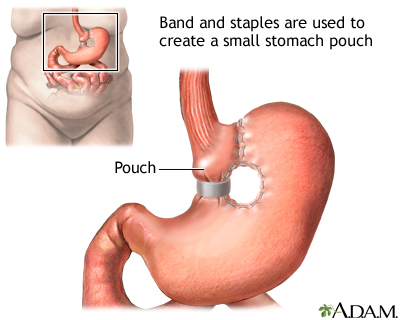
Vertical Banded Gastroplasty
- Purely a restrictive procedure
- Without inherent risks of anastomosis
- Poor results long-term compared to bypass
- But maybe not compared with bands
- Probably due to disruption of the gastroplasty & maladaptive eating patterns
- Strictures at site of band causing outlet obstruction was an ongoing problem
Jejunoileal Bypass
- Early procedure
- Too many complications
- Malnutrition
- Cirrhosis
- Malabsorptive diarrhoea
- Bacterial overgrowth
- Renal stones (oxalate)

BPD alone - see DS
- Malabsorptive
- Unpopular
- Reconstructed to allow only a short common channel of distal 50cm of terminal ileum for absorption of fat & protein
- Roux limb = distal 200cm of SB (including the common channel)
- Distal stomach & duodenum just distal to pylorus is resected & removed
- The stomach volume you choose to create depends on size of patient
- Complications for both BPD same as DS
Newer Procedures
Single Loop (Mini) Gastric Bypass
- Newer operation
- Increasing popularity
- Long gastric pouch and long BP limb
- BP limb up to 200cm
- Longer gastric pouch than RYGB
- Aim to prevent bile reflux getting to oesophagus
- Also better restriction
- Get same metabolic effects of RYGB, esp. If long BP limb
- Less Complications
- Single join
- Risk of obstruction dramatically reduced

Complications
- Reflux**
- May need later conversion to RYGB
- Malnutrition
- May need reversal
- Marginal Ulcers**
- Acid load from long pouch getting to jejunum
- More commonly in smokers
- Nausea
- Gallstones (as per other bariatric procedures)
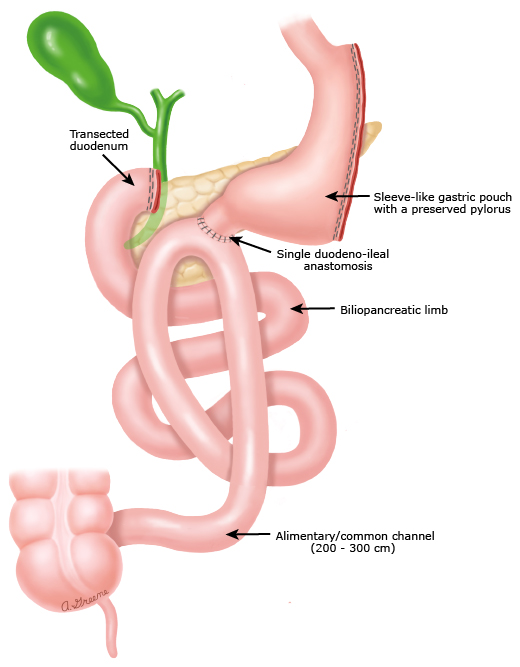
Single Anastomosis Duodenal-Ileal Bypass (SADI)
- Fundamentally a variant of the BPD/DS operation, in which the transected duodenum is anastomosed to a loop of distal small bowel as opposed to the Roux-en-Y configuration used in classic BPD/DS
- Components
- Sleeve gastrectomy
- Divide duodenum distal to pylorus
- Single loop anastomosis
- Duodenum to ileum with 230-300cm common channel
Complications of Obesity Surgery
Slipped gastric band
- Present with obstructive symptoms
- 15% 1st 3 yrs, > 50% at 10 yrs
- Typically at 2-3 yrs
- Usually anterior slippage
- Posterior slippage rare
- Investigations
- AXR to look at PHI angle
- Posterior slippage
- O-sign - gastric band being visible end on
- Anterior slippage – band rotates clockwise
- Recognised by loss of normal phi angle (10 - 60 degrees)
- Posterior slippage
- Contrast swallow
- AXR to look at PHI angle
- Creates acute angle between oesophagus and stomach
- Can lead to ischaemia of Fundus
- Management
- Deflate band completely, may resolve symptoms
- If works, then adequate acute rx, and send back to surgeon for further review
- Deflate band completely, may resolve symptoms
- May need removal of band
- Or repositioning (by bariatric surgeon)


Gastric band erosion
- 1-7%
- Aetiology
- Gastric wall ischaemia from tight band placement
- Trauma/injury during band placement
- Presents with
- Pain, nausea, vomiting +/- haematemesis
- Failure of weight loss/Loss of restriction
- Red port sign (infected port)
- Usually seals itself so unusual to see free peritonitis
- Investigations
- Diagnosed endoscopically
- CT scan to look for leak/collection (rare)
- Management
- Removal of band - Generally lap
- Cut down over the capsule surrounding the band
- There may be gastro-gastric stitches that need to be removed
- Cut down onto buckle of band with diathermy
- Divide band and then remove it
- May need distal gastrotomy to access if phlegmon
- Leave a drain
- ALWAYS – Keep all pieces of the band on a mayo table and reassemble to be sure entire band is removed
- Removal of band - Generally lap


Gastric band obstruction
- Dysphagia
- Can be
- Slippage
- Over inflation
- Fibrotic foreign body reaction/oedema from surgery
- First step is to remove all of fluid from band
- Pillow behind lower back
- Lift head like sit-up
- Brace with fingers and insert Huber needle
- Huber needle is non-coring
- If can’t find, then use 25g fine bore
- NB: Can get pseudo-achalasia with the bands and resultant dysmotility
Post-op Leak
Bypsss
- JJ, GJ, Remant pouch, blind limb
Contained vs uncontained Stable vs unstable
Princples Source control Exclude distal obstruction Abx Nutrition Pyschosoical Treatment injury Communication with family and patient
Porto-mesenteric vein thrombosis
- 1% sleeve
- up to 1m after
Sleeve
- One staple line
- Definition
- Deep/organ space surgical site infection
- Infrequent but can be severe
- Deep/organ space surgical site infection
- Is it
- Localised vs Lateralised?
- Early vs Persistent?
- Stenosis involved?
- Key points
- Stents (Megastent) very handy way of managing
- But don’t over-rely or keep them in too long
- Early and repeated use of endoscopy invaluable
- Assessment, drainage, dilatation, stenting, feeding
- Prevent external fistula by conservative use of external drainage
- And removing any external drains early
- Focus on
- Drainage of cavity, then ablation of the cavity
- Treatment of stenosis
- Rapid discharge
- Conversion of sleeve to RYGB is valid option for leak
- Stents (Megastent) very handy way of managing
Aetiology
- Crossed staple lines
- Anastomotic tension/ Ischaemia
- Stenosis
- Sleeve leaks more common than RYGB
- High pressure organ with sphincters at both ends
- At angle of HIS as this is the thinnest and most avascular part
- High pressure organ with sphincters at both ends
- Most in first week, often after discharge
- Can be weeks, months, years later
- Presentation - Sepsis, pain
- Investigations
- CRP (if high be concerned)
- Contrast swallow CT – 80-90% sensitivity
- Free gas, fluid, +/- contrast extravasation
- Abscess at top of sleeve = Leak until proven otherwise
- Left pleural effusion may be sign of evolving leak
- Fluoroscopy = 70% sensitivity
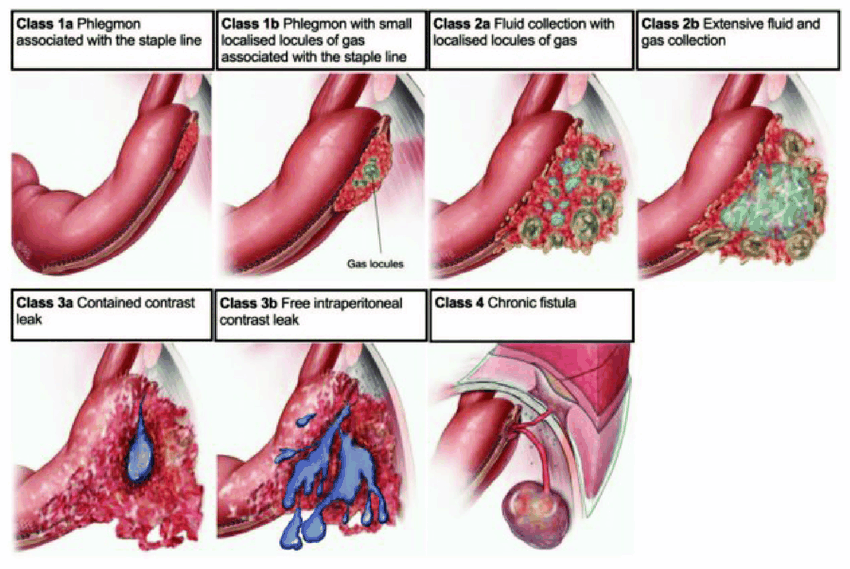
Classification
- Type 1
- Phlegmon only
- Oedema around staple line, maybe small amount of gas
- Type 2
- Abscess (with or without contrast extravasation)
- 2a Close to staple line
- 2b Extends away from staple line
- Type 3
- Generalised Peritonitis
- Gas and fluid throughout abdomen
- Type 4
- Chronic Fistula
- 4a Close to staple line
- 4b Distant
Management
Early Leak (Type 1)
- Size of cavity, stenosis, and ileus are the main drivers
- Appropriate resuscitation, antibiotics and nutrition
- Aim for rapid discharge (within 1-2 weeks)
- Avoid surgery if possible
- Avoid resection if surgery done
- If patient does not progress, they are getting worse!
- Try something different
- Phlegmon
- IV Abx, observation
- Fasting until subjectively improved or CRP falling
- Then high protein fluids
- Low threshold for OGD within first 24hrs
Type 2a - Medial Abscess
- Endoscopy and internal drainage (better if available)
- Suitable for sleeve, total gastrectomy, staple-line leak in RYGB
- Avoids fistula formation
- Allows endoscopic reassessment of defect
- Can place NJ feeding tube past it
- Aim for PO fluids day 1, and early discharge
- External Drainage if not available
- Laparoscopy and drainage, or CT guided drainage
- But will create external fistula unless drain removed early
Type 2b - Lateral Acute Abscess
- Usually more complex and unwell
- May have ileus +/- stenosis driving increased intraluminal pressure and increased leak volume
- Patients need rapid sepsis control and drainage
- Laparoscopy, external drainage, and stent (esp. RYGB)
- NB: Laparoscopy will convert small abscess to large abscess
- Stents very good at preventing fistulas but not as good at treating them
- So place stent early!
- Consider endosponge
- Laparoscopy, external drainage, and stent (esp. RYGB)
- Remove stents or endosponges after 2/52 and convert to internal drains
- Usually need TPN
Type 3 - Generalised Peritonitis
- Laparoscopy, lavage, and drain
- On table endoscopy and stent
- Place stent from 4cm above GOJ
- If sleeve, go to pre-or post-pyloric distally
- If RYGB, go across anastomosis
- Lap suture stent to stomach/small bowel to prevent migration
- Place stent from 4cm above GOJ
- TPN for Sleeve, Free fluids for bypass
- Remove stent in 1-3 weeks once clinically well and ileus settled
- Remove external drain BEFORE stent if possible to avoid external fistula
- If not improving at the end of the first week with stent in-situ
- Consider converting Sleeve to RYGB
- Leak in a RYGB will heal with a drain better than sleeve
- Can just anastomose below the leak level
- Ensure anastomosis wide to prevent pressure on upstream leak
Stent Problems
- Poorly tolerated
- If occludes due to impaction
- Will then fill with fluid
- Which will then leak around stent and into abscess cavity
- Stent straightening can lead to impaction/erosion
- Occurs in most stents over time
- Erosion can occur
- Remove by 6 weeks
- Consider segmental stent

Type 4 – Chronic Fistulas
- Usually associated with
- Lateralisation of sepsis
- Prolonged unsuccessful therapy
- Where there is a failure to consider alternative management
- Stenosis
- Causes preferential drainage into the cavity
- Bacteria change from expressing virulence, to persistence factors
- Biofilm, antibiotic resistance etc.
- Needs referral to specialist centres
- Internal drainage and pneumatic dilatation (30-40mm)
- Usually on fluid diets
- Outpatient management commonly
Post-Operative Bleed
- 0.4-4%
- Sites
- Staple line (Sleeve Gastrectomy, DS)
- Anastomosis (RYGB, DS)
- Intra-luminal or extra-luminal
- Vascular
- Gastric or Short Gastric vessels
- Mesentry
- Omentum
- Management
- 2 x IVL, resus/transfuse, Correct coags
- Conservative (PPI) vs. Operative
- Late bleeds
- Cause: Usually ulcers
Stenosis
- Main cause of on-going leak problems
- Causes increased pressure
- Assume all persisting fistulae/abscesses have at least a functional stenosis
- Endoscopy specific but very insensitive
- Even if scope through, doesn’t mean no stenosis
- Can dilate balloon to 20mm and pass through stomach
- 30mm dilatation safe after 2 weeks in sleeve
- After 6 weeks in bypass
- Therapeutic and diagnostic procedure
- 3D CT can help (FIZZ scan)
Stricture
- 6-20%
- Aetiology
- Tissue ischaemia
- Marginal ulceration
- GJ anastomosis tension
- Symptoms usually if < 10mm
- Several weeks post-op
- Nausea, vomiting, dysphagia, GORD
- Inability of oral intake (even liquids)
- Can potentiate leaks
- Most commonly at GOJ and angularis
- Endoscopic diagnosis and initial management
- Dilatation 3-4mm at a time, aim 15mm
- Anything > 20mm will decrease restrictive effect of operation
- If refractory – surgical revision of GJ, or convert a Sleeve to RYGB
Roux-En-O Configuration
- BP limb accidentally anastomosed onto the gastric pouch
- Requires re-do surgery

Candy Cane Roux Syndrome
- Excessively long blind afferent Roux limb at the gastrojejunostomy
- Causes post-prandial pain
- Often relieved by vomiting
- Blind afferent limb acts as an obstructed loop when filled with food (often preferentially)
- Distention of the loop causes pain until the food either spills into the Roux limb or is vomited back out
- Diagnosis is confirmed by:
- Contrast studies
- Afferent limb fills before contrast spills into the Roux limb
- Endoscopy
- Afferent limb is usually the most direct outlet of the gastrojejunostomy
- Contrast studies
- Management is revision bariatric surgery
- Laparoscopic resection of the afferent limb
- Symptoms resolve after revision surgery in most

Internal hernia after gastric bypass
- Occurs in 2% (usually months/years later)
- Massive weight loss creates long floppy mesentery with loose ligaments
- Presentation non-specific
- Suspect in any bypass with vomiting or abdominal pain
- Investigations
- CT scan (70-80% sensitive), signs can be subtle and difficult to diagnose
- Needs to go to OT if evidence of SBO on CT
- Mesenteric swirl sign, retroperitoneal stranding
- Increased volume of bowel in LUQ
- Closed-loop internal hernia
- Diagnostic laparoscopy
- CT scan (70-80% sensitive), signs can be subtle and difficult to diagnose
- Occurs in 3 locations:
- Petersen’s Space (Transverse Colon and Roux limb mesentery)
- Mesenteric defect behind the jej-jej anastomosis
- Mesocolic space (if retrocolic)

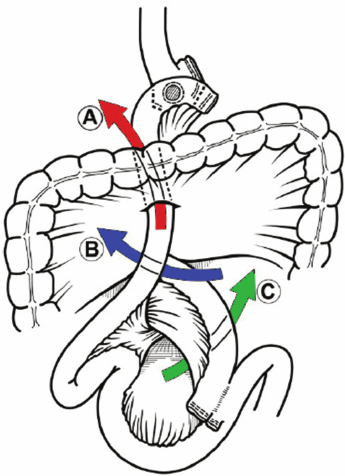 Mesenteric defects: A) transverse mesocolic; B) Petersen’s space; and C) jejunojejunostomy mesentery
- Needs to go to OT as can decompress biliary limb AND increased risk of vascular compromise
- Risk lower in laparoscopic cases and if mesenteric defects closed
- But can never prevent 100% risks
Gastric Remnant Distension (BP Limb Obstruction)
- Aetiology
- Ileus
- Mechanical obstruction
- Iatrogenic vagal injury causing decreased gastric emptying
- Gastric remnant distends and becomes necrotic
- Pt becomes hypovolaemic
- Stomach ruptures
- Massive fluid loss as well as massive 3rd spacing will cause sudden cardiac arrest
- Management
- Needs urgent decompression
- Surgical or percutaneous gastrostomy

Alimentary Limb Obstruction
- Occurs in situations like over-closure of mesenteric defects
- Causes food build up at gastro-jej, in pouch, and oesophagus
- Manage by NG decompression
- Not as severe as BP limb obstruction
Gastro-Gastric Fistula
- Rare complication of RYGB
- Can lead to
- Weight regain
- Marginal ulceration
- Aetiology
- Anastomotic leak
- Incomplete gastric division
- Marginal ulcers
- Distal obstruction
- Erosion of foreign body
- Endoscopy is diagnostic but therapeutic efficacy is very low
- Can also use PO contrast CT
- Surgery, incl. remnant gastrectomy, is the definitive treatment
- Treatment results in resolution of symptoms and improved weight loss


Marginal Ulcer
- 2-10%
- Incidence can be reduced by pre-op treatment for H. pylori
- Aetiology
- H. pylori, Smoking, NSAIDs, EtOH
- Also consider
- Poor tissue perfusion/tension
- Foreign body
- Gastro-gastric fistula
- Presentation
- Usually constant boring epigastric pain
- Nausea, GI bleed, stricture, perforation
- Usually settle with medical treatment
- Manage with high dose PPI and re-endoscopy
- Eradicate H. pylori
- Persistent ulcers may require surgical revision
- Resect ulcer/fistula and revise gastro-jej anastomosis
- Consider other causes (Gastrin levels etc.) if recurs after this
- May need reversal or gastric remnant resection
Gallstones
- Expected complication of weight loss
- 10% have symptomatic stones at 1 yr
- Can mitigate with the use of ursodeoxycholic acid
- Ursodiol 300mg po BD
- Drops risk to 2%
- But expensive
- If choledocholithiasis:
- Lap/open CBDE
- Lap/open assisted ERCP
- Enteroscopy assisted ERCP
Dumping Syndrome
- Recommend small frequent meals
- Low CHO intake
- Octreotide can help if dietary modification fails
Early Dumping Syndrome
- Occurs within 20-30mins after meal
- More common than late dumping
- More GI and less cardiovascular effects
Late Dumping Syndrome
Reflux Post Sleeve
- 20% have GORD at 5 years
- Barrett’s 10% at 10 yrs
- 2.5-5% require surgery for reflux at 5 years
- Options
- First line is anti-reflux medical therapy
- Hiatus hernia repair (with falciform sling) if hernia present and no weight regain
- Rule out and treat strictures
- RYGB if weight regain, no HH, or failure of above
Gastric volvulus
- Due to loss of fixation along greater curvature
- Symptoms
- Borchardt’s triad
- Epigastric pain
- Retching
- Inability to pass NGT
- Borchardt’s triad
- Management
- Reduce
- Operative fixation to omentum
Portal Vein Thrombosis
- Rare
- Present with pain
- Often missed on CT, need to specifically look for this
- Easily treated, but major if missed