Section: UGI Sub-section: Gastric and Oesophagus
Definition
- Rotation of the stomach > 180° around a fixed axis of rotation
Incidence
- Usually occurs in association with Hiatus hernia
- 20% in infants – 80% in adults
- Ischaemia in up to 30% of acute gastric volvulus
Aetiology
- Ligamentous abnormality (e.g. laxity, disruption) is required to allow rotation
- Other predisposing factors:
- Stomach abnormalities
- E.g. Conditions that produce acute/chronic distension
- Abnormalities of surrounding viscera
- E.g. Splenomegaly = Laxity of Gastrosplenic ligament
- Rotation of the stomach to fill an abnormal space
- E.g. Large H/H, Diaphragmatic Hernia in child
- Stomach abnormalities
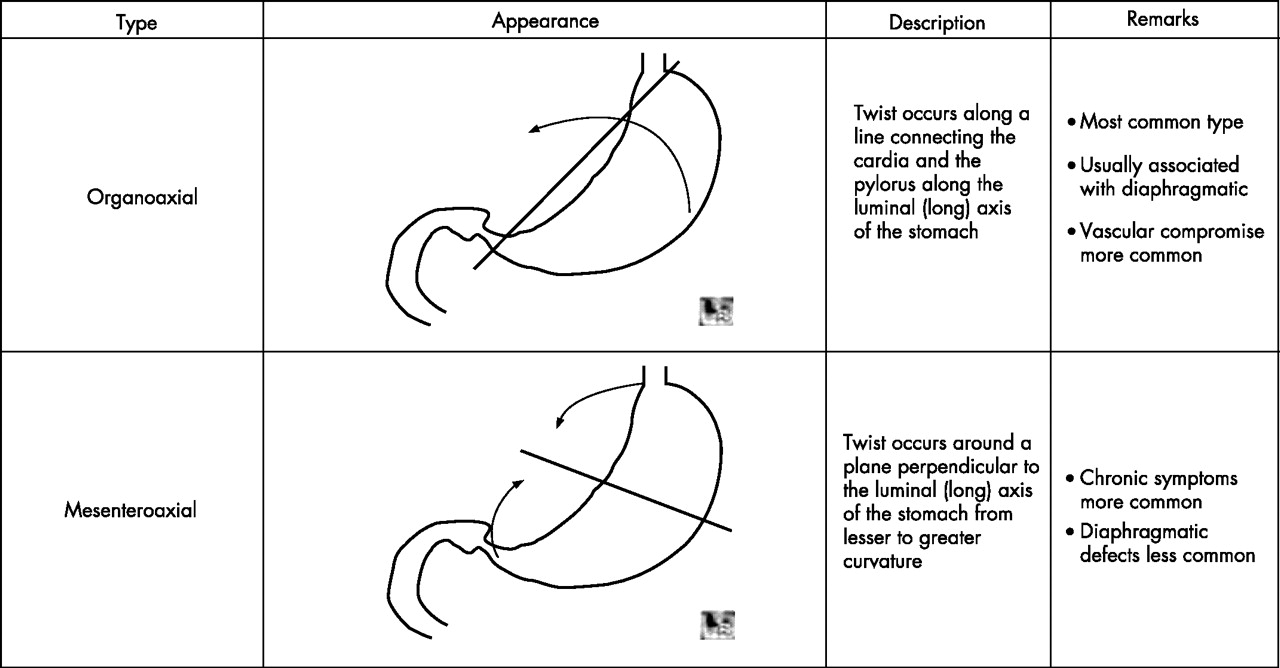
Classification
- Organo-axial (2/3)
- Rotates on longitudinal axis between GOJ and Pylorus
- Because GOJ and pylorus are fixed
- More commonly associated with other defects (e.g. paraoesophageal hernia)
- Rotates on longitudinal axis between GOJ and Pylorus
- Mesenterico-axial (1/3)
- Rotates on horizontal axis between line bisecting lesser and greater curves (“folds on itself’)
- More common in children/developmental
- Cardia remains fixed, pylorus moves
- Usually incomplete rotation
- Therefore intermittent symptoms
- Therefore intermittent symptoms
Clinical
- Often chronic condition that may be surprisingly asymptomatic
- Chronic volvulus more common than acute
- Symptoms may be confused with GB disease, gastritis, or PUD
- Pain is often episodic with vomiting
- Acute Gastric Volvulus: Borchardt’s triad
- Severe Epigastric Pain
- Retching without Vomiting
- Inability to pass NG tube
- May be profoundly haemodynamically compromised
Pathology
- Stomach usually maintained in normal position by 4 structures:
- Phreno-oesophageal ligament (fixes the cardia)
- Lesser omentum
- Gastrosplenic
- Greater omentum
Investigations
- CXR
- May see double fluid bubble
- Can evaluate positioning of the stomach
- Consider contrast studies in chronic volvulus
- Endoscopy can be hazardous


Management
- For chronic volvulus:
- Expectant non-operative management usually advised
- Esp. Elderly
- Repair the hernia & perform anterior gastropexy in symptomatic pts
- Expectant non-operative management usually advised
- If Borchardt’s triad is present
- Surgery:
- Resuscitate
- IV fluids
- NGT if able (Don’t push this)
- Correct electrolyte abnormality
- Determine if ischaemia
- Response to resus, Ongoing pain, WCC/CRP, gas on CT in stomach wall or portal venous system
- Urgent decompression
- Endoscopy – allows inspection for necrosis and decompression
- Surgery
- Can be delayed 2-3 days as staged procedure after decompression and correction of physiological derangements
- If unable to decompress or concern for ischaemia
- Lap or open reduction
- Either hiatus hernia repair
- Or can pull down stomach, place NG tube, pexy stomach (suture or gastrostomy)
- If ischaemia and resection required
- may need 2 stage surgery
- Resect and place drain + NGT
- Then return for anastomosis - with UGI surgeon
- may need 2 stage surgery
- Lap or open reduction
- Resuscitate
Prognosis/Natural History
- Risk of strangulation / infarction in asymptomatic pt is low
- Acute symptomatic volvulus left untreated can cause perforation or necrosis