- Method
- Bassini
- Shouldice
- Division and double breasting of transversalis fascia
- Then suturing conjoint tendon to inguinal ligament with continuous suture
- Marcy
- Simple deep ring closure
Advantages and Disadvantages
- Advantages
- Can be performed under local anaesthesia
- So Age is never a factor
- Minimal equipment necessary
- Most cost-effective repair
- Incidence of dysejaculation and inguinodynia seen less frequently with pure tissue repairs
- Disadvantages
- Inadequate in the treatment of femoral hernias
- Basic pathology of herniation is not addressed
- Higher incidence of testicular atrophy - more skeletonisation of cord
- 1% incidence of chronic pain lasting beyond a year after surgery
- Cannot be relied upon for recurrent inguinal hernias
Bassini Repair
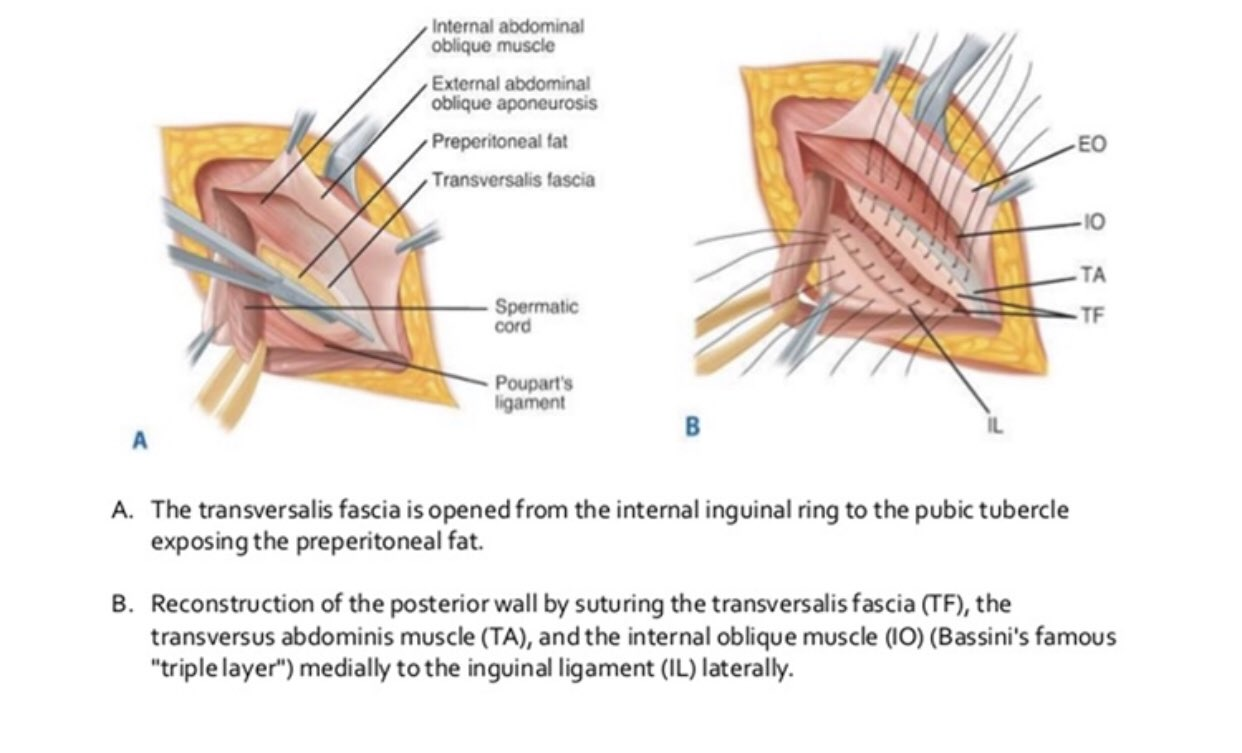
- The Bassini technique for inguinal hernia repair involves suturing the transversalis fascia and the conjoined tendon to the inguinal ligament behind the spermatic cord with monofilament nonabsorbable suture.
- It also involves the so-called Tanner slide, which is a vertical relaxing incision in the anterior rectus sheath intended to prevent tension.
Shouldice repair
- Four-layer inguinal hernia repair performed with the patient under local anesthesia.
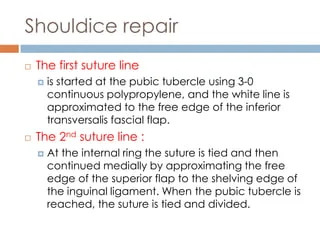
- Transversalis fascia is incised from the internal ring laterally to the pubic tubercle medially, and upper and lower flaps are created. These flaps are then overlapped (double-breasted) with two layers of sutures.
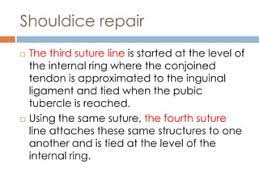
- The conjoined tendon is then sutured to the inguinal ligament, again in two overlapping layers.
- This reinforces the posterior wall and narrows the deep inguinal ring.
- The Shouldice repair is classically done with a continuous suture of 32- to 34-gauge stainless steel wire, but synthetic monofilaments (eg, polypropylene) can also be used.
- The external oblique aponeurosis is then closed in a double-breasted fashion in front of the spermatic cord.
Shouldice, page 2