Section: Surgical Oncology Curriculum: Curriculum, page 64
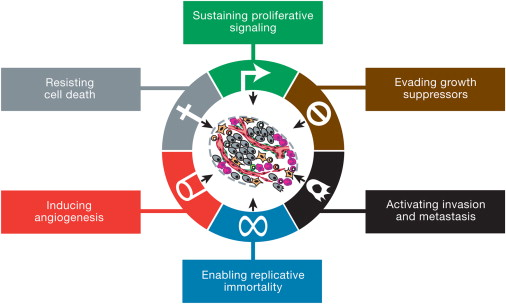
Hallmarks of Cancer- The Next Generation, page 1
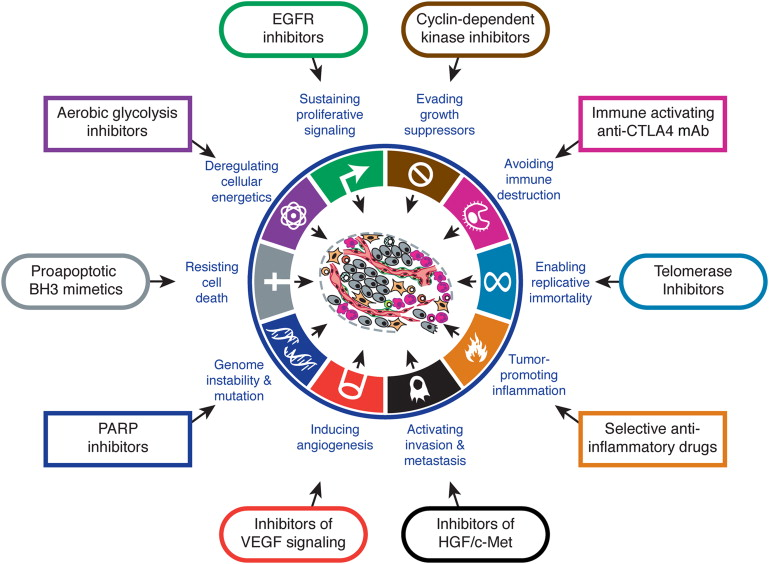
Hallmarks of Cancer- New Dimensions, page 1
Cancer biology
- Metaplasia = “transforming growth” change from one cell/tissue type to another
- Polyp = a tissue mass forming a visible projection above the mucosal surface
- Harmatoma = a mass of disorganized but mature specialized cells / tissue indigenous to the particular site of origin
- Neoplasia =”new growth”- abnormal mass of tissue, the growth of which exceeds & is uncoordinated with that of normal tissues & persists in the same excessive manner after cessation of the stimuli that evoked the change
- Dysplasia – “disordered growth” – loss in uniformity of individual cells as well as loss in architectural orientation
- Teratoma = tumor composed of cells from more than one (usually all three) germ cell layers
- Desmoplasia = abundant collagenous stroma stimulated to form by tumor parenchymal cells
- Carcinoma in situ: cytological feature of malignancy – usually involves entire mucosa, without invasion of the BM
- Malignancy / cancer = the result of uncontrolled cell growth which can manifest as invasion or metastasis
- Tumour grade: relates to nuclear pleomorphism, cellularity, necrosis, cellular invasion, degree of differentiation and no of mitoses
- Pleomorphism = variation of size & shape
- Differentiation = the degree to which parenchymal cells resemble comparable normal cells, morphologically +/- functionally
- Anaplasia = lack of differentiation
- Oncology therapy
- Complete response = absence of a demonstrable cancer
- Partial response = ↓ in tumor mass by >50%
- -oma – tends to be of mesenchymal origin
- -Adenoma – forms glands or derived from glands
- Papilloma – finger-like or warty projections
- Cystadenoma – form cystic masses
- Malignant tumors of epithelium = carcinoma
- Malignant tumor of mesenchymal tissue = sarcoma
Differentiation
- The extent to which neoplastic cells resemble comparable normal cells, both morphologically & functionally
- Pleomorphism – variation in size & shape of nuclei
- Abnormal nuclear morphology (hyperchromatic, large nucleoli)
- Mitoses – indicates proliferative rate
- Loss of polarity
- Tumour giant cells
Four classes of regulatory genes
- Proto-oncogenes
- Tumour suppressor
- Genes that regulate programmed cell death (apoptosis)
- Genes involved in DNA repair
Cancer genetics
- Multistep
- “gatekeeper” gene - directly suppress growth
- “caretaker” genes - maintain overall genetic stability
- Tumour suppressor genes:
- Mutations usually recessive (ie both copies of the gene must be damaged)
- p53
- In response to DNA damage, it inhibits cell cycle (by ↑ing expression of the CDK (cyclin-dependent kinase) inhibitor p21), causing arrest in G1 phase & inducing DNA repair genes or activating genes that induce apoptosis (eg by upregulating bax gene)
-
50% of human tumours contain mutations in this gene
- E-cadherin
- Involved in cell adhesion; mutation → stomach, breast CA
- APC
- Inhibits signal transduction (by degrading beta-catenin, which functions to up-regulate cellular proliferation); mutations → CA stomach, colon, pancreas, melanoma
- Oncogenes:
- Mutations are typically dominant
- Mutations may occur as point mutations or chromosomal rearrangements
- RAS: involved in signal transduction: regulates growth by transmitting signals from cell membrane to nucleus
- GTP mediated signal → MAP kinase → phosphorylates transcription factors (eg c-jun & c-fos) → activate gene expression → stimulate quiescent cells to enter growth cycle
- RAS mutations are involved in 10-20% of all human tumours
- RET: growth factor receptor (tyrosine kinase) → involved in MEN2 & familial MTC
- erb = epidermal growth factor receptor family → eg Her-2 neu in breast CA
- DNA repair genes:
- BRCA-1/-2 → CA breast (& ovary in BRCA-1)
- In HNPCC: hMSH2, hMLH1, hPMS-1/-2 = mismatch repair gene → leads to replication error (RER+) if mutated → microsatellite instability
- Genes that regulate apoptosis:
- bcl-2: inhibits apoptosis; over-expression of bcl-2 favours tumorogenesis
- bax: favours apoptosis
Metastatic cascade
- clonal selection model
- Clonal expansion, growth, diversification, angiogenesis
- Subclone randomly acquires the necessary traits to disseminate successfully
- Adhesion to and invasion of basement membrane
- Passage through ECM
- Intravasation
- Tumor cell embolus
- Adhesion to basement membrane
- Extravasation
- Metastatic deposit
- Angiogenesis and growth
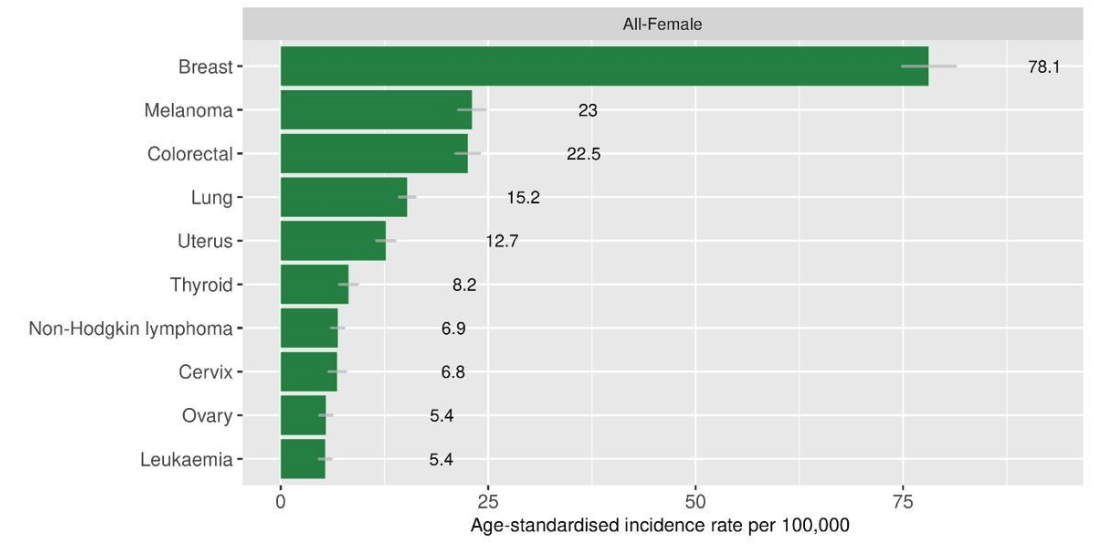
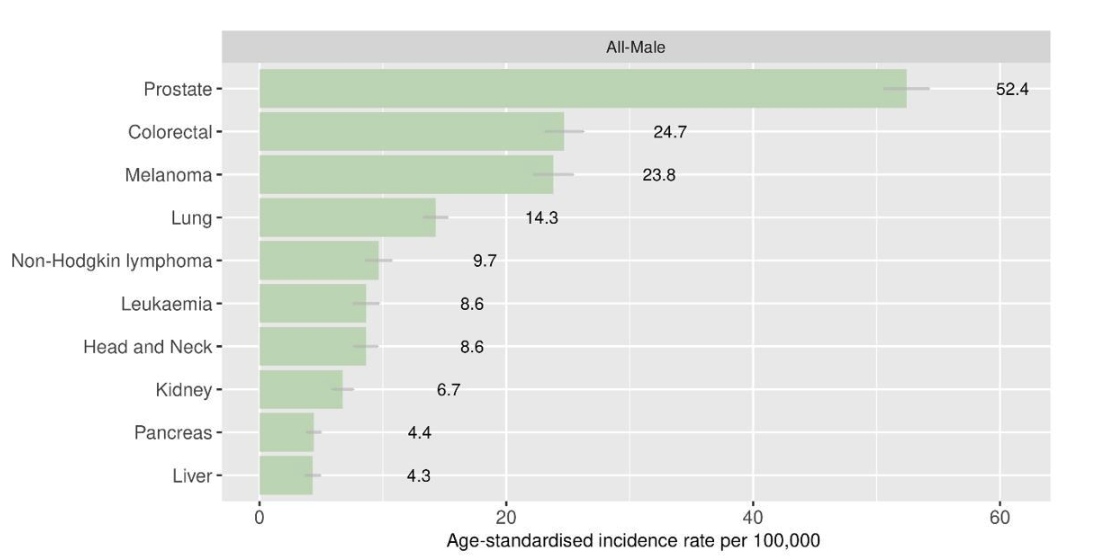
Cancer statistics
Cell cycle
- Time interval between mitotic divisions
- Phases:
- Interphase (non-dividing phase) – usually occupies most of the life-cycle of the cell
- G1 = first gap phase: cells differentiate and perform their specialized functions
- S phase = synthesis phase: DNA is replicated (before the onset of mitosis)
- G2 = second gap phase: cells prepare for mitotic division
- Mitotic (M) phase
- Some cells continually progress through the cycle; while other (terminally differentiated) cells leave the cycle → G0 phase
Carcinogenesis
- Involves
- Initiators (cause mutations → irreversible DNA damage) – eg tobacco / ionizing radiation / HBV, EBV
- Promoters:
- act to ↑ cell proliferation (eg by irritation)
- stimulated hyperplasia / growth (eg by ↑transcription factors)
- eg oestrogens act as promoters for liver tumours; thyroxin promotes thyroid CAs
- A cell affected by a CA gene (initiation) must replicate in order for cancer to occur (promotion)
Essential alterations for malignant transformation
- Self-sufficiency of growth signals
- Insensitivity to growth-inhibitory signals
- Evasion of apoptosis
- Defects in DNA repair
- Limitless replicative potential
- Sustained angiogenesis
- Ability to invade & metastasize