- Definition
- Non-penetrating injury to the carotid or vertebral arteries.
- Pathophysiology
- Stretching or impingement of the vessel wall as the head and neck are forcefully moved in flexion extension or rotation.
- Causes
- Intimal tears and exposure of the subintimal layers to blood flow
- Leads
- Thrombus formation
- Dissections in the vessel wall
- Pseudo aneurysms
- Complete occlusion of the vessel
- Transection of the vessel.
- Strokes
- Denver grading system
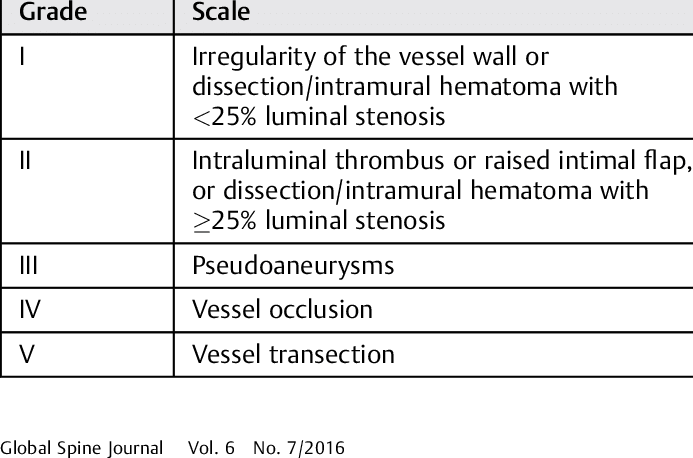
- Signs and symptoms
- Arterial hemorrhage from the neck, nose or mouth
- Expanding neck hematoma
- Cervical bruit in a patient less than 50 years old
- Focal neurological deficit that may indicate an ischemic injury to the brain
- Horner’s syndrome
- Stroke seen on imaging
- If any of the above
- CT angiogram
- Low threshold
- High energy neck trauma
- Displaced facial fractures, mandibular fractures, complex base of skull fractures, a severe traumatic brain injury, cervical spine fractures, a near hanging with hypoxic brain injury, a clothesline type injury or a seatbelt sign on the neck, significant scalp degloving, significant chest, upper rib or abdominal injuries.
- Low threshold
- CT angiogram
- Treatment
- Medical
- Antiplatelets or heparin
- Grade 1, 2 and 3
- If survive in grade 4 then for life long antiplatelet therapy
- Antiplatelets or heparin
- Endovascular
- Grade 1 - No role, self resolve
- Grade 2 - Consider in 2 if progresses on repeat imaging at 7-10 days
- Grade 3 - Consider in 3, often based on size (>1cm)
- Grade 4 - No role in grade 4
- Grade 5 - Can attempt in 5 but high mortality rate/stroke rate regardless.
- Surgery
- If hard signs
- Medical
- Follow up
- In medical management at 2 weeks and 3 months re-image
Carotid Artery Repair
- IR option available for stenting but not always amenable
- Contraindications to repair
- Ischaemic Infarct > 4hrs old
-
4hrs of interrupted flow with coma
- No back flow from carotid stump
- Repair options
- Shunt if needing to temporise
- Repair - Suture +/- Patch
- Replace - Graft - Interposition (reversed GSV)
- Bypass - Graft
- Transposition Graft - for ICA → replumb onto ECA
- Ligation - for high injuries, if no neurology or > 48 hrs neurology
- Access
- As above - depends on zone