Section: Trauma Curriculum: Curriculum, page 81
Basics
- If unstable - Surgery
- If not and suspicious - Image
Management
- Life saving
- Pressure bandage or tourniquet - Ongoing external bleeding
- Detect other sources of bleeding
- Limb saving
- Assess limb injuries - note distal perfusion
- Early ortho and plastics involvement
- Fasciotomy
- Restore impaired circulation
- Cover open wounds with sterile dressing
- Abx and tetanus
- Debridement of devitalised tissue
- Restore skeletal stability
- Temporary wound closure
- Rehabilitation
- Successful limb salvage
- Defined by patient - overall satisfaction and functionality
Extremity Vascular Injury
- Steps
- Ischaemia initial assessment
- Exploration of the vessels
- Fasciotomy - if needed or if there is doubt
- Temporary stenting of vein and artery
- Temporary orthopaedic fixation of skeletal damage
- Definitive repair of vascular damage
- Options to manage vascular damage
- Repair
- Replace - graft
- Shunt
- Stent
- Ligate and bypass
- Signs of Vascular Compromise
- Hard signs (warrant exploration without imaging)
- Loss of distal pulse (pulse deficit)
- Pulsatile bleeding
- Expanding haematoma
- Bruit
- Thrill
- Unilateral cool and pale peripheries
- Soft signs
- Pulsatile haematoma
- False aneurysm
- Continuous murmurs of AVF
- Progressive swelling of an extremity
- Unexplained ischaemia or dysfunction
- Hard signs (warrant exploration without imaging)
- Assessment/Imaging
- ABPI
- Doppler USS
- Duplex USS
- CT angiogram
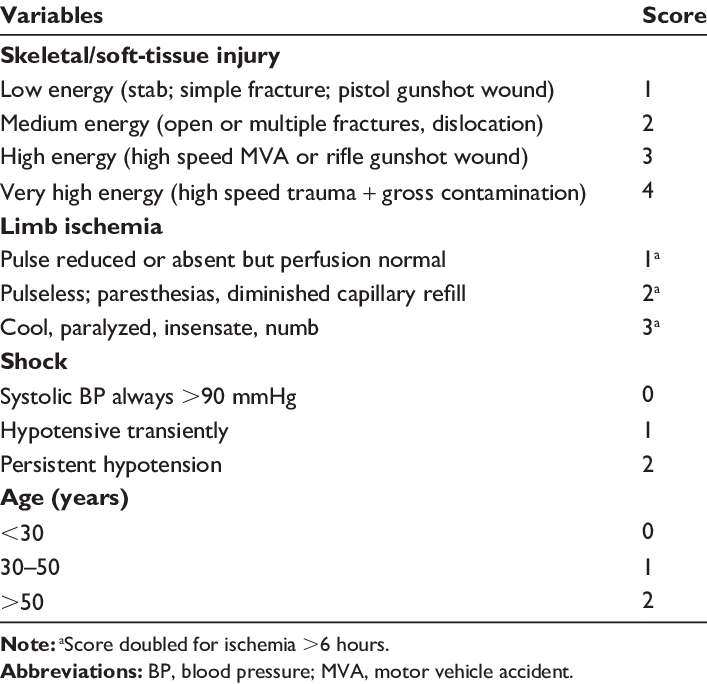
Mangled Limb Severity Score
- = MESS (MISA)
- Score stratifies risk of need for amputation vs limb salvage
- Ischaemia of limb with double points for duration
-
7 = Highly likely need amputation
Management
- Direct pressure
- Torniquet
- Clamping
- Abx
- Tetanus
- Surgery
Open Fractures
- Risk Factors for Infection
- Severity of injury
- Type of contamination
- Delay from injury to surgical care (> 6hrs)
- Failure to use prophylactic abx
- Inappropriate wound toilet
- Lack of coverage of bony structures
- Inappropriate wound closure (e.g. primary closure in contaminated/contused wounds)
- Open fracture wounds that are more likely to get infected
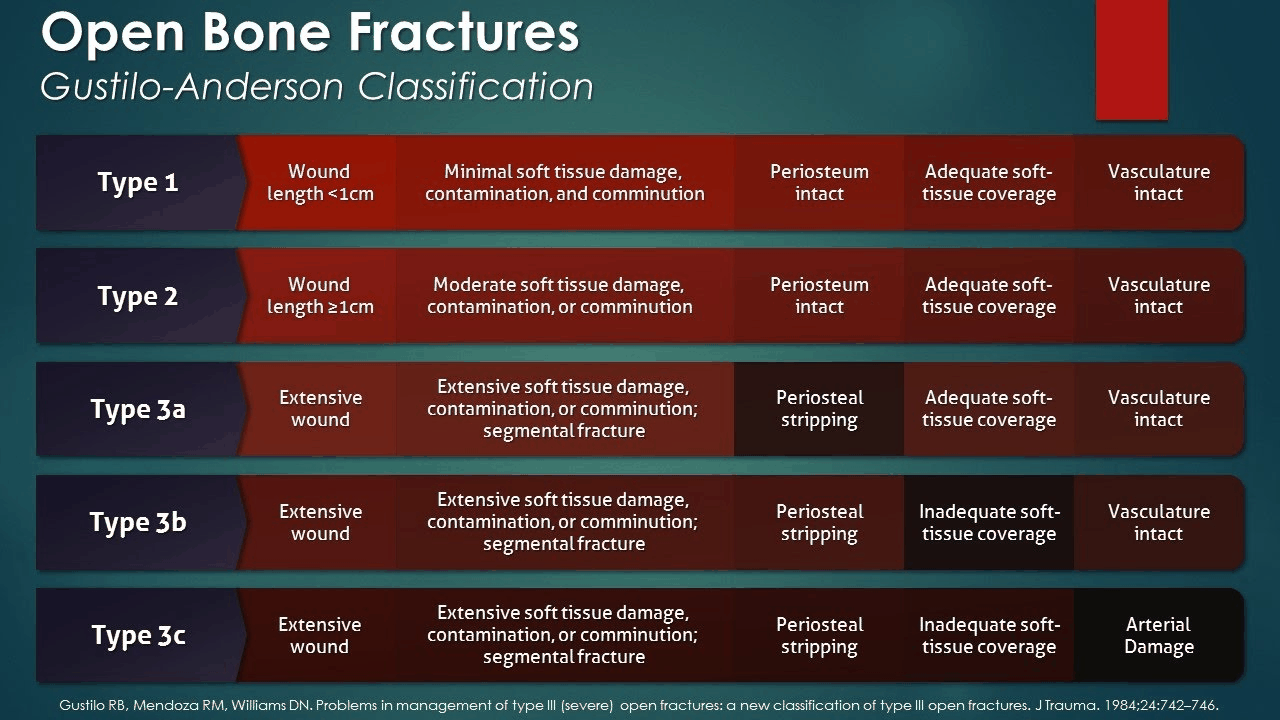
Gustilo Classification of Open Fractures
- Grades are from 1-3 with 3 being divided into A,B,C
- Higher grade correlates with a more severe open fracture which is more challenging to manage, may require more invasive management and has a higher risk of morbidity/loss of limb
- Antibiotics
- Just Staph cover for Grade 1 and 2
- Grade 3 need broader cover
- Skeletal Fixation Timing in Polytrauma
- Weak evidence that earlier fixation has better outcomes overall
- Other option is ex fix and definitive surgery later (DCS/DCO)
- Scores
- Many scores exist to grade mangled limbs
- They focus largely on patient stability, age, comorbidities, and limb information
- Injuries to bone, vessel, soft tissue, nerve
- Scores should not be the mainstay of mx decisions
Compartment Syndrome
- 5 P’s are all late signs
- Pain on passive flexion, pulseless, pallor, paraesthesia, paralysis (poikilothermia)
- Difficult to assess in ICU pts - Can measure compartment pressure
-
30mmHg = Compartment syndrome
- Have a low index of suspicion to dx and treat with fasciotomy
-
- Fasciotomy should be first done while trying repair vessel
- Fasciotomy
- Lower leg = 2 incision and 4 compartment
- Lateral
- 2cm below Fibula Head (anterolateral) all the way down to Lateral Malleolus
- Need to open the anterior and lateral compartments on either side of the septum
- Avoid the Common Peroneal Nerve at Fibula head
- Medial
- 2cm medial and below Tibial Tuberosity to 2cm above the Medial Malleolus
- Need to open deep and superficial compartments
- Avoid the Great Saphenous Vein
- Lateral
- Lower leg = 2 incision and 4 compartment
- Fasciotomy
Complications of major limb injury
- Skin/soft tissue - Scarring, infection, need for grafts, compartment syndrome
- Bone - Mal-union, non-union, delayed union, infection
- Nerve - Direct or ischaemic injury with functional loss
- Vascular - DVT
- Joint - Poor mobility, arthritis
- Other - Chronic pain, psych