- Atrophic gastritis leads to atrophy/loss of the original gastric glands
- This is then replaced by intestinal-type epithelium
- GIM is a premalignant stage in the gastric cancer cascade through a series of well-defined and recognizable precursors
- “Correa cascade”
- Patients with GIM are thought to be at increased risk for gastric cancer but the absolute risk appears to be modest in areas of low gastric cancer incidence (2.5 per 1000 person-years).
- However, among patients with GIM, the risk of gastric cancer is higher in individuals with extensive and incomplete IM.
Classification
- Topographic
- Extensive (includes body/corpus)
- Limited ( antrum or incisura)
- Histology
- In intestinal metaplasia, the original gastric mucins, which have a neutral pH, are replaced by acid mucins, which may be sialic or sulfated
- Complete vs incomplete
- Complete IM
- defined by the presence of small intestinal-type mucosa with goblet cells that secrete sialomucins, a brush border, and eosinophilic enterocytes
- Incomplete IM
- defined by the presence of colonic-type epithelium with multiple, irregular mucin droplets of variable size in the cytoplasm and absence of a brush border
- Complete IM
- Type
- Type I (complete) intestinal metaplasia expresses only sialomucins and expresses MUC2 (an intestinal mսciո), while gastric mucins are either decreased or absent (MUC1, MUC5AC, and MUC6).
- Type II (incomplete) intestinal metaplasia expresses a mixture of gastric (neutral) mucins and intestinal sialomucins.
- Type III (incomplete) intestinal metaplasia, which is the least common, is characterized by the presence of columnar mucous cells containing sulfomucins. Incomplete metaplasia coexpresses intestinal mսϲiո and gastric mucins.
- Complete vs incomplete
- In intestinal metaplasia, the original gastric mucins, which have a neutral pH, are replaced by acid mucins, which may be sialic or sulfated
Risk factors for gastric cancer in patients with GIM
- Family history of gastric cancer in a first-degree relative
- Incomplete GIM
- Extensive or corpus GIM
- Racial/ethnic minorities in the United States (including African Americans, Hispanics, and Asians)
- First-generation immigrants from high-incidence areas (eg, Eastern Asia, mountainous Latin America)
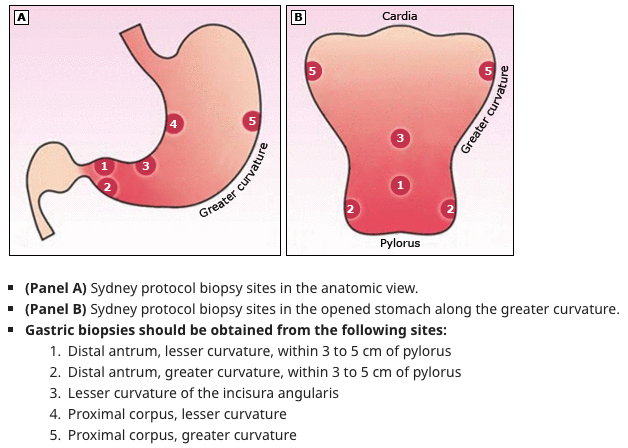
Sydney protocol biopsy
- Gastric topographic mapping, biopsies are obtained from a minimum of five nontargeted biopsy sites (the lesser and greater curvatures of both the antrum and corpus, and the incisura angularis), with one or two biopsies (“bites”) per site
- Specimens should be placed in a minimum of two bottles, for the corpus and antrum with incisura, respectivel
- Targeted biopsies should be obtained from irregular areas of the mucosa to rule out dysplasia and early gastric cancer.
Management
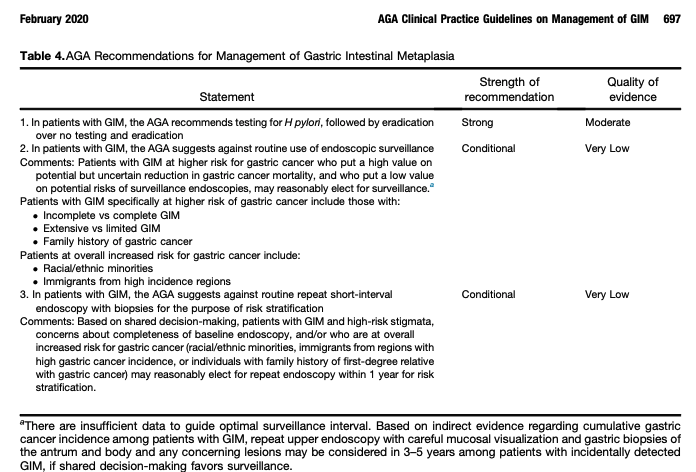
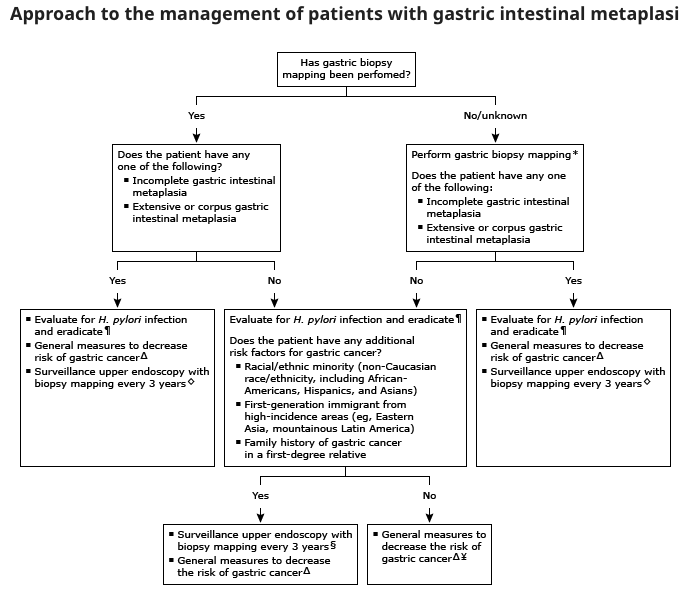
Conservative approach is 3 yearly endoscopy - I will say this for the exam