- Developmental abnormality
- Aberrant right subclavian artery from descending aorta
- Most common
- Travels behind oesophagus, incomplete ring
- Often asymptomatic, may cause posterior compression
- “Dysphagia Lusoria”
- Associated with non-recurrent laryngeal nerve
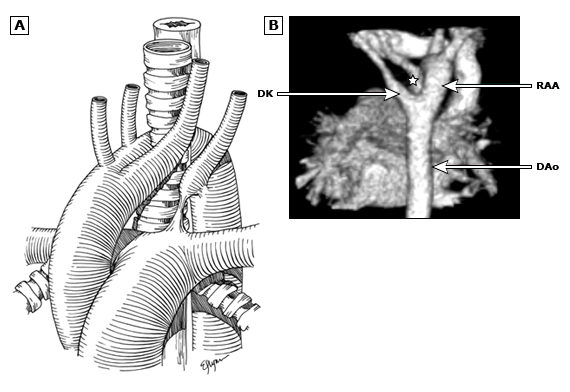
- Anomalous formation of right aortic arch with left ligamentum arteriosum and resultant retro-oesophageal left subclavian artery
- Complete ring
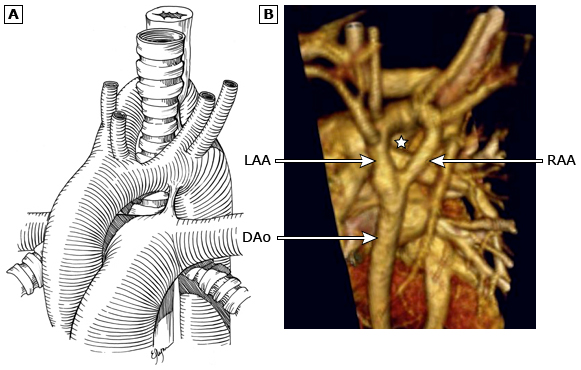
- Double aortic arch
- Fail to remodel appropriately, which results in two aortic arches both connecting the ascending and descending aortas
- Complete ring
- Other causes
- Left aortic arch with a right descending aorta and right ductus arteriosus (or ligamentum)
- Right aortic arch with a left descending aorta and left ductus arteriosus (or ligamentum)
- Left aortic arch with an aberrant right subclavian and a right ductus arteriosus (or ligamentum)
- Right aortic arch with mirror-image branching and a left ductus arteriosus (or ligamentum) arising from a retroesophageal dimple pointing to the left (also described as a double aortic arch with atretic left arch)
- Right aortic arch with retroesophageal left innominate and either a left ductus arteriosus or diverticulum
- Aberrant right subclavian artery from descending aorta
Double aortic arch
 Right aortic arch with aberrant left subclavian artery and left ligamentum arteriosum

Pulmonary artery sling
- Left pulmonary artery comes off right instead of main branch & courses between trachea & oesophagus
- Associated with other cardiac defects & foregut abnormalities
- All require repair to prevent tracheal or left PA stenosis

Innominate artery compression syndrome
- This syndrome occurs when the innominate (or brachiocephalic) artery originates later along the course of the transverse arch, resulting in takeoff to the left of the trachea.
- Anterior tracheal compression with associated tracheomalacia results when the aberrant innominate artery passes back to the right.