- Dissection of the thoracic aorta
Incidence
- Aortic dissection = Most common catastrophe of Aorta (more common than AAA)
- M > F (3:1)
- Peak age: 50-65; (75% occur in pts aged 40-70yrs)
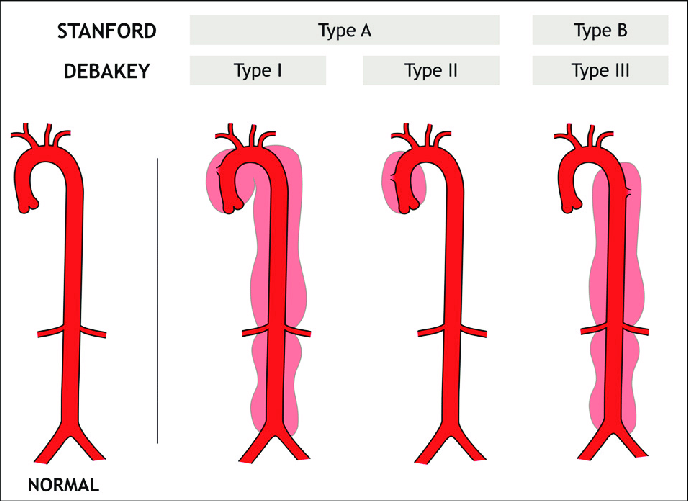
Classification
Aetiology
- Marfans, Ehlers-Danlos & other connective tissue diseases
- HTN can propagate dissection
- Atherosclerosis
- Iatrogenic injury (e.g. Catheter, Open heart procedures)
- Blunt chest trauma
- Can be associated with Pregnancy
Clinical
- Chest pain
- Ripping / tearing/ sudden onset
- Neck, jaw, interscapular pain
- Pain tends to be felt anteriorly in ascending dissection & posterior interscapular in descending dissection
- Neurological Sx / stroke Sx / limb paraesthesia, pain or weakness – in 20%
- BP differential of > 20mmHg
- Renal failure, acute mesenteric occlusion & lower extremity arterial occlusion may occur
- If the dissection involves the pericardial space, tamponade may result
- Occlusion of coronary arteries may also occur
- Aortic root involvement is also associated with prolapse of the Aortic valve
Pathology
- 90% occur within 10cm of the Aortic valve
- Tear in the intimal layer → Formation & propagation of subintimal haematoma
- Cystic Medial Necrosis
- Hallmark change associated with dissection, esp. in Marfan’s
- Degenerative changes in the media leading to breakdown of the collagen, elastin and smooth muscle
- Medial degeneration predisposes to rupture of Vasa Vasorum → Intramural haematoma formation → Dissection
Investigations
- ECG
- 8% of pts with type A dissections have ST elevation (none with type B)
- CXR
- Normal in up to 50%
- Widened mediastinum (> 8cm on PA CXR)
- Abnormal (blunted) Aortic knuckle
- Left Apical Cap
- Angiography
- Accurate Dx in 95% (historically the gold standard)
- CT
- Helical / multiplanar CT = Replacing angiography as the test of choice
- Sensitivity 83-94%, specificity 87-100%
- Echo
- Transthoracic – Sensitivity 80%, specificity 90%
- Transoesophageal – Sensitivity 97-99%, specificity 97-100%
- MRI
- Sensitivity >90%, specificity >95%
Management
- Type A: Surgery → Dacron graft
- Type B: Medical therapy → Control of BP (β-blockers)
- But ≈ 20% will require surgery for organ ischaemia
Prognosis / Natural Hx:
- If untreated, Acute Type A → 33% die within 24/24, 50% die in 48/24; 70% by 1/52
- 2-week mortality ≈ 75% in pts with undiagnosed Ascending Aortic dissection
- After surgery
- Operative mortality: 5-15%
- 5YS Open surgery 50%
- Type B risks: 3% Paraplegia, 34% Renal failure, 7% Bowel ischaemia, 4.7% CVA
Follow-up
- For Type B dissection, 20% develop aneurysmal dilation of the aorta, therefore yearly imaging surveillance advised