See: Diaphragm anatomy
Definition:
- Abnormal diaphragmatic defect, which permits herniation of abdominal contents into the chest
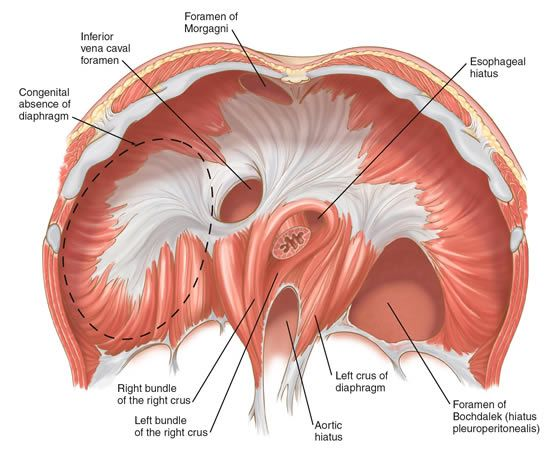
Sites of Hernia
- Parasternal (Morgagnia)
- Between sternal and costal muscle fibres
- Posterolateral (Bochdalek)
- Failure of Pleuroperitoneal Membrane to grow anteriorly and close the pericardioperitoneal canals
- Usually on left
- Liver protects herniation on the right
- Hiatus
- Traumatic
Incidence
- Congenital diaphragmatic hernias occur 1:2000-3000 live births
Aetiology / Classification
- Congenital
- Through foramen of Morgagni
- Foramen of Bochdalek
- Acquired
- Hiatus
- Traumatic
Clinical
- Most congenital hernias present as newborn
- But up to 10% present later, even in adulthood
- Bochdalek hernia: usually on LHS
- Get respiratory distress at birth
- Due to pulmonary hypoplasia
- Symptoms from Morgangi hernia usually do not develop until middle life
- Usually right-hand side
- Traumatic:
- Lacerations usually occur in tendinous part of the diaphragm
- Usually left hand side
- Acute
- May cause respiratory insufficiency
- Chronic (unrecognized tear)
- May present with pain or bowel obstruction years later
Pathology
- Congenital hernias result from failure of fusion of portions of the diaphragm
- 30% of cases associated with chromosomal abnormality
Investigations
- CXR
- CT
- +/- barium study
Management
- Repair:
- Transabdominal (most common) or transthoracic
Prognosis / Natural Hx:
- Neonatal presentation of congenital hernia
- Survival rates of 40-90%
- Prognosis of congenital hernias presenting in adult life is excellent
- Recurrence rare after surgical repair