- Origin: Front of the Abdominal Aorta between the crura of the diaphragm
- A little below the Median Arcuate Ligament
- At the level of T12 vertebra body
- Flanked by Coeliac group of Pre-Aortic Lymph Nodes
- Coeliac Ganglia lie one on each side – send sympathetic nerves carried along its branches
- Supplies: The GI tract from the lower part of the oesophagus down to the opening of the bile duct into the duodenum + Foregut derivatives (liver and pancreas) and the spleen
- Branches: Left Gastric Artery, Splenic Artery, and Common hepatic artery
- Course: Divides at the upper border of the Pancreas into three branches behind the peritoneum of the posterior wall of the Lesser Sac
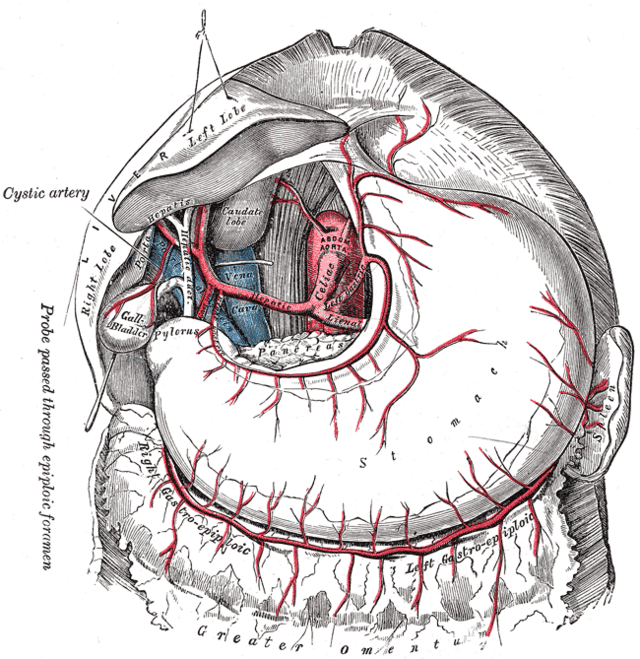
- Course:
- Runs upwards across the left crus to the oesophageal opening in the diaphragm
- Gives off oesophageal branches
- Turns antero-inferiorly raising a small fold of peritoneum, the Left Gastropancreatic Fold
- Turns right in the Lesser Omentum along the Lesser Curvature
- Supplies stomach
- Branches:
- Oesophageal branches
- Course:
- Passes to the left
- Tortuous
- Crests of its waves appear above the Pancreas
- From the middle part, may give off a Posterior Gastric Artery to the stomach, which raises a fold of the parietal peritoneum called the Gastrosplenic Ligament, as it arches forwards towards the Stomach
- Runs across the Left Crus and Left Psoas to the hilum of the Left Kidney
- Turns forward in the Splenorenal Ligament to the hilum of the Spleen
- Gives off 6 Short Gastric Arteries, which run in the Gastrosplenic Ligament
- Gives off the Left Gastroepiploic Artery – runs to the right in the Greater Omentum
- Gives branches to the Stomach and Omentum
- Breaks up into terminal splenic branches
- Branches:
- Posterior Gastric Artery
- Short Gastric Arteries
- Left Gastroepiploic Artery
- Common hepatic artery Course
- Passes over upper border of pancreas
- Then downwards and to the right behind the peritoneum of the posterior abdominal wall (in the lesser sac) as far as the first part of the duodenum
- Turns forward at the opening into the lesser sac (epiploic foramen) and turns upwards into the space between the 2 layers of the lesser omentum
- Becomes the hepatic artery
- Meets the bile duct
- Lies on left side of bile duct
- Both bile duct and hepatic artery are in front of the portal vein
- All 3 lie between duodenum and porta hepatis surrounded by peritoneum at free edge of lesser omentum
- NOTE: ‘Common hepatic’ becomes ‘hepatic proper’ as soon as it turns UPWARDS
- Meets the bile duct
Hepatic artery
- Reaches porta hepatis and divides:
- Right hepatic artery – right half of liver
- Left hepatic artery – left half of liver
Other branches
-
Right gastric
- Leaves common hepatic as it turns into lesser omentum to reach the stomach
-
Gastroduodenal
- Passes down behind first part of duodenum to the left of the portal vein
- Then divides into 2
- Right gastroepiploic artery
- Passes forward between first part of duodenum and pancreas
- Turns to the left to enter between the 2 leaves of the greater omentum at their attachment over the front of the head of the pancreas
- Superior pancreaticoduodenal artery
- Divides into 2 branches – encircle the head of the pancreas in the concavity of the duodenum down to the entrance of the bile duct
- Anterior branch (small)
- Posterior branch (large)
- Both branches anastomose with similar branches of the ‘inferior pancreaticoduodenal branch’ (from SMA)
- Bile duct entrance marks the junction of foregut/midgut – is the meeting place of the arterial distributions of the respective arteries (coeliac/SMA)
- Pancreaticoduodenal arteries supply:
- Duodenum
- Adjacent head of pancreas
- Divides into 2 branches – encircle the head of the pancreas in the concavity of the duodenum down to the entrance of the bile duct
- Right gastroepiploic artery
-
Entrance of Bile Duct marks junction between Foregut and Midgut
- Meeting place of the arterial distributions of the Coeliac and Superior Mesentery Arteries