- Origin
- Arises from the medulla oblongata in the postolivary sulcus
- Emerges as several rootlets, superior to the vagus nerve
- Skull Exit
- Exits the posterior cranial fossa via the jugular foramen
- Passes through the pars nervosa (anteromedial portion)
- Ganglia
- Superior (jugular) ganglion: general somatic afferent
- Inferior (petrosal) ganglion: general and special visceral afferent
- Cervical Course
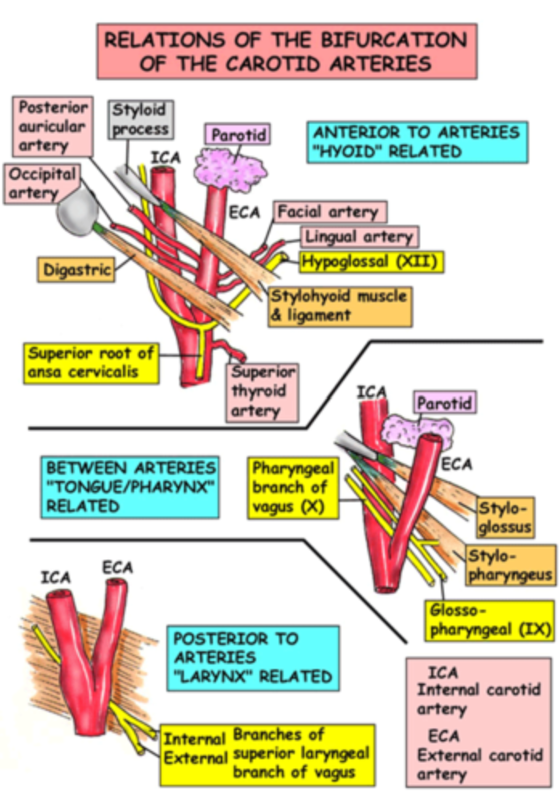
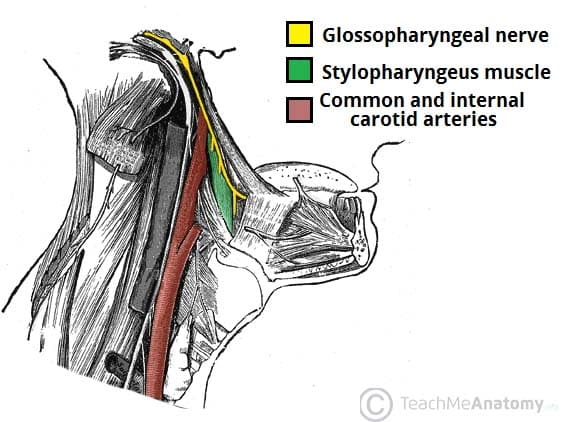
- Descends between the internal carotid artery and internal jugular vein
- Curves around the stylopharyngeus muscle (which it innervates)
- Enters the pharynx between the superior and middle pharyngeal constrictors
- Branches
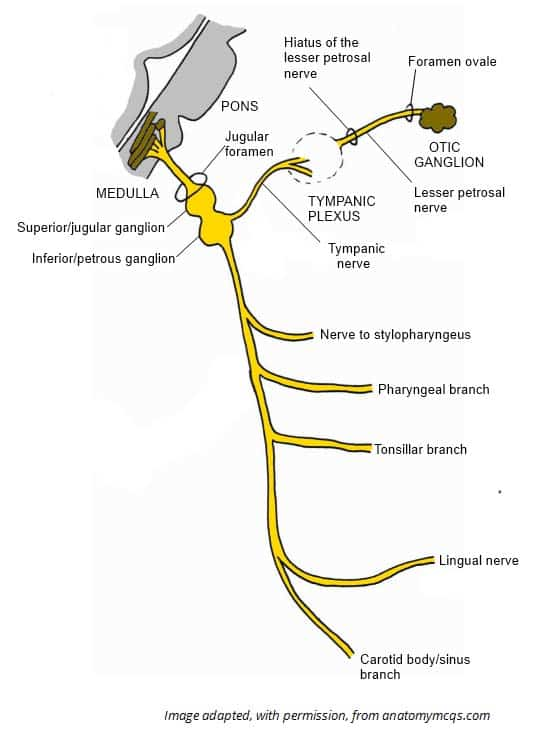
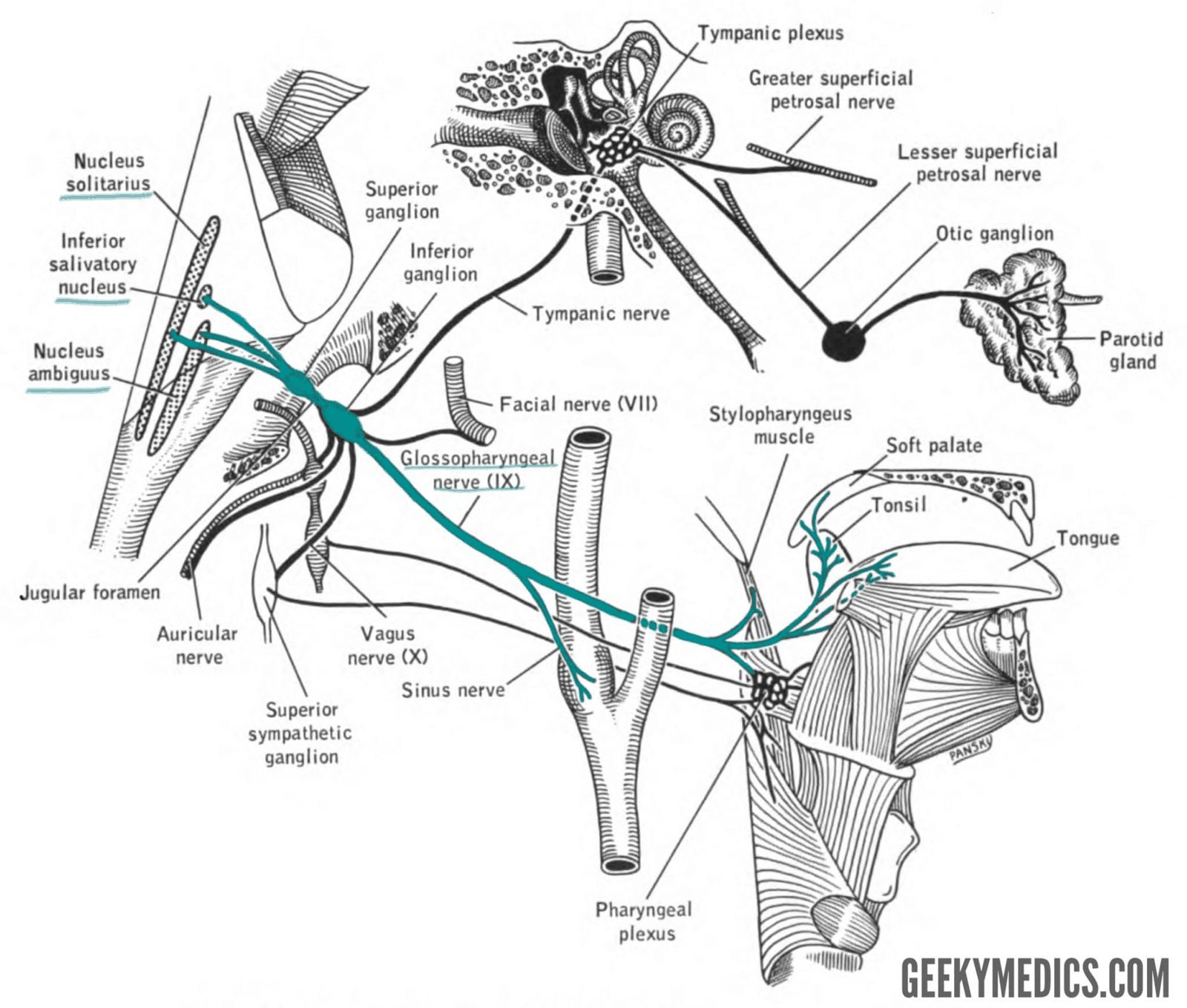
- Tympanic nerve (Jacobson’s nerve)
- Re-enters the temporal bone to form the tympanic plexus
- Gives rise to the lesser petrosal nerve → otic ganglion → parotid gland (via Auriculotemporal nerve)
- Carotid branch
- To carotid sinus (baroreceptors) and carotid body (chemoreceptors)
- Pharyngeal branches
- Join CN X and sympathetic fibres to form the pharyngeal plexus
- Muscular branch
- Innervates stylopharyngeus muscle
- Tonsillar branches
- Sensory to palatine tonsils and soft palate
- Lingual branches
- General sensory and taste from the posterior third of the tongue
- Functional Components
- Branchial motor (SVE): stylopharyngeus
- Visceral motor (GVE): parotid gland
- General sensory (GSA): posterior tongue, pharynx, middle ear, auditory tube
- Special sensory (SVA): taste from posterior third of tongue
- Visceral sensory (GVA): carotid sinus and carotid body