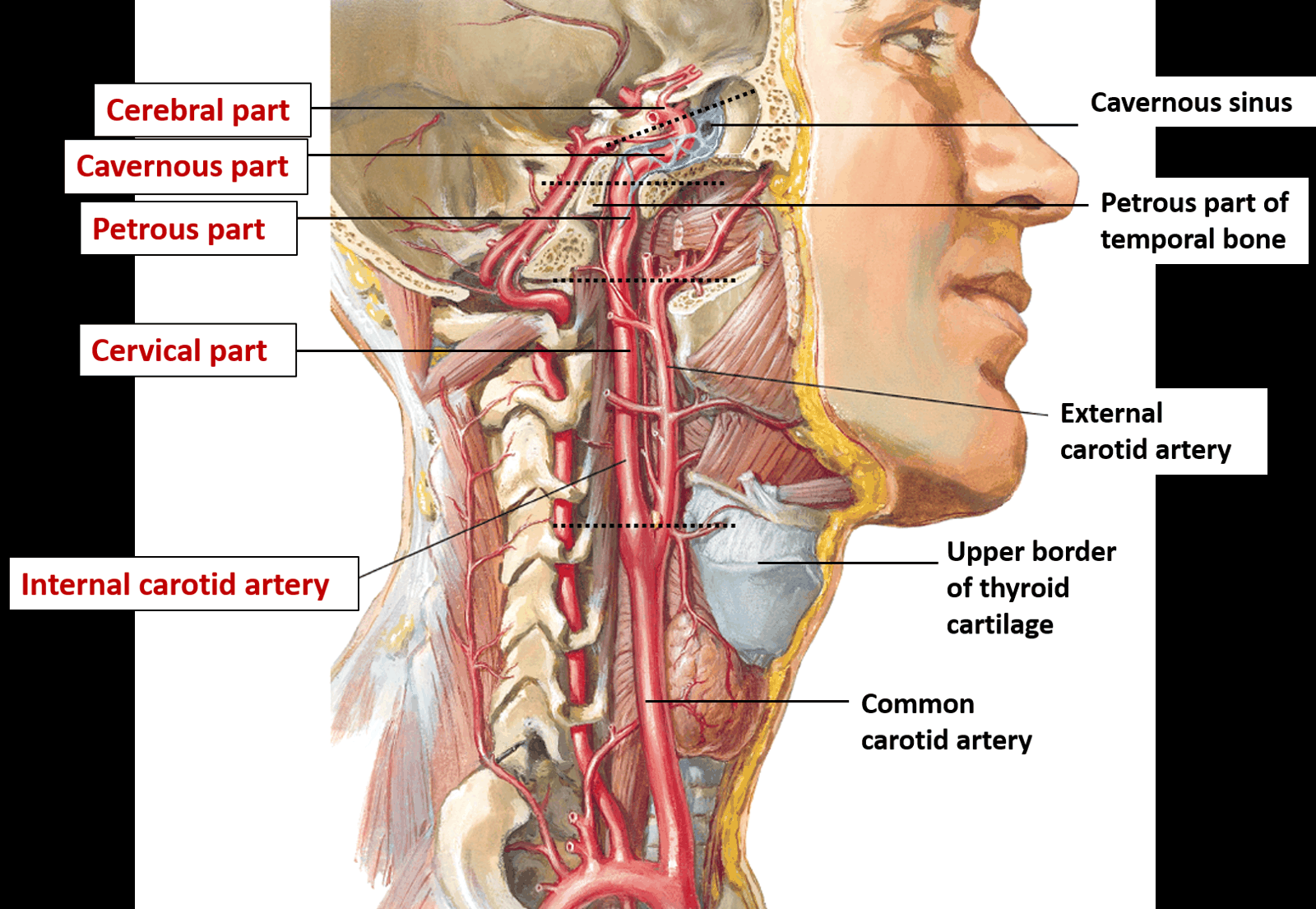
- Arises at Bifurcation of Common Carotid
- Continues upwards within Carotid Sheath
- Carotid Sinus
- At its commencement, – arterial wall is thin and contains Baroreceptors
- Supplied by the Glossopharyngeal Nerve and Vagus Nerves
- At its commencement, – arterial wall is thin and contains Baroreceptors
- Carotid Body
- Small structure lying behind the bifurcation – receives 2 or 3 small glomic arteries
- Chemoreceptors supplied by Glossopharyngeal and Vagus Nerves
- Small structure lying behind the bifurcation – receives 2 or 3 small glomic arteries
- Lateral to External Carotid at its origin but soon passes posteriorly to a medial and deeper level
- Has no branches and passes to the Carotid Canal in base of the skull
Internal Carotid Artery Relations
- Posterior:
- Sympathetic Trunk (Outside Carotid Sheath)
- Pharyngeal Veins
- Superior Laryngeal Branch of the Vagus Nerve
- Medial:
- Ascending Pharyngeal Artery
- Lateral:
- Internal Jugular Vein
- Deep:
- Vagus Nerve between Artery and IJV
- Anterior:
- Crossed by Lingual Vein
- Facial Vein
- Occipital Artery
- Hypoglossal Nerve
- At a higher level, crossed by Posterior Belly of Digastric and Stylohyoid and Posterior Auricular Artery and the structures that separate it from the External Carotid
Surgical Approach
- Incision along anterior border of SCM
- Muscle retracted backwards
- Facial and Lingual Veins divided
- Carotid Sheath incised
- Hypoglossal Nerve must be safeguarded and this may require division of the lower SCM branch of the Occipital Artery
- Emergence of branches from the External Carotid ensures its differentiation from the Internal Carotid