- Stems from endodermal cells
- Starts as hepatic diverticulum (Liver Bud) around the 4th week of development
- Develops from proliferation of cells from the blind ends of a Y-shaped diverticulum which grows from the Foregut into the Septum Transversum (structure that divides the heart from the abdominal cavity – later contributes to diaphragm formation)
- Caudal part of Septum Transversum becomes the Ventral Mesogastrium which the liver grows into
- Connection between hepatic diverticulum and future duodenum narrows to form bile duct
- Outpouching of the bile duct forms into gallbladder and cystic duct
- Diverticulum differentiates into primordium of liver or gallbladder
- Liver develops into hepatic cords that anastomose around spaces lined by endothelium (intermingle with Vitelline and Umbilical Veins) – forming primordium of hepatic sinusoids
- Portal vein is the central vessel in which the hepatic cords form around
- Original diverticulum from the Endoderm of the Foregut becomes the Bile Duct
- The Y-shaped bifurcation produces the Right and Left Hepatic Ducts
- Blind diverticulum from the Bile Duct becomes the Cystic Duct and Gallbladder
- Hepatocytes create bile at around 12th week
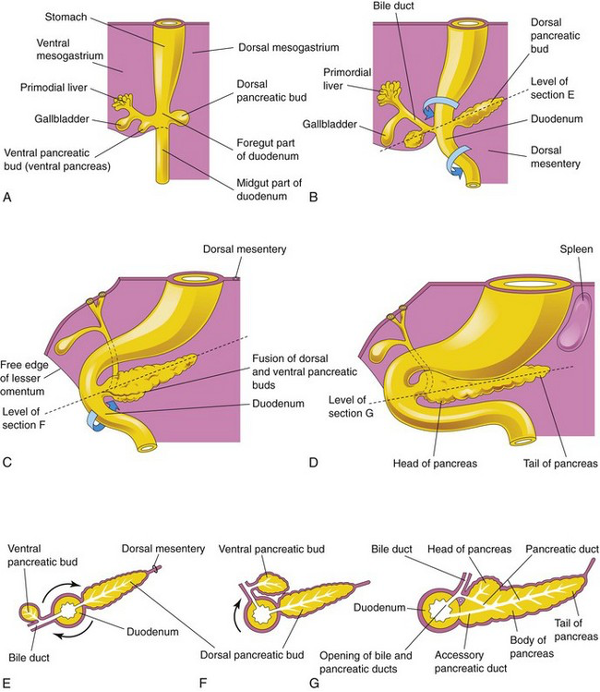
Mesoderm of Septum Transversum
- Gives off haematopoietic cells, Kuppfer cells and connective tissue
- Connects liver to ventral abdominal wall and foregut
- Stretches into thin membranes to become Falciform Ligament and Lesser Omentum
- Mesoderm on surface of liver becomes visceral peritoneum
- Except superiorly, where contact is kept between liver and mesoderm (future diaphragm)
- Forms bare area