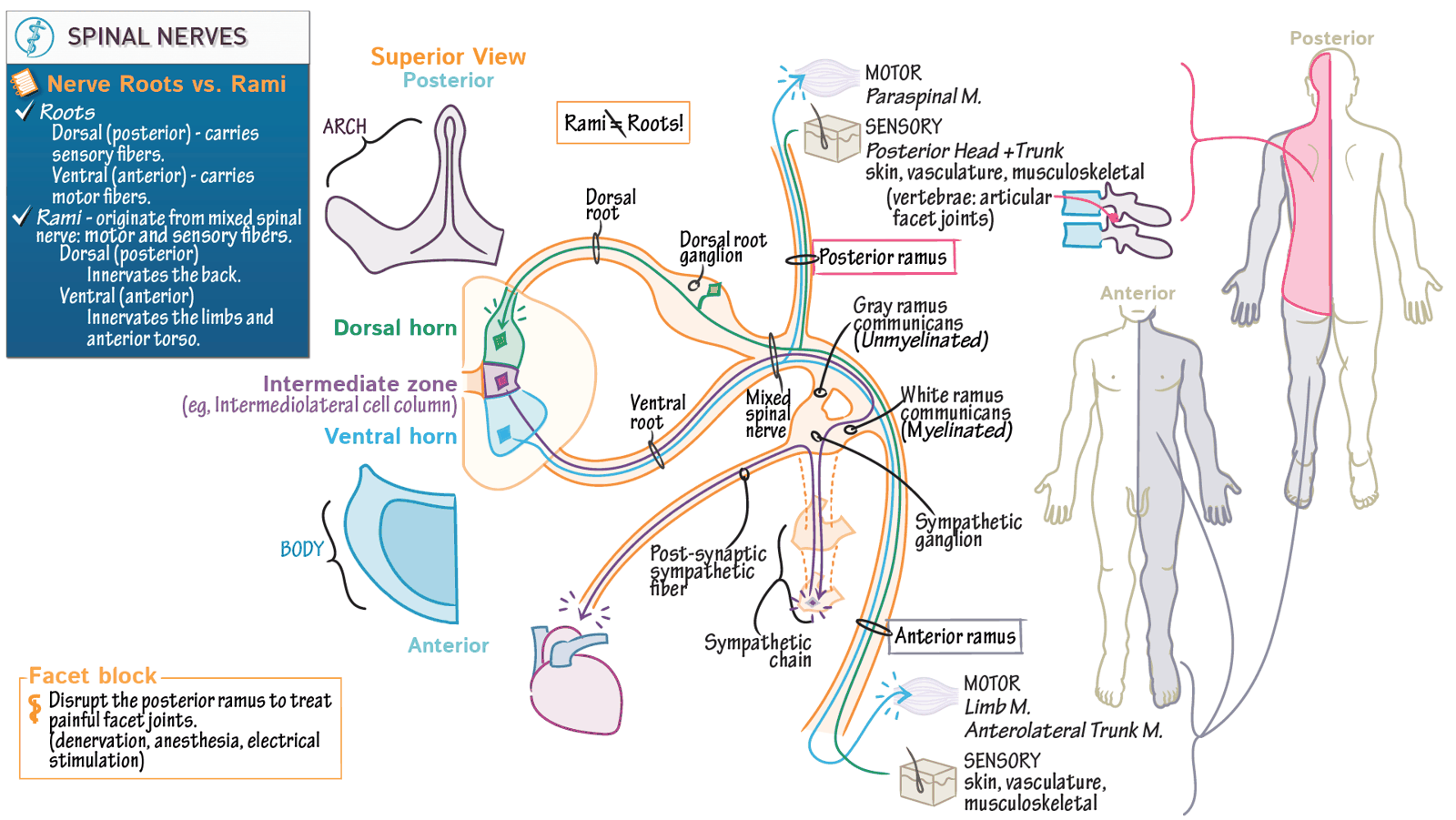
Each spinal nerve (31 pairs: 8 cervical, 12 thoracic, 5 lumbar, 5 sacral, 1 coccygeal) exits the vertebral column and divides into:
- Anterior Rami - Supplies the anterolateral body wall, limbs, and forms major nerve plexuses
- Posterior Rami
- Innervates true (intrinsic) back muscles, facet joints, zygapophyseal joints, and skin overlying
Brocken down by region
- Upper Cervical
- Anterior Rami:
- C1–C4: Form the Cervical Plexus
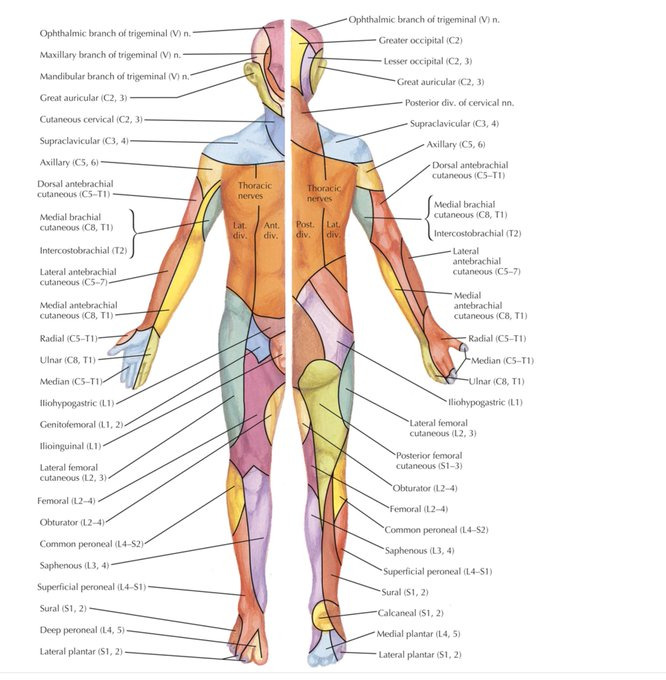
- Sensory: skin of scalp (lesser occipital), neck (transverse cervical), mandible (greater auricular), supraclavicular area (supraclavicular nerve)
- Motor: infrahyoid muscles, geniohyoid, thyrohoid, prevertebral muscles
- Phrenic nerve (C3–C5): diaphragm
- Posterior Rami:
- Supply intrinsic back muscles (e.g., splenius, semispinalis, suboccipital muscles)
- C1 (suboccipital nerve): motor only, to suboccipital muscles
- C2 (greater occipital): sensory to posterior scalp
- C3-C8
- Run posteriorly around their respective articular pillars and provide motor innervation to various muscles including semispinalis capitis, multifidus, interspinalis, longissimus colli, splenius colli and iliocostalis colli muscles.
- In addition, sensory innervation is provided to the facet joints above and below the nerve and the skin around the medial back region.
- Anterior Rami:
- Lower cervical
- Anterior Rami
- C5-C8
- Run posteriorly around their respective articular pillars and provide motor innervation to various muscles including semispinalis capitis, multifidus, interspinalis, longissimus colli, splenius colli and iliocostalis colli muscles.
- In addition, sensory innervation is provided to the facet joints above and below the nerve and the skin around the medial back region
- Thoracic
- Anterior Rami:
- T1–T11: Form Intercostal Nerves (segmental, not plexiform)
- Motor: intercostal muscles, abdominal wall muscles (lower T6–T11)
- Sensory: overlying skin, pleura, peritoneum
- T12: Subcostal nerve (below 12th rib)
- T1: also contributes to brachial plexus (inferior trunk) - Posterior Rami:
- Supply erector spinae, multifidus, rotatores
- Segmental cutaneous branches supply midline back skin
- Anterior Rami:
- Lumbar
- Anterior Rami:
- Form the Lumbar plexus (L1–L4)
- Motor: abdominal wall (iliohypogastric, ilioinguinal), anterior and medial thigh (femoral, obturator)
- Sensory: groin, upper thigh, medial leg (genitalfemoral nerve, lateral femoral cutaneous and femoral nerve) - L4–L5: contribute to lumbosacral trunk, joining sacral plexus - Posterior Rami:
- Supply deep back muscles (erector spinae, multifidus, quadratus lumborum)
- Medial branches: innervate zygapophyseal (facet) joints
- Lateral branches: supply posterior skin over lumbar region and iliac crest
- Anterior Rami:
- Sacral Region
- Anterior Rami:
- L4–S4: form the Sacral plexus
- Motor: posterior thigh, most of leg and foot (via sciatic nerve)
- Sensory: posterior thigh, leg, foot, perineum
- S2–S4: Pudendal nerve → perineum (motor and sensory)
- Pelvic splanchnic nerves (S2–S4): parasympathetic to pelvic organs, hindgut - Posterior Rami:
- Supply multifidus, erector spinae, gluteal skin
- Superior cluneal nerves (L1–L3 posterior rami) and medial cluneal nerves (S1–S3 posterior rami) → sensory to buttocks
- Anterior Rami:
Cranial nerves
The cranial nerves that carry somatic components are:
Cranial Nerves with Somatic Motor Fibres
- CN III – Oculomotor
- Somatic motor to most extraocular muscles (SR, IR, MR, IO, levator palpebrae superioris) - CN IV – Trochlear
- Somatic motor to superior oblique muscle - CN VI – Abducens
- Somatic motor to lateral rectus muscle - CN XII – Hypoglossal
- Somatic motor to intrinsic and extrinsic tongue muscles (except palatoglossus)
Cranial Nerves with Somatic Sensory Fibres
- CN V – Trigeminal
- Major somatic sensory nerve of face, scalp, cornea, oral and nasal mucosa, teeth, anterior 2/3 of tongue, and dura - CN VII – Facial
- Somatic sensory from skin of external ear and external auditory canal - CN IX – Glossopharyngeal
- Somatic sensory from posterior 1/3 of tongue, oropharynx, middle ear, and Eustachian tube - CN X – Vagus
- Somatic sensory from external ear, external auditory canal, part of tympanic membrane, and dura of posterior cranial fossa