Overview
- Network of nerve fibres that supplies the skin and musculature of the upper limb.
- Begins in the root of the neck, passes through the axilla, and runs through the entire upper extremity.
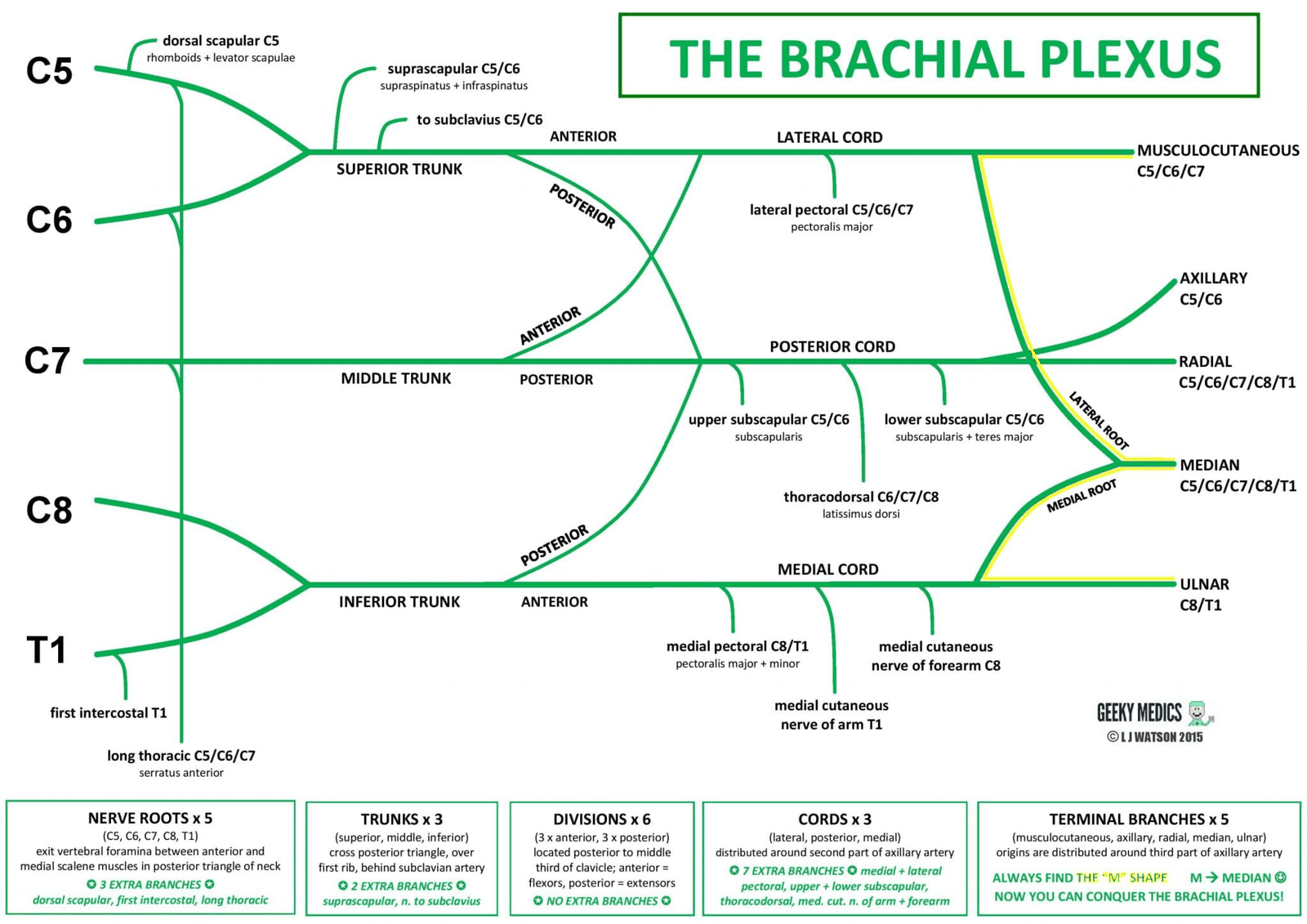
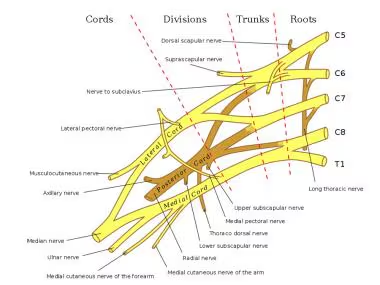
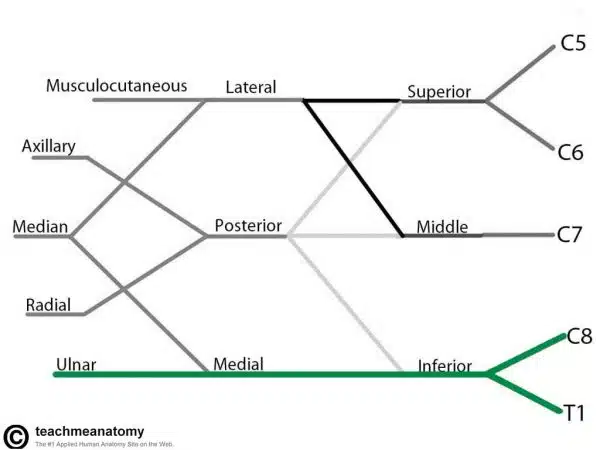
- Formed by the anterior rami (divisions) of cervical spinal nerves C5, C6, C7 and C8, and the first thoracic spinal nerve, T1
- Divided into five parts
- Roots
- Trunks
- Divisions
- Cords
- Branches
- Mnemonic: Read That Damn Cadaver Book
Roots
- Anterior rami of the spinal nerves
- C5, C6, C7, C8, and T1.
- Spinal nerve
- Leave the spinal cord via the intervertebral foramina of the vertebral column.
- Then divides into
- Anterior ramus
- Form brachial plexus
- Posterior ramus
- Innervate the skin and musculature of the intrinsic back muscles
- Anterior ramus
- Course
- Pass between the anterior and medial scalene muscles to enter the base of the neck
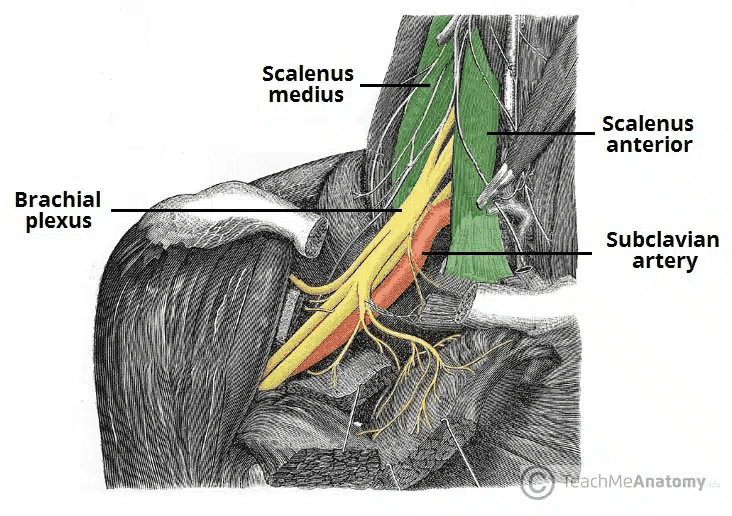
- Pass between the anterior and medial scalene muscles to enter the base of the neck
Trunks
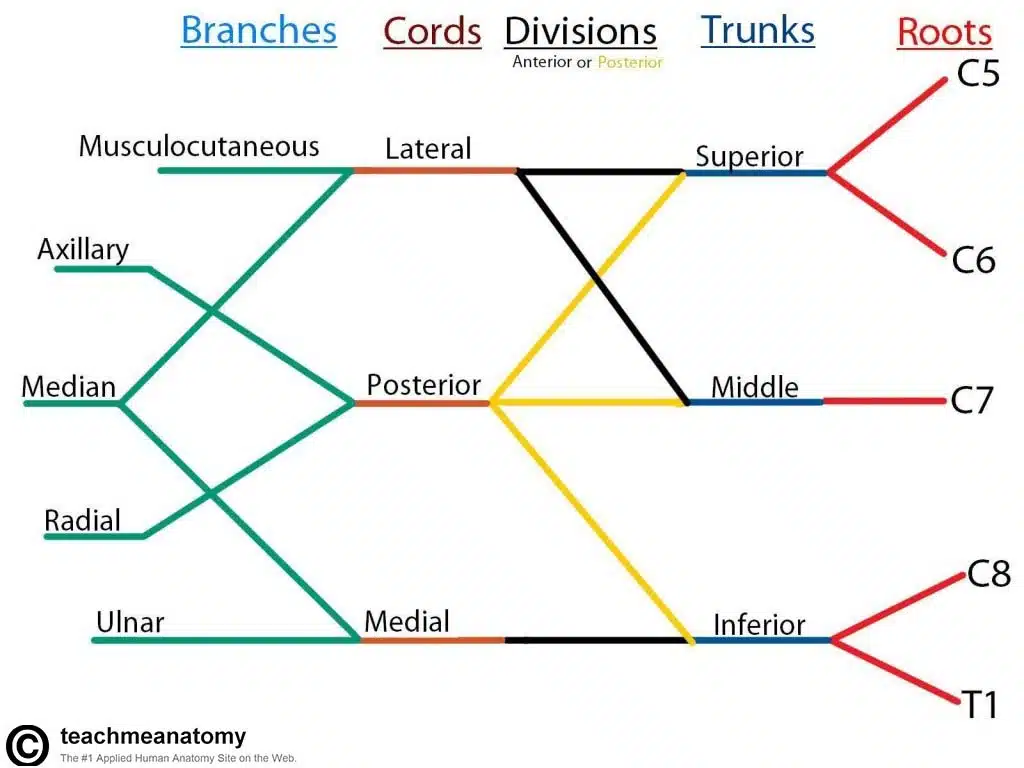
- At the base of the neck, the roots of the brachial plexus converge to form three trunks
- These structures are named by their relative anatomical location:
- Superior trunk – a combination of C5 and C6 roots.
- Middle trunk – continuation of C7.
- Inferior trunk – combination of C8 and T1 roots.
- The trunks traverse laterally, crossing the posterior triangle of the neck
Divisions
- Each trunk divides into two branches within the posterior triangle of the neck.
- One division moves anteriorly (toward the front of the body) and the other posteriorly (towards the back of the body).
- Thus, they are known as the anterior and posterior divisions.
- One division moves anteriorly (toward the front of the body) and the other posteriorly (towards the back of the body).
- The three anterior and three posterior nerve fibres leave the posterior triangle and pass into the axilla
Cords
- Division combine to form cords
- Lateral cord
- The anterior division of the superior trunk
- The anterior division of the middle trunk
- Posterior cord
- The posterior division of the superior trunk
- The posterior division of the middle trunk
- The posterior division of the inferior trunk
- Medial cord
- The anterior division of the inferior trunk.
- The cords give rise to the major branches of the brachial plexus.
- Lateral cord
Major Branches
- In the axilla and the proximal aspect of the upper limb
- Three cords give rise to five major branches.
- Nerves continue into the upper limb to provide innervation to the muscles and skin present
- Three cords give rise to five major branches.
Musculocutaneous Nerve
- Roots
- C5, C6, C7.
- Motor Functions
- Brachialis
- Biceps brachii
- Coracobrachialis muscles.
- Sensory Functions
- Gives off the lateral cutaneous branch of the forearm, which innervates the lateral half of the anterior forearm, and a small lateral portion of the posterior forearm.
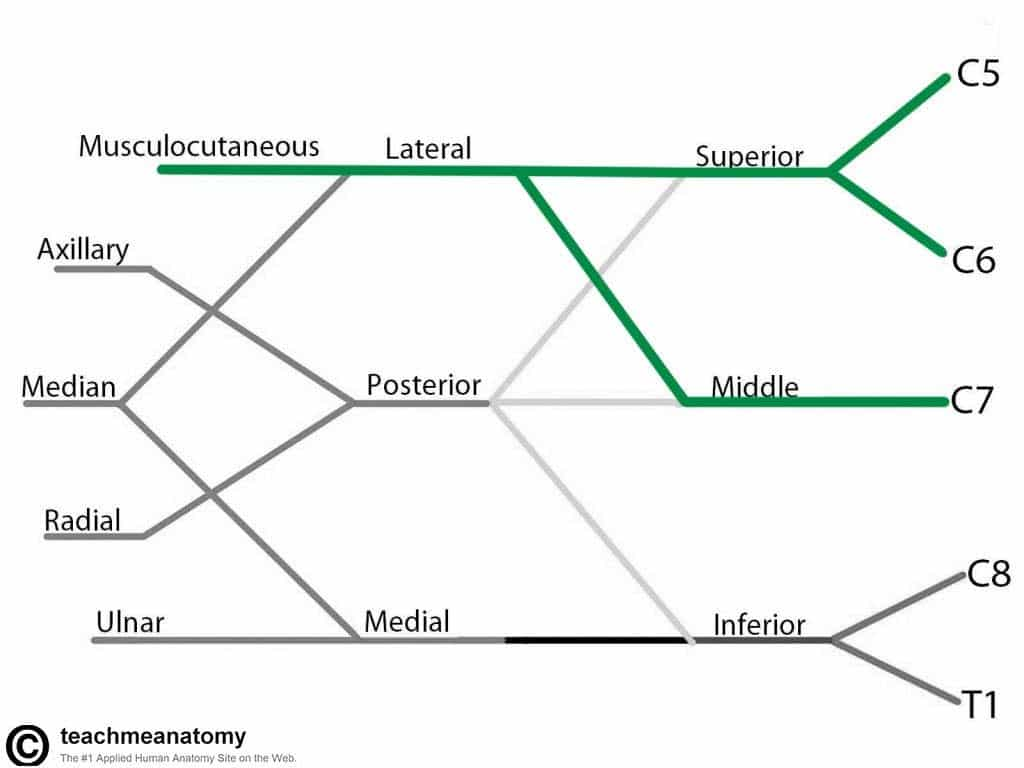
- Gives off the lateral cutaneous branch of the forearm, which innervates the lateral half of the anterior forearm, and a small lateral portion of the posterior forearm.
Axillary Nerve
- Roots
- C5 and C6.
- Motor Functions
- Teres minor
- Deltoid muscles.
- Sensory Functions
- Gives off the superior lateral cutaneous nerve of arm, which innervates the inferior region of the deltoid (“regimental badge area”)
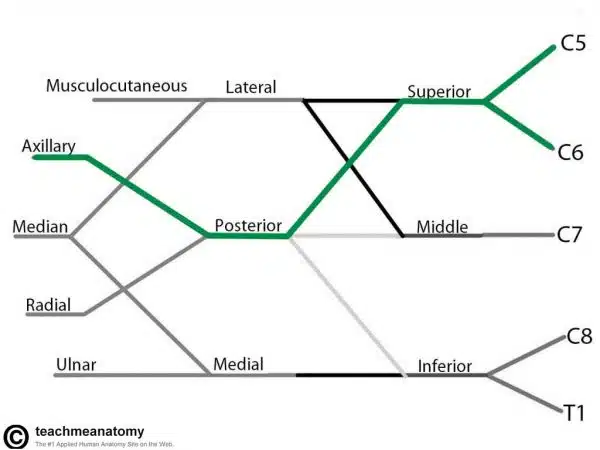
- Gives off the superior lateral cutaneous nerve of arm, which innervates the inferior region of the deltoid (“regimental badge area”)
Median Nerve
- Roots
- C6 – T1. (Also contains fibres from C5 in some individuals).
- Motor Functions
- Flexor muscles in the forearm
- Thenar muscles
- Two lateral lumbricals associated with the index and middle fingers.
- Sensory Functions
- Gives off the palmar cutaneous branch, which innervates the lateral part of the palm, and the digital cutaneous branch, which innervates the lateral three and a half fingers on the anterior (palmar) surface of the hand.
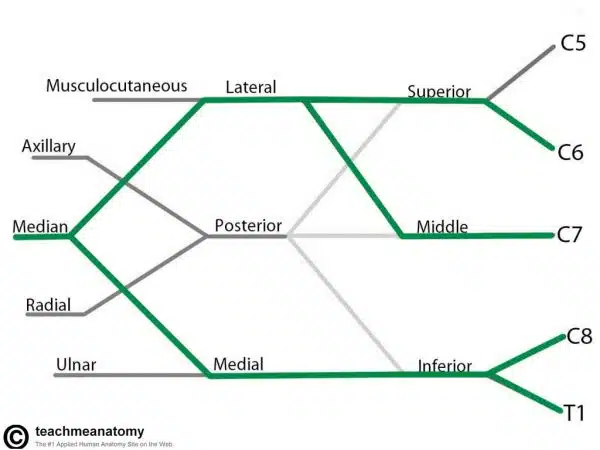
- Gives off the palmar cutaneous branch, which innervates the lateral part of the palm, and the digital cutaneous branch, which innervates the lateral three and a half fingers on the anterior (palmar) surface of the hand.
Radial Nerve
- Roots:
- C5 – T1.
- Motor Functions
- Triceps brachii
- Muscles in the posterior compartment of the forearm (which are primarily, but not exclusively, extensors of the wrist and fingers)
- Sensory Functions
- Innervates the posterior aspect of the arm and forearm, and the posterolateral aspect of the hand.
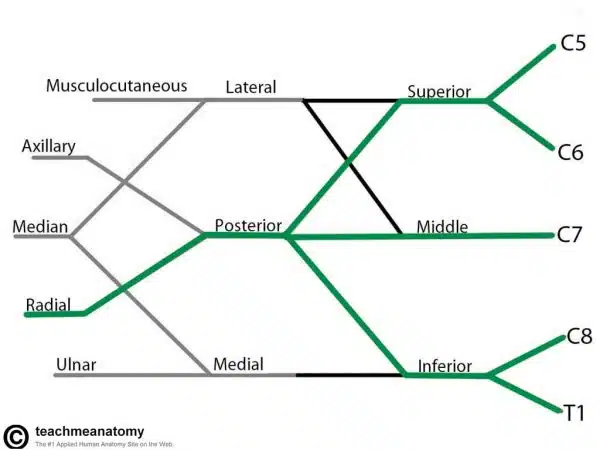
- Innervates the posterior aspect of the arm and forearm, and the posterolateral aspect of the hand.
Ulnar Nerve
- Roots:
- C8 and T1.
- Motor Functions
- Muscles of the hand (apart from the thenar muscles and two lateral lumbricals)
- Flexor carpi ulnaris
- Medial half of flexor digitorum profundus.
- Sensory Functions
- Innervates the anterior and posterior surfaces of the medial one and half fingers, and associated palm area.
- Innervates the anterior and posterior surfaces of the medial one and half fingers, and associated palm area.
Upper Brachial Plexus Injury (Erb’s Palsy)
Erb’s palsy refers to an injury to the upper roots of the brachial plexus (typically C5-6). It most commonly occurs as a result of a stretching injury during a difficult vaginal delivery.
- Nerves affected – the peripheral nerves derived from C5-6 roots are most affected. This includes the musculocutaneous, axillary, suprascapular, and nerve to subclavius.
- Muscles affected – supraspinatus, infraspinatus, subclavius, biceps brachii, brachialis, coracobrachialis, deltoid and teres minor.
- Motor functions affected – abduction at shoulder, lateral rotation of arm, supination of forearm, and flexion at shoulder.
- Sensory functions affected – sensation over the lateral aspect of upper limb (C5-6 dermatomes).
The affected limb hangs limply, medially rotated by the unopposed action of pectoralis major. The forearm is pronated due to the loss of biceps brachii. The wrist is weakly flexed due to the normal tone of the wrist flexors relative to the weakened wrist extensors. This is position is known as ‘waiter’s tip’ and is characteristic of Erb’s palsy.
Lower Brachial Plexus Injury (Klumpke’s Palsy)
Klumpke’s palsy is an injury of the lower roots of the brachial plexus (C8-T1). It is also most commonly associated with a difficult vaginal delivery but has a much lower incidence than Erb’s palsy.
- Nerves affected – the peripheral nerves derived from T1 root are most affected; the ulnar and median nerves
- Muscles affected – the intrinsic hand muscles
- Sensory functions affected – sensation along medial side of upper limb (C8-T1 dermatomes).
The primary feature of Klumpke’s palsy is a clawed hand. This occurs due to paralysis of the lumbrical muscles, which normally act to flex the metacarpophalangeal joints (MCPJs) and extend the interphalangeal joints (IPJs). When paralysed, the fingers subsequently become extended at the MCPJs and flexed at the IPJs, producing a clawed appearance.
Branches
- 11 Branches
- 2 Root
- 2 Trunk
- 7 cord
- 1 Lateral cord
- 3 Medial cord
- 3 posterior cord
| Roots | Trunks | Lateral cord | Medial cord | Posterior cord |
|---|---|---|---|---|
| Dorsal scapular nerve Long thoracic nerve | Suprascapular nerve Nerve to subclavius | Lateral pectoral nerve | Medial pectoral nerve Medial cutaneous nerve of arm Medial cutaneous nerve of forearm | Superior subscapular nerve Thoracodorsal nerve Inferior subscapular nerve |
Root branches
- Dorsal scapular nerve
- The dorsal scapular nerve most commonly arises directly from the root of C5 spinal nerve. Occasionally, it can arise from the superior trunk of the brachial plexus. The dorsal scapular nerve provides motor innervation to the levator scapulae, rhomboid major and rhomboid minor muscles.
- Long thoracic nerve
- The long thoracic nerve arises from the merger of the roots of C5, C6 and C7. This nerve provides motor innervation to the serratus anterior muscle.
Trunk branches
- Suprascapular nerve
- The suprascapular nerve emerges from the superior trunk and carries fibers of the C5 and C6. The suprascapular nerve provides sensory innervation to the glenohumeral and acromioclavicular joints, and motor innervation to the supraspinatus and infraspinatus muscles.
- Nerve to subclavius
- This nerve emerges from the superior trunk of the brachial plexus and contains fibers of C5 and C6 spinal nerves. The subclavian nerve provides motor innervation to the subclavius muscle.
Cord branches
Lateral cord
- Lateral pectoral nerve
- The lateral pectoral nerves arise from the lateral cord of brachial plexus and carry fibers of C5, C6 and C7 spinal nerves. Through the anastomoses with the medial pectoral nerves, the lateral nerves participate in the innervation of the pectoralis minor muscle.
Posterior Cord
- Superior subscapular nerve and Inferior subscapular nerve
- There are usually two of these nerves: superior subscapular and inferior subscapular nerve. Both of these nerves arise from the posterior cord carrying the fibers of C5 spinal nerve. The superior subscapular nerve innervates the superior portion of the subscapularis muscle, whereas the inferior subscapular nerve innervates the rest of the subscapularis muscle, as well as the teres major muscle
- Thoracodorsal nerve
- The thoracodorsal nerve arises from the posterior cord of the brachial plexus and carries the fibers of C7 and C8. This nerve provides motor innervation to the latissimus dorsi muscle.
Medial Cord
- Medial pectoral nerve
- The medial pectoral nerves arise from the medial cord of the brachial plexus, containing fibers of C8 and T1 spinal nerves. This nerve provides motor innervation to the pectoralis minor muscle and the lower sternocostal part of the pectoralis major muscle.
- Medial cutaneous nerve of arm
- The medial brachial cutaneous nerve, also called the medial cutaneous nerve of the arm, arises from the medial cord carrying fibers of C8 and T1 spinal nerves. This nerve provides sensory innervation to the skin of the inferior portion of the medial side of the arm.
- Medial cutaneous nerve of forearm
- The medial antebrachial cutaneous nerve, also called the medial cutaneous nerve of the forearm, arises from the medial cord carrying fibers of T1 spinal nerve. This nerve provides sensory innervation to the skin of the arm overlying the biceps brachii, and the skin of the medial side of the forearm.