Section: Colorectal Sub-section: Colorectal cancer Curriculum: Curriculum, page 21
Definition
- Surgical: convergence of teniae coli, sacral promontory
- Radiological: take-off of sigmoid mesentery.
- Distance: 12 (US) or 15 cm (UK) from the anal verge.
Local recurrance
Risk factors for local recurrence:
- Size of primary
- Involvement of CRM
- Main factor; which can also be modified by optimal treatment
- Postive CRM defined as tumour within 1mm margin of specimen
- Distal location of tumour
- Extramural vascular invasion (n.b. also higher predictor of distant mets than nodal status; usually locoregional nodes will be removed by TME).
- Tumour differentiation
- Nodal status (N stage)
- Extent of extramural spread (T stage)
- Peritoneal involvement by tumour (T stage)
Neoadjuvent treatment
Radiotherpay
- Uses ionising radiation to eliminate cancer cells.
- Reduce the risk of local recurrence compared with surgery alone.
- Although cancer-specific survival is improved there was is definite evidence of any impact on overall survival.
History
- Short course (25 Gy in five daily fractions of 5 Gy)
- Adjuvant short course
- Swedish rectal cancer trial (RT decreases LR)
- The first to report an improvement in overall survival
- decreased local recurrence from 27 to 11%
- Swedish rectal cancer trial (RT decreases LR)
- Adjuvant short course
- Neoadjuvent short course (SCT + TME vs TME + selected therapy)
- Dutch TME trial and MRC CR07 (RT with TME improves LR)
- Local recurrence from 11% to 5%
- No difference in mortality, leak or overall survival
- Dutch TME trial and MRC CR07 (RT with TME improves LR)
- Addition of 5-FU and Leucovorin to Long course radiotherapy (50.4 Gy over 5 weeks)
- EORTC 22921 trial and FFCD 9203
- Both showed the risk of local recurrence was reduced from 15% to 8–10% in favour of CRT
- The German Rectal cancer group (Give RT pre-op)
- compared Preoperative versus Postoperative Chemoradiotherapy for Rectal Cancer
- Lower rate of local recurrence (6% vs. 12%), reduced acute and late toxicity in favour of preoperative CRT
- EORTC 22921 trial and FFCD 9203
- CRT vs SCRT
- Polish Trial
- The Trans Tasman Radiation Oncology Group
- No difference found
- Short course with delay
- Stockholm III
- Increase cPR and less surgical complications
- Stockholm III
- PROSPECT trial, page 1
- In patients with locally advanced rectal cancer who were eligible for sphincter- sparing surgery, preoperative FOLFOX was noninferior to preoperative chemoradiotherapy with respect to disease-free survival.
Inidications
UK NICE recommend consideration of neoadjuvant radiotherapy for high-risk stage II and all stage III rectal cancer.
Purpose
- Reduce risk of local recurrence
- Shrink locally advanced rectal cancer to facilitate successful resection
- No impact on overall survival
- Although studies showing improved DFS and distant recurrence rates with TNT.
- Benefits of neoadjuvant as opposed to adjuvant:
- Undisturbed pelvic anatomy – less chance of SB irradiation
- Better oxygenated tissue (better radiosensitivity)
- Better compliance
- Allows for tumour response assessment (prognostication)
- Indications:
- (DisTANCE)
- Dis -tance from sphincter (low tumours have smaller mesorectum, narrow distally)
- T stage
- Anal sphincter involvement
- Nodes
- CRM
- EMVI
- Upper rectal
- Not indicated unless T4b
- Treat like colonic cancer
- Mid rectal
- Local advanced
- T3/T4 or any N stage i.e stage II or stage III
- Local advanced
- Low rectal cancer
- T1 - surgery
- T2 - neoadjuvent if close to sphincters
- The rest neoadjuvent treatment
- Can consider in any T stage if discussion regarding sphincter preservation
- (DisTANCE)
- Timing of restaging and surgery
- Usually at 6-10 weeks with surgery at 12-14 weeks.
- Complications/toxicity of radiotherapy:
- Early: perineal wound breakdown, diarrhoea, proctitis, UTI, SBO, leucopenia and VTE
- Late: bowel, urinary and sexual dysfunction, sterility, new malignancy – lymphoma, sarcoma
- Total Neoadjuvant Treatment
Adjuvant chemotherapy:
- Trials have not shown significant benefit.
- Often poor effectiveness due to treatment delay and poor compliance. Morbidity from radiotherapy and surgery reduce tolerance to AC. Ileostomy also impairs delivery with diarrhoea.
- Despite poor evidence some groups recommend adjuvant chemotherapy to all patients who underwent pre-operative radiotherapy (excluding TNT patients)
Surgery
Decision making on type of operation:
Patient factors
- Local – previous radiotherapy, obstetric injury and low anastomosis all risks for poor function and should consider permanent stoma. Ask about flatus incontinence history.
- Systemic – comorbidities Tumour/disease factors
- Biology
- Site
- Extent/fixity, e.g. early T1 may be suitable for local excision.
- Imaging characteristics: CRM threat, EMVI, local invasion of sphincter complex.
Extent of resection
TME – for middle and lower rectal cancers (Heald 1982)
- Extrafascial excision for low to mid rectal cancers
- Reduced LR from 20-30% → 5-10% (McCall 1995)
- Mechanism:
- Tumour deposits have been found in the mesorectum up to 4 cm caudally to tumour in poorly differentiated cancers
- Low rectal tumours – reasonable to have 1 cm margin, given that mesorectum eventually disappears as it approaches the pelvic floor sphincter muscle complex. 1 cm margin not associated with increased recurrence.
- Upper rectal tumours – divide the mesorectum tangentially 5 cm distal to primary tumour, maintaining benefits of bowel function and potential reduction in anastomotic leak, with no negative oncological consequences.
- Other benefits: improved haemostasis & nerve preservation
- Margins
- High ant resection: aim for 5cm clearance (& 10 cm of proximal bowel)
- Low ant resection (if CA <5cm from anal verge): aim for 2cm clearance (fresh) / 1cm - when fixed Lateral pelvic lymph nodal involvement (more Japanese practice; in Western countries, assumption that neoadjuvant therapy will sterilise these nodes)
- Subset of patients may benefit from lateral pelvic lymphadenectomy (LPLD) or modified approach with pelvic autonomic nerve preserving dissection.
- Factors predicting increased risk are:
- Female
- Low rectal cancer
- Involved mesorectal nodes
- Advanced T stage
- Poor differentiation
- LVI High vs low IMA ligation
- No difference in oncological outcomes
- A high ligation may be needed to provide length of conduit as left colic artery is too short to allow descending colon to reach anal canal.
- If marginal artery minimal or absent, sigmoid may be prone to ischaemia.
Quality of life
- Aim to preserve continence, and avoid sexual and urinary disturbance
- Considerations – APR may be needed for:
- Oncological: Cancer involving or close to sphincter
- Functional: restorative surgery outcome may be poor that colostomy better QoL.
- Frailty: potential complications too risky in elderly or frail
- Distal margin
- For low tumours, a resection margin of 2 cm is recommended, except for poorly differentiated tumours, still 5 cm.
- In low rectal cancers so long as the margin itself is uninvolved then the risk of recurrence is not increased
- Tumour height
- By palpation (PR)
- Landmarks
- Anal verge is perianal skin at intersphincteric groove. Where hair bearing skin commences.
- Dentate line is junction between columnar and squamous epithelium. Mucosa above usually more slippery than skin of pecten.
- Distal margin
- Can a clamp or stapler be placed between tumour and dentate line? Colorectal Surgery A Companion to Specialist Surgical Practice 1, page 84
- Tumour bulk and location
- Surgical accessibility of pelvis
- Functional quality of anus
- ?faecal incontinence or flatus continence
Low anterior resection syndrome
- Frequency or urgency of stools, largely due to the fact you have less space to store stool after removing part of the rectum
- Clustering of stools (many bowel movements during a few hours)
- Fecal incontinence (lack of control over bowel movements)
- Constipation for more than a few days, followed by multiple bowel movements a few days later
- Increased gas
- Abdominal pain
- Small risk of urinary and/or sexual function due to nerve damage

Operations
General options
Temporary defunctioning stoma
- Leak rate after rectal cancer surgery is 10 – 28%
- Diverting stoma recommended for all low rectal – low leak rate & fewer clinical leaks.
Laparoscopic vs open
- Both open and laparoscopic approaches can be considered to be appropriate for rectal cancer resection, though laparoscopic surgery may be better in a subset of patients when performed by surgeons with advanced laparoscopic skills.
- Patients that could be considered to be particularly challenging for a laparoscopic approach would be those with low, bulky tumours, particularly in obese, male patients.
- Oncological outcome – AlaCaRT and ACOSOG Z6051 failed to show ‘non-inferiority’ for laparoscopic rectal cancer compared to open.
- Effect of Laparoscopic-Assisted Resection vs Open Resection on Pathological Outcomes in Rectal Cancer The ALaCaRT Randomized Clinical Trial, page 1
- Benefits of laparoscopic: reduced adhesions, incisional hernia and faster return to work.
- Despite method, most important is achieving good quality TME.
Robotic vs laparoscopic
- ROLARR study. No difference in rate of conversion or other outcomes.
- Effect of Robotic-Assisted vs Conventional Laparoscopic Surgery on Risk of Conversion to Open Laparotomy Among Patients Undergoing Resection for Rectal Cancer The ROLARR Randomized Clinical Trial
- Advantages: articulating instruments, high definition allow more precise dissection in narrow male pelvis.
- Disadvantages: substantial cost, lack of training opportunities, increased operating times especially in early stages.
Abdominoperineal resection
- Extra-levator APR recommended for advanced low rectal cancer – need to excise widely at the level of pelvic floor (level of cancer).
- Positioning is important – may need to be prone.
Laparoscopic anterior resection
Alternative approaches:
Papillon/contact radiotherapy
- Considered for exophytic mobile cancers < 3 cm.
- Curative non-op approach for some T1 cancers.
- For frail/elderly patient unfit for major resection.
- Disadvantage – lack of definitive histology and does not treat mesorectum; nodal mets are contraindication
- Can be combined with conventional external beam or CRT.
- Side effect of bleeding – due to angiogenesis and neovascularisation
Transanal
- Indications
- Superficial T1 cancer, limited to the submucosa
- No radiographic evidence of metastatic disease to the regional nodes
- Tumor <3 cm in diameter
- Well-differentiated histology, no lymphovascular or perineural invasion
- Mobile, non-fixed
- Margin clear (>3 mm)
- Involving <30 percent of the bowel lumen circumference
- Patient is able to comply with frequent postoperative surveillance
- If has a transanal excision and then adverse histology → proceed to trans-abdominal excision
- If adverse features on histo, completion surgery has similar cancer-specific survival to upfront major rectal resection.
- Options
- TEMS (Transanal endoscopic microsurgery)
- TAMIS (Transanal Minimally Invasive Surgery)
- ESD
- Ta-TME
- Approached through rectotomy from below with an airseal system, followed by purse-string closure of the rectum.
Non-operative approach – ‘watch and wait’
- Low tumour more likely to respond – more accurate target for delivery of radiation; possible difference in behaviour of low rectal compared to mid or upper rectum.
- CCR may not equate to pCR.
Locally advanced
Pelvic multivisceral exenteration
Patterns of recurrence • Central – at previous rectal anastomosis or residual mesorectum. Can extend anteriorly to urogenital structures or posteriorly up to sacral fascia but not bone. • Sacral – when bony invasion present • Lateral – lateral pelvic sidewall, iliac vessels, autonomic nerves, ureter and can invade greater sciatic foramen to sciatic nerve. Most difficult to achieve R0 - poorest prognosis.
Type of clearance
-
Total pelvic clearance (TPC) – removal of rectum, sigmoid, bladder, draining lymph nodes, pelvic peritoneum and lower ureters.
- In males – prostate and seminal vesicles
- In females – uterus, ovaries, fallopian tubes and part of vagina.
- End colostomy + ileal conduit
-
Central
- Rectum
- Female - TAH/BSO/Vagina
- Male - Prostate/seminal vescivles
-
Anterior pelvic clearance (Urogenital)
- Removal of distal ureters, bladder
- In males – prostate and seminal vesicles
- In females – uterus, ovaries, fallopian tubes and vagina.
- Ileal conduit required.
-
Posterior pelvic clearance
- Sacrum
-
Lateral dissection can be done in 3 planes: • A – mesorectal plane (TME) • B – ureteric plane • C – bony plane – lateral to iliac vessels along obturator internus and piriformis
-
Perineal reconstruction
- Omentoplasty to pelvis can be attempted
- Mesh can be used
- Pedicled flaps most commonly used:
- Vertical Rectus abdominis myocutaneous (VRAM) flaps (unilateral with reconstruction of abdominal harvest site often with mesh).
- Gracilis myocutaneous flaps (bilateral due to limited coverage)
- Gluteal myocutaneous rotational or advancement flaps (usually bilateral)
- Inferior gluteal artery perforator flap (usually bilateral)
- Free flaps considered if pedicled not an option.
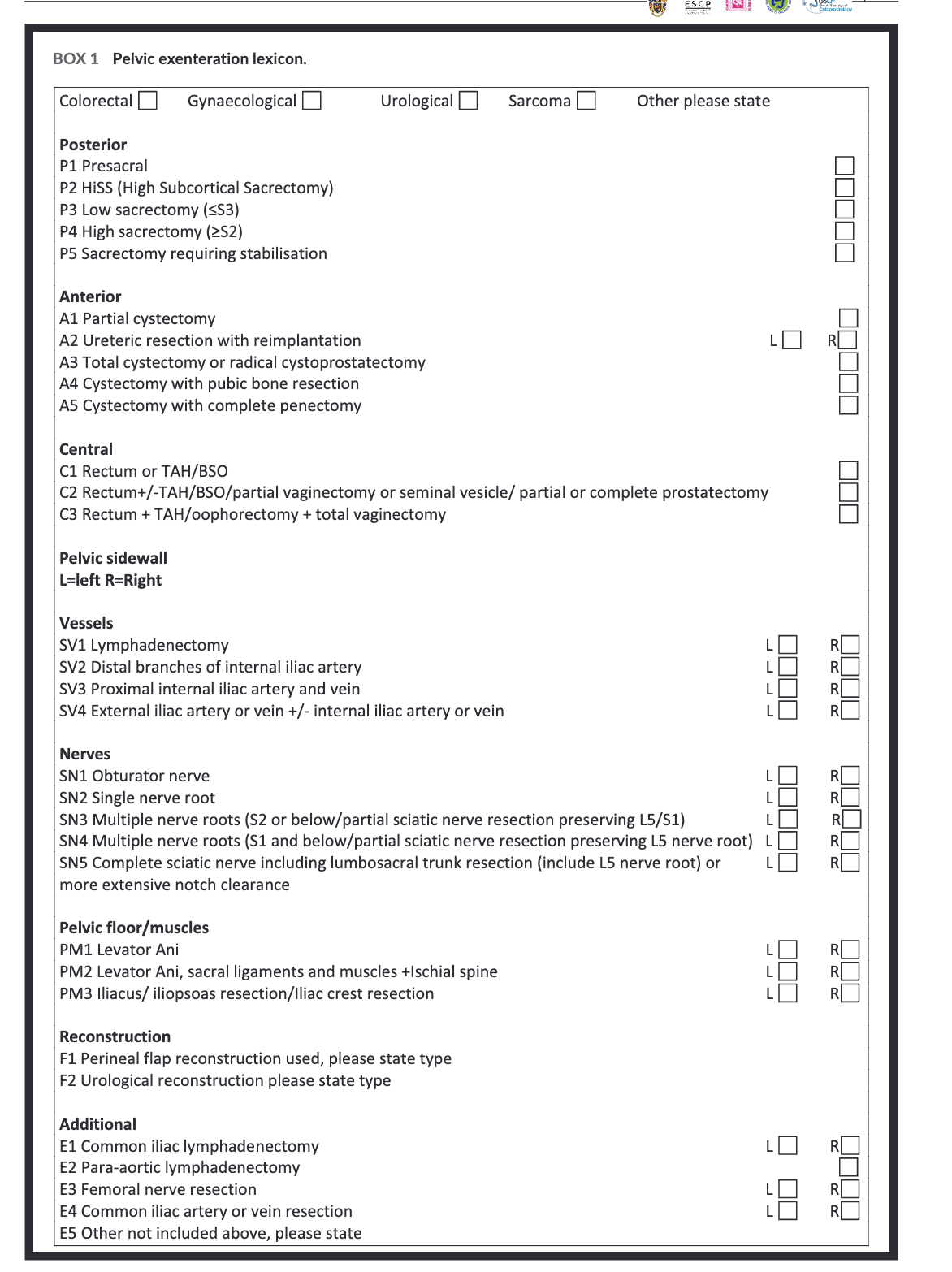 Pelvic exenteration lexicon, page 1