Advantages:
- Possibly better delivery/compliance
- Micrometastases receiving full dose months earlier than postop chemo.
- Can allow earlier reversal of defunctioning ileostomy
- Allows further downstage of tumour
- Higher resectability and higher rates of pCR or cCR
- May decrease systemic relapse
- Possible improved survival Disadvantages:
- Delay time to surgery with possible disease progression
- Decreased effectiveness of subsequent radiotherapy due to emergence of radio-resistant clones.
- Possible over treatment with increased side effects
Summary/exam answer:
- TNT may be an option for patients with locally advanced rectal cancer after MDM discussion
- Higher likelihood of completing chemo
- Significantly increased cCR and pCR
- If W+W is the aim, then TNT is reasonable choice
- 25% will recur within 2 years but typically salvageable.
- May be improvement in DFS (no impact on OS yet)
- If aim for cCR – consolidation chemo preferred.
- Need further studies to reassess.
OPRA Trial
OPRA original
Organ Preservation in Patients With Rectal Adenocarcinoma Treated With Total Neoadjuvant Therapy OPRA orginal , page 1
Publication information
Journal of Clinical Oncology, 2022
Hypothesis:
Patients with stage II and III rectal adenocarcinoma treated with TNT followed by either TME or a selective watch-and-wait (WW) approach on the basis of tumor response will have better disease-free survival (DFS) compared with historical DFS in patients treated with a standard therapy of CRT, TME, and intended postoper- ative adjuvant chemotherapy.
Methods
Design
Randomized, nonblinded, phase II trial conducted at 18 US institutions
Inclusion
Stage 2 and 3
Procedure
Randomly assigned to: INCT-CRT or CRT-CNC. Chemotherapy was either FOLFOX or CAPOX Patients with incomplete response went for TME. Near complete or complete CR went into W&W.
Outcome
Primary DFS
Results
Population
360 patients 158 vs 166 2% died during TNT (5/6 due to toxicity)
Primary endpoint
The 3-year DFS rates, 76% for the INCT-CRT group and 76% in the CRT-CNCT group, did not differ when compared with the historical 3-year DFS rate of 75% Similar local recurrence free survival at 94% 26% underwent TME, 74% W&W 53% (CRT-CNC) vs 41% (INCT-CRT) organ preservation at 3 years
Takehome
Higher organ preservation rate in CRT-CNCR group.
OPRA 5 year follow up
Long-Term Results of Organ Preservation in Patients With Rectal Adenocarcinoma Treated With Total Neoadjuvant Therapy: The Randomized Phase II OPRA Trial OPRA 5y, page 1
Publication information
JAMA 2024
Methods
Assessment
8weeks +/- 4weeks - flexi + MRI + DRE → complete, near and incomplete
Outcome
DFS, DMFS, LRFS, OS, OP (organ preservation)
Results
Population
324 41% CCR, 37.5% NCCR, 21% ICR
CCR Local regrowth 22% Surgery in: 25/27 salvage TME Mets: 5.2% at 5 years
NCCR Surgery 50.9% (17.5% upfront, 82.5% offered W&W) 48, 51.1% of those offered had a local regrowth 38/48 underwent surgery
ICR 89% proceeded to TME
Primary endpoint
Organ preservation at 3 years - 47% overall, 77% for CCR, 40% NCCR Risk of local regrowth at two years was 20% in the CCR group and 49% in the NCCR
DFS 74% overall, 88% CCR, 69% NCCR, 56% ICR
DFS was similar for patients who underwent TME after restaging (64%) and patients in WW who underwent TME after regrowth (64%
Takehome
Consolidation is likely better for OP
- Total mesorectal excision-free survival was higher with the CRT-first approach (54% vs. 39% with induction chemotherapy at the 5-year follow-up)
RAPIDO
RAPIDO original
Short-course radiotherapy followed by chemotherapy before total mesorectal excision (TME) versus preoperative chemoradiotherapy, TME, and optional adjuvant chemotherapy in locally advanced rectal cancer (RAPIDO): a randomised, open-label, phase 3 trial RAPDIO, page 1
Publication information
Lancet, 2020 Dutch Colorectal Cancer Group (DCCG) and the Nordic Gastrointestinal Tumour Adjuvant Therapy Group (NGTATG)
Hypothesis:
Aim to reduce disease related treatment failure at 3 years
Methods
Design
54 centres in the Netherlands, Sweden, Spain, Slovenia, Denmark, Norway, and the USA
Inclusion
One of: cT4a or cT4b, EMVI, cN2, involved mesorectal fascia (tumour or lymph node ≤1 mm from the mesorectal fascia), or enlarged lateral lymph nodes considered to be metastatic.
Primary
Disease-related treatment failure DRTF: locoregional failure, distant metastasis, a new primary colorectal tumour, or treatment-related death. Locoregional failure included locally progressive disease leading to an unresectable tumour, local R2 resection, or local recurrence after an R0–R1 resection
Procedure
SCT + CAPOX/FOLFOX vs LCCRT + TME
Outcome
Results
Population
920 overall. 462 Experimental, 450 Standard of care Majority stage 3
Endpoint
DRTF: 23.7% (vs 30.4% ) HR 0.75, p = 0.019 Locoregion al failure: 8.3% (vs 6.0%) HR 1.42, p = 0.12 Distant metastases: 3 years cumulative probability 20.0% (vs 26.8%) HR 0.69, p = 0.0048 3y OS: 89.1% (vs 88.8%) HR 0.92, p = 0.59 pCR: 28% (vs 14%) OR 2.37, p < 0.0001 Proceeded to surgery: 92% (89%) p 0.086 Metastatic disease: Exp 86/128 (67%) vs Standard 123/152 (81%) LR recurrence: Exp 22/128 (17%) vs Standard 13/152 (10%)
Take home
RAPIDO 5 years
Locoregional Failure During and After Short-course Radiotherapy Followed by Chemotherapy and Surgery Compared With Long-course Chemoradiotherapy and Surgery A 5-Year Follow-up of the RAPIDO Trial RAPIDO 5y, page 1
Publication information
Annals of Surgery, 2023
Hypothesis:
To analyze risk and patterns of locoregional failure (LRF) in patients of the RAPIDO trial at 5 years.
Outcome
Results
Primary endpoint
LRF 11.7% exp vs 8.1% standard LRR (recurrence) - 10.2% vs 6.1% 5y DRTF 27.8% vs 34% 5y mets 23% vs 30.4% 5y OS 81.7% vs 80.2% More mesorectal plane breach in exp group.
Take home
Worse loco-regional control at 5 years although favourable systemic control. Limitation with SCRT maintaining loco-regional control although positive for TNT regarding systemic control.
PRODIGE-23
PRODIGE-23 original
Neoadjuvant chemotherapy with FOLFIRINOX and preoperative chemoradiotherapy for patients with locally advanced rectal cancer (UNICANCER-PRODIGE 23): a multicentre, randomised, open-label, phase 3 trial UNICANCER-PRODIGE 23, page 1
Publication information
Lancet, 2021 5 French hospitals (comprehensive cancer centres, university hospitals, private hospitals, and public hospital
Hypothesis:
Methods
Design
Inclusion
Staged cT3 (at risk of local recurrence + MDT recommended preoperative chemoradiotherapy) or cT4.
Primary outcome
DFS 3y
Procedure
FOLFIRINOX + LCCR + TME + FOLFOX3m vs LCCR + TME + FOLFOX6m
Outcome
Results
Population
461, 231 exp, 230 standard
Primary endpoint
DFS - Exp 76% vs Standarf 69% Metastasis-free survival 78.8% vs 71.7% OS 90.8% vs 87.7%
Take home
Improved DFS
PRODIGE-23 7years
Oral abstract only: PRODIGE-23 7 years, page 1
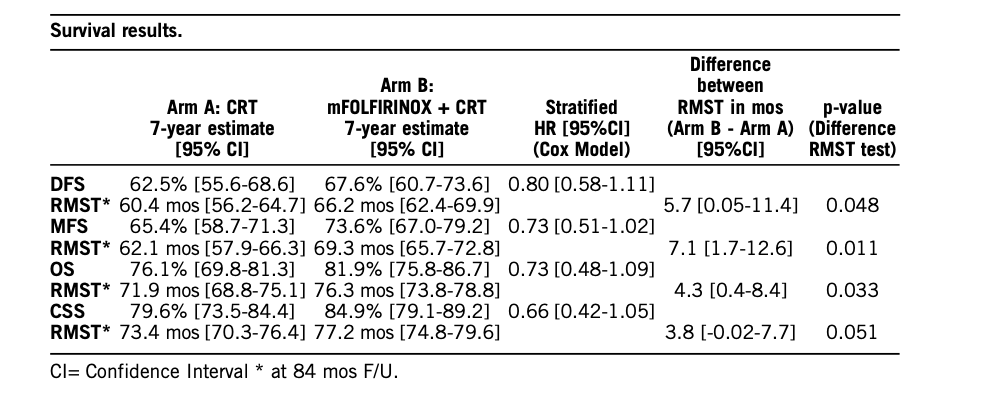
DFS - The absolute increase in 5-year survival were 7.6% for Disease-Free Survival (DFS), 6.9% for Overall Survival (OS), 9.9% for Metastasis-Free Survival (MFS), and 5.7% for Cancer Specific Survival (CSS). 7-year cumulative incidence of locoregional relapses are 5.3% in Exp vs 8.1% Standard of care (p= 0.38)
Double pCR in Exp group 12.1 to 27.8%
 Take home:
Improved DFS, OS, MFS, CSS. No difference in local relapse.
Take home:
Improved DFS, OS, MFS, CSS. No difference in local relapse.
STELLAR
Multicenter, Randomized, Phase III Trial of Short-Term Radiotherapy Plus Chemotherapy Versus Long-Term Chemoradiotherapy in Locally Advanced Rectal Cancer (STELLAR) Jing Jin, MD1,2 ; Yuan Tang, MD 1 ; Chen Hu, PhD3 ; Li-Ming Jiang, MD 4 ; Jun Jiang, MD4 ; Ning Li, MD1
STELLAR orginal, page 1
Publication information
Journal of Clinical Oncology, 2022
Hypothesis:
To ascertain if preoperative short-term radiotherapy followed by chemotherapy is not inferior to a standard schedule of long-term chemoradiotherapy in patients with locally advanced rectal cancer.
Methods
Design
Inclusion
Distal or middle-third, clinical primary tumor stage 3-4 and/or regional lymph node–positive rectal cancer.
Procedure
Exp: SCT + chemo vs CRT Both received adjuvant chemotherapy (2 cycles in Exp vs 6 in standard of care)
Outcome
3y DFS
Results
Population
599
Primary endpoint
DFS - 64.2 vs 62.5% MFS - 77.1 vs 75.3% LRR - 8.4% vs 11% OS 86.5 vs 75.1%
Take home
Summary article
Adoption of Total Neoadjuvant Therapy in the Treatment of Locally Advanced Rectal Cancer
Adoption of Total Neoadjuvant Therapy in the Treatment of Locally Advanced Rectal Cancer, page 1
RAPIDO - SCT then consolidation. But SCCT messed it up and led to higher rates of locoregional disease dispite better systemic disease. PRODIGE-23 - Induction with FOLFIRINOX (more agressive) then CRT. Improved DFS, OS, MFS, CSS. No difference in local relapse. OPRA - Consolidation is likely better for OP
If no suspicion of distant disease then either consolidation or induction is reasonable. If there is suspicion of distant disease but cannot be confirmed then induction makes sense - repeat imaging/assessment and adjust as required.