- Preoperative preparation
- Confirm diagnosis with clinical exam:
- Aching in proximal volar forearm
- Paresthesia in median nerve distribution
- Positive resisted pronation or elbow flexion test
- Differentiate from carpal tunnel syndrome or anterior interosseous syndrome
- Nerve conduction studies often normal but may help rule out alternatives
- Consent for nerve injury, incomplete relief, recurrence
- Confirm diagnosis with clinical exam:
- Anaesthesia and positioning
- Regional block or general anaesthesia
- Supine position with arm abducted on arm board, forearm supinated
- Tourniquet to upper arm
- Incision and exposure
- Make a longitudinal incision over the proximal volar forearm, from ~2 cm distal to the elbow crease, extending 8–10 cm distally
- Incise skin and subcutaneous tissue
- Identify and protect superficial veins and medial antebrachial cutaneous nerve branches
- Identification of the median nerve
- Locate the biceps tendon and brachial artery, then find the median nerve just medial and deep to the artery
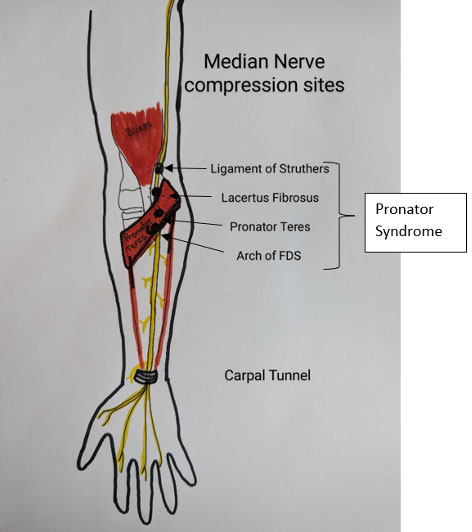
- Trace the median nerve distally through the lacertus fibrosus (Bicipital aponeurosis)
- Decompression
- Ligament of Struthers
- travels from tip of supracondylar process to medial epicondyle
- not to be confused with Arcade of Struthers which is a site of ulnar compression neuropathy in cubital tunnel syndrome
- Lacertus fibrosus
- Release the lacertus fibrosus (bicipital aponeurosis) — often the first site of compression
- Pronator teres
- Release the fascia overlying the superficial head of pronator teres
- Retract or divide the superficial head to access the deep head
- Release fibrous bands or compressive tissue between or around both heads
- Fibrous arch of the flexor digitorum superficialis (FDS)
- Release if compressing the nerve
- Ligament of Struthers
- Completion and closure
- Ensure median nerve is fully decompressed along its course in the proximal forearm
- Check for good nerve mobility and absence of residual constriction
- Achieve haemostasis
- Close fascia loosely or leave open depending on exposure
- Close subcutaneous tissue and skin with absorbable/interrupted sutures
- Apply sterile dressing and splint forearm in neutral or slight flexion if needed
- Postoperative care
- Elevate arm and initiate gentle range of motion exercises
- Watch for improvement in sensory symptoms and resolution of forearm pain
- Nerve recovery may take weeks to months
https://www.youtube.com/watch?v=_sQESrS9vy4&ab_channel=WUSTLLearnSurgery