-
Pronator Syndrome is a compressive neuropathy of the Median Nerve at the level of the elbow.
-
Diagnosis is made clinically with pain at the proximal volar forearm, sensory changes over the palmar cutaneous branch, and positive Tinel’s over the proximal volar forearm.
-
Treatment involves a prolonged nonoperative course, and rarely, surgical decompression.
-
Pathoanatomy
- 5 potential sites of entrapment include
- supracondylar process
- residual osseous structure on distal humerus present in 1% of population
- ligament of Struthers
- travels from tip of supracondylar process to medial epicondyle
- not to be confused with arcade of Struthers which is a site of ulnar compression neuropathy in cubital tunnel syndrome
- bicipital aponeurosis (a.k.a. lacertus fibrosus)
- between ulnar and humeral heads of pronator teres
- considered the most common site of entrapment
- FDS aponeurotic arch
- supracondylar process
- 5 potential sites of entrapment include
-
Associated conditions
- commonly associated with medial epicondylitis
-
The median nerve is a terminal branch of the brachial plexus, taking divisions from the lateral and medial cords to derive supply from C5-T1.
-
It supplies most of the flexor muscles of the forearm, but only the thenar muscles (FPL, OP, APB) and two lumbricals in the hand. 1/2LOAF
-
In the arm it is medial to the brachial artery but it crosses the ulnar artery just distal to the ACF to run down the midline of the forearm where it dives between the heads of pronator teres and deep to the arch of FDS.
-
Prior to this it supplies PL, PT, FCR, and FDS.
-
Its anterior interosseous branch is the nerve of the deep flexor compartment supplying the radial half of FDP, as well as PQ and FPL.
-
It enters the hand through the carpel tunnel where it may be compressed causing Carpal tunnel syndrome
-
Sensory supply of the median nerve is to the radial 3.5 digits on the entire palmar side and the tips of the dorsal digits.
-
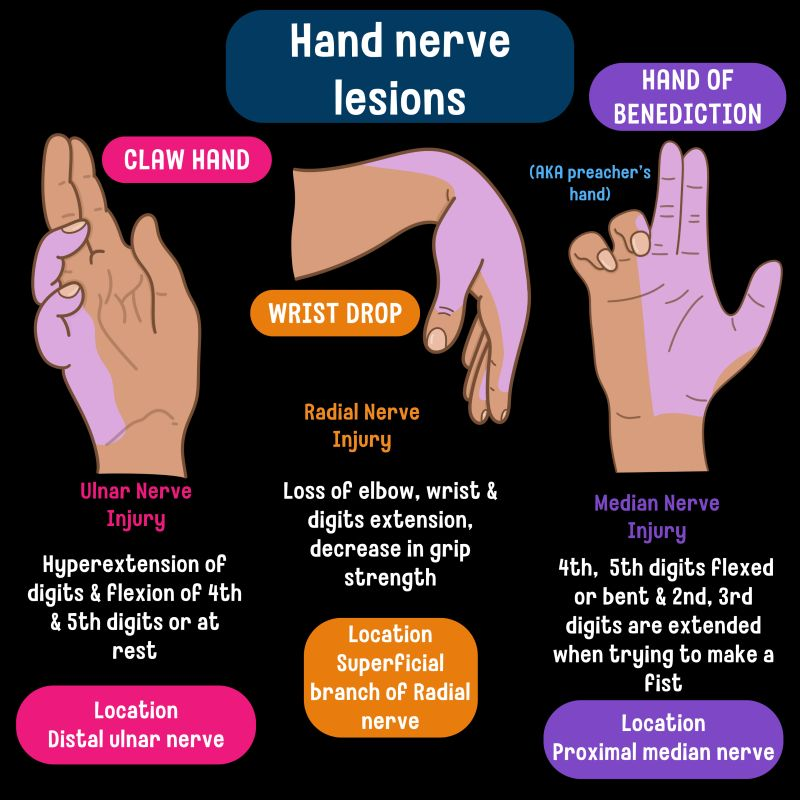
The Hand of Benediction occurs when a patient with a high median nerve injury (proximal to the elbow) attempts to make a fist, but the index and middle fingers remain extended, while the ring and little fingers flex.
-
Nonoperative
- rest, splinting, and NSAIDS for 3-6 months
- indications
- mild to moderate symptoms
- technique
- splint should avoid forearm rotation
- indications
- rest, splinting, and NSAIDS for 3-6 months
-
Operative - Decompressive surgery for pronator syndrome
- surgical decompression of median nerve
- indications
- only when nonoperative management fails for 3-6 months
- technique
- decompression of the median nerve at all 5 possible sites of compression
- outcomes
- of surgical decompression are variable
- 80% of patients having relief of symptoms
- of surgical decompression are variable
- indications
- surgical decompression of median nerve