Section: Head and neck Curriculum: Curriculum, page 43
Definition
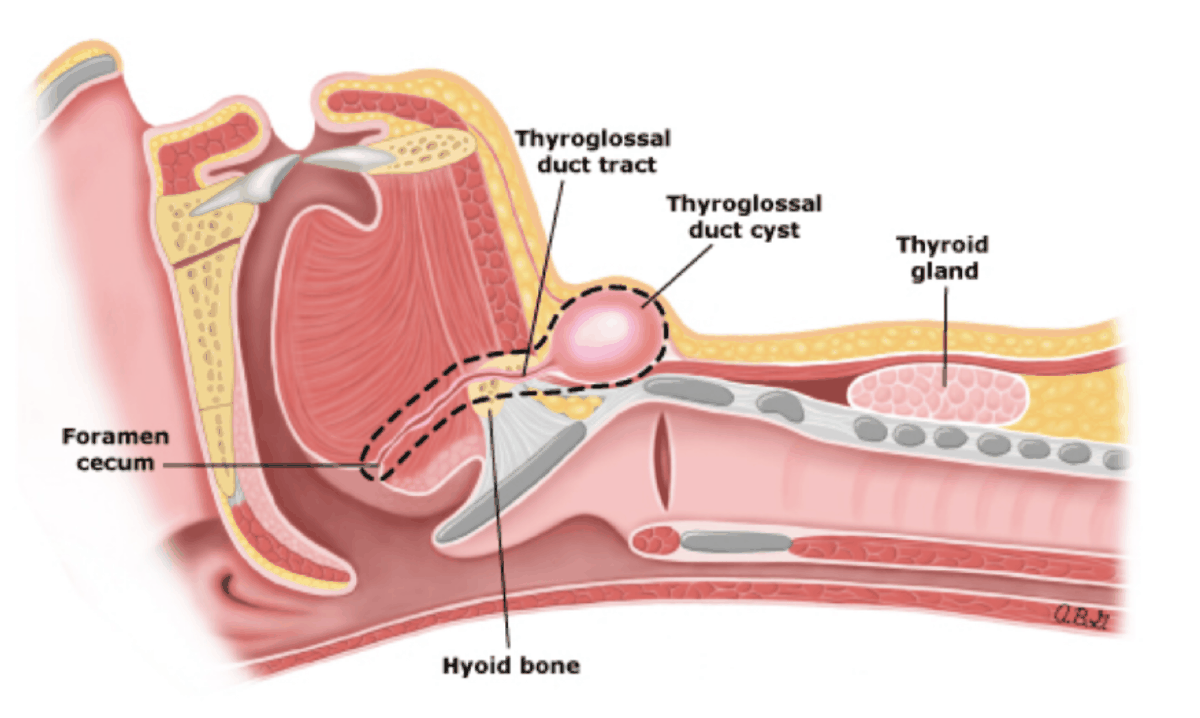
- Congenital epithelial cyst of thyroglossal tract remnants
- Midline neck lump in the anterior neck
Epidemiology
- Most common congenital neck cyst
- 7% of pop
- M=F
- Mainly infrahyoid - 60%
Relevant Embryology
- Week 3 thyroid commences development
- Median outgrowth from primitive pharynx (foramen caecum)
- Located at junction of ant ⅔ and post ⅓ tongue
- Thyroid descends in ant neck, anterior to hyoid and closely associated
- Week 7 it reaches the pretracheal position
- Thyroglossal duct (narrow tubular structure) follows thyroid down
- Connects foramen caecum to thyroid gland
- Distal part of it becomes the pyramidal lobe in 50% of people
- Week 10 usually the duct involutes
Pathology
- Failure of thyroglossal duct involution → Normally week 10
- Epithelial lining can secrete - causing inflammation and cyst formation
Classification
- Suprahyoid - 15%
- Level of hyoid 25%
- Infrahyoid - 60%
Clinical
- Asymptomatic
- Midline neck swelling
- Elevates with tongue protrusion
- Can be associated with infection/inflammation
- In context of URTI
- 1% risk of thyroid malignancy (papillary)
Investigations
- USS - good for cyst, not for relationship with hyoid bone
- CT/MRI - gives info about relationship with hyoid bone
- (?semantics as hyoid will come out anyways)
- TFT/USS/thryoid scan to ID ectopic thyroid tissue prior to sistrunk
Thyroid Ectopia
- 50% of pts with thyroglossal cyst have ectopic thyroid tissue
- Ectopic thyroid tissue most commonly
- LINGUAL then
- Thyroglossal cyst
- Can have associated hypothyroidism
- Should be corrected pre-surgery
- Identified by doing TFTs, USS and thyroid scan
- Need to plan for this as if it is hyper/hypofunctioning and not responsive to medical therapy or has associated malignancy - needs resection too
Differential diagnosis
Central neck lump
- Congenital
- Branchial cleft cyst
- Dermoid Cyst
- Cutaneous cysts
- Epidermoid cyst
- Thymic cyst
- Ranula (plunging)
- Pseudocyst in floor of mouth
- Painless, blue and fluid filled
- Obstruction of sublingual gland duct
- Plunging if descending over edge of mylohyoid into submandibular space
- Transoral sublingual gland excision or marsupialization and packing
- Inflammatory
- LN
- Bacterial
- Viral
- Parasitic
- Neoplastic
- Benign
- Thyroid nodule
- Salivary gland cyst
- Malignant
- Primary
- Thyroid cancer
- Salivary gland tumour
- Secondary
- Lymphoma
- SCC
- Melanoma
- Primary
- Benign
Management
- Treat infection - abx and settle (oral flora) (communicates with tongue)
- Augmentin
- Avoid I+D at all costs as it makes subsequent surgery very difficult
- Surgery
- Sistrunk procedure
- What is it
- Thyroglossal cyst, duct and partial hyoid resection (pyramidal lobe)
- When
- Once infection has settled down
- Rationale
- Operate on all
- Get recurrent infection
- Particularly if they’ve had one bout already
- Risk of malignancy
- Goals
- Complete excision of thyroglossal duct tract up to base of tongue
- Superior and posterior to hyoid bone
- Procedure
- Setup - GA/IVabx, supine, shoulder roll, head ring, stand on right
- Steps
- Transverse incision over cyst
- Subplatysmal flaps
- Dissect cyst
- Identify thyroglossal duct (posterosuperior to cysts)
- Follow and mobilise duct until hyoid bone is reached
- Divide muscle on sup and inf aspects of hyoid bone (diathermy)
- Transect central hyoid bone with cutter 1-1.5cm
- Continue duct dissection to floor of mouth
- Depress tongue with hand in mouth to help
- Ligate and transect duct at foramen caecum with vicryl
- Layered absorbable closure
- What is it
- Sistrunk procedure