Section: Small bowel Curriculum: Curriculum, page 61
Definition
- A reduction of gut function below the minimum necessary for absorption of macronutrients or fluid and electrolytes so intravenous administration is necessary to maintain function and growth
- Short-bowel syndrome
- Total small bowel length that is inadequate to support nutritional requirements on a standard conventional diet
- For adults, an anatomic definition of ЅΒS is residual small bowel length <200 cm, measured from the duodenojejunal flexure, with or without colon. For ϲhildrеո (<18 years), the corresponding definition is small intestinal length <25 percent
Classifications
- Functional classification
- Type 1
- Acute short term intestinal failure which is self limiting i.e. post-operative ileus.
- Type 2
- Prolonged intestinal failure, life-sustaining parenteral nutrition is needed for longer than 20 days i.e. mesenteric ischaemia, abdominal trauma.
- Type 3
- Long-term intestinal failure in patients who are metabolically stable.
- Usually stable people who are able to be managed at home with home-based parenteral nutrition i.e. Crohn’s disease, chronic intestinal pseudo-obstructions.
- Type 1
- ESPEN classification
- Loss of intestinal length – short bowel syndrome
- Loss of intestinal functional length – fistula
- Loss of intestinal function – intestinal dysmotility
- Loss of intestinal absorptive capacity – extensive small bowel mucosal disease
- Intestinal obstruction - mechanical obstruction.
Aetiology
- 75% due to resection
- Inflammatory
- 25% - Multiple sequential resections – usually Crohn’s
- Iatrogenic
- Vascular
- Ischaemia
- Internal Hernia
- Mid-gut Volvulus, SMA Occlusion
- Traumatic injury to SMA
- Inflammatory
- Neonatal short bowel is usually due to necrotizing enterocolitis
Intestinal dysmotility
- Most common cause is a post-operative ileus.
- Other causes include Parkinson’s disease, chronic pseudo-obstruction, Chagas disease, medication associated endocrine disorders (hypothyroidism), systemic sclerosis.
- Mechanism is that patients reduce there oral intake due to feeding related symptoms or due to episodes of non-mechanical obstruction.
- Can lead to bacterial overgrowth
- Vomiting, diarrhoea, and intestinal secretion contributes to increased fluid and electrolyte losses.
Mechanical obstruction
- Bowel obstruction restricts oral intake.
- Also get increased intestinal secretion of fluid and electrolytes in the obstructed segments.
- Causes
- Intra-luminal – polypoid tumours, intussusception, gallstone ileus
- Intra-mural – strictures (could be neoplastic, inflammatory, fibrotic)
- Extra-mural – neoplastic, hernias, volvulus, band adhesions.
Extensive small bowel mucosal disease
- Any condition which reduces the function of enterocytes which reduces the absorptive ability.
- Vomiting, diarrhoea, and restricted oral intake also contributes to intestinal failure.
- Causes include Crohn’s, scleroderma, Radiation enteritis, coeliac disease, food allergies, intestinal epithelial dysplasia, chemotherapy related enteritis
Length
- Colon/ICV preserved
- Can resect up to 70% of the small bowel if ICV and terminal ileum retained
- If patients have 200cm of jejunum and an intact colon, then they should be able to tolerate enteral feeds without TPN supplementation
- Healthy patients with healthy bowel may tolerate down to 100cm with intact ICV and colon however unlikely to tolerate less than 150cm without ICV
- Ileum has better adaptive ability then jejunum
- Proximal resection is tolerated better than distal
- TI also important for B12 absorption and Bile Salt recirculation
- Ileum
- Resection > 60 cm of ileum is associated with malabsorption of vitamin B12
- Resection > 100 cm of ileum is associated with insufficient bile salt concentrations in the duodenum for optimal fat absorption
- Leading to fat and fat soluble vitamin malabsorption
- ICV valve
- Loss of the ICV reduces small intestinal transit time, which may impair nutrient absorption
- Ileocecal valve serves as a barrier to the translocation of colonic bacteria into TI
- Bacterial overgrowth following ICV resection may be associated with malabsorption of fats, B12 and bile salts
- What lengths do you need?
- Adults with residual small intestine of less than 180 cm are at risk for developing ЅΒS
- Half colon is equivalent to 50cm
- End jejunostomy – long term IF most likely if <180cm of small bowel.
- Jejunocolic anastomosis – long term IF likely if < 130cm of small bowel.
- Jejuno-ileal anastomosis – long term IF likely if <80cm of small bowel.
- In the short term – if you leave less than 180cm of small bowel then you will get at least short term intestinal failure.
Pathology
- Adaptive hyperplasia has a remarkable ability to compensate for significant resections however will be overwhelmed after a certain point
- Intestinal fistula
- Large area of absorptive capacity is being bypassed.
- Large losses of fluids and electrolytes
- Disruption of the bile salt entero-hepatic cycle
- Restriction of oral nutrition in order to reduce fistula output.
- Increased metabolic demands due to sepsis associated with the fistula.
Absorption
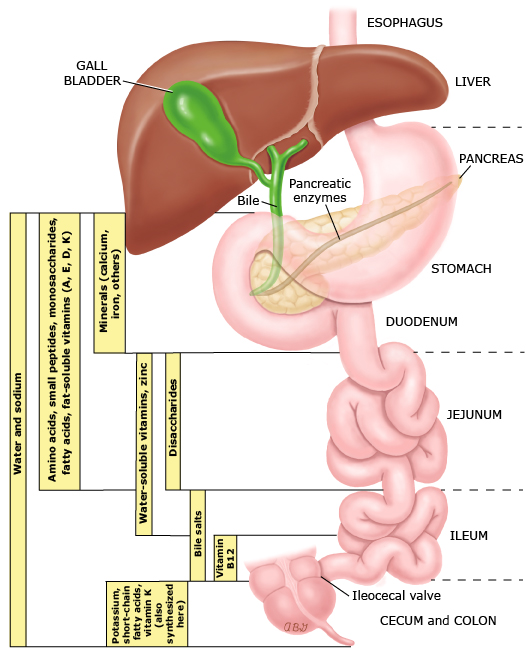
- Small bowel absorption
- Duodenum
- Minerals - calcium, Iron absorption
- Jejunum
- Primary site for most macro and micro nutrients
- Amino acids, monosaccharides, fatty acids, fat soluble vitamin (ADEK), water soluble vitamins, Zinc
- Ileum
- Bile salts
- Vitamin B 12, water soluble vitamins, Zinc
- Notes
- The ileum has better absorptive ability and adaptation than the jejunum
- If you lose the distal 60cm then you will get B12 deficiency
- If you lose all the ileum you will lose the ability to absorb bile acids which will lead to bile acid malabsorption
- Colon
- Primarily sodium, water and potassium.
- Can also absorb digested carbohydrates and short chain fatty acids.
- Notes
- The whole colon is equivalent to an extra 150cm of small intestine (which is lots!!)
- For patients with short gut but an intact colon, you would put them on a high carbohydrate diet (as the colon can absorb this).
- The colon is also really efficient at absorbing fluid – can absorb up to 6L of intestinal fluid per day – thus it is really important to restore continuity.
- Duodenum
Bile acid malabsorption
- Resection of >100 cm of terminal ileum leads to disruption of the enterohepatic circulation
- Eventually resulting in bile acid deficiency
- because bile acid losses exceed the compensatory increase in hepatic bile acid production
- Causes
- Malabsorption
- Fat
- Fat soluble vitamin
- Secreto-motor diarrhoea (the colon doesn’t like being exposed to bile acids)
- Kidney stones (increased oxalate absorption)
- Malabsorption
Stages
- 3 stages of intestinal failure
- Phase 1 – acute intestinal failure/hypersecretory phase.
- Phase 2 – adaptation phase
- Phase 3 – chronic failure/stabilization phase
Phase 1 – acute intestinal failure phase
- Occurs in the first 4 weeks post-operatively
- Patients loose large volumes of fluid, electrolytes, and have significant malabsorption.
- Up to 7L per day is secreted by the pancreas, liver, stomach and SI – this is normally all re-absorbed so in this phase there will be large intestinal loses.
Initial management
- Resuscitation and IV correction of fluids and electrolytes
- Identify reversible factors – intra-abdominal sepsis, anastomotic leak.
- Sepsis needs to be source controlled – either re-operation or percutaneous drainage and IVAbx.
- Patients should be put on acid suppression with a PPI to treat there hypergastrinemia and excess acid secretion – this lowers the small bowel pH and reduces the efficacy of digestive enzymes.
- Patients should have there nutrition optimised.
- May need TPN
- Enteral feeding should be started early to maximise the guts ability to adapt
- Anatomy should be defined – length and integrity
- Rule out a reason why a fistula won’t heal – i.e. obstruction, malignancy.
- Wound care and fistula care needs to be addressed.
Stage 2 – adaptation phase
- 1-24 Months
What is adaptation?
- Is a combination of both functional and structural changes
- Combination of both macroscopic and microscopic changes.
- More adaptation occurs in the ileum than jejunum.
- The bowel dilates and elongates
- Gastro-intestinal transit slow down.
- Villi get longer to increase the absorptive area.
- Epithelial hyperplasia occurs – increasing the number of enterocytes.
- Upregulation of the brush-border membrane permeability and transporters occur.
- Early intestinal feeding increases the rate at which adaptation occurs.
Management principles in stage 2
- Establish oral feeding in a stepwise manner over weeks to months
- Type of diet will depend on the presence or absence of a colon
- Colon present
- Higher carbohydrate diet
- Moderate restriction in fat consumption
- Restrictive oxalate diet
- Malabsorbed fat binds to calcium increasing colonic oxalate absorption which increases the risk of neprolithiasis
- Oral rehydration solutions can be used.
- Hypotonic solutions can be given. Avoid hypertonic solutions (i.e. fruit juice) as this will cause diarrhoea.
- Isotonic solution may be helpful
- Soluble fiber supplements can be useful – this decreases fluid losses, and slows gastric emptying.
- If the colon is not present
- More even balance between carbohydrates and fats.
- Should avoid both hypo and hypertonic solutions.
- Should use Saint Marks Solution (is an isotonic solution).
- Hypertonic - induce secretion to dilute → diarrhoea
- Hypotonic - lack sugar required to be absorbed → diarrhoea
- Should use Saint Marks Solution (is an isotonic solution).
- Drugs should be introduced to increase with GI intestinal absorptive capacity.
Drugs
- PPI
- Should be continued for 6 months then stopped to avoid SB bacterial overgrowth.
- Loperamide
- Can use very high doses i.e. 48mg per day
- Codiene
- Can also be used – 60mg per day.
- Octreotide
- Can be trialled – is expensive, patients can get tachyphylaxis, it can cause gallstones. If not improving after 2 weeks should be stopped.
- Antibiotics
- Can be used to Small intestinal bacterial overgrowth
- GLP2 analogue – Teduglutide – SC injection
- Is a growth hormone which encourages GI tract adaptation.
- Cholestyramine and Colestipol
- May help reduce diarrhoea by binding to bile acids and making them insoluble so they are not stimulating colonocytes to secrete chloride/fluid into the colon
- Not useful for patients who do not have a colon
- May make steatorrhea worse (as binding bile salts)
Monitor vitmains and mineral
Phase 3 – chronic failure/stabilization phase
Stabilisation phase/Chronic intestinal failure.
- Maximal adaptation of the GI tract can take up to 2 years.
- After that time – you need to figure out how you can get that patient living as normal a lifestyle as possible at home.
Irreversible chronic intestinal failure
- Survival rate is 65% at 5 years.
- Long term complications include catheter associated infections, loss of venous access, and development of TPN induced liver failure.
Intestinal transplantation
- Is reserved for patients who have a risk of death due to complications of TPN or underlying GI disease
- 5 year survival post intestinal transplantation is 50%.
- Indications for intestinal transplantation
- Recurrent catheter associated infections
- TPN associated liver disease
- Complications of venous thrombosis
- Frequent episodes of dehydration where fluid losses exceed the maximum infusion rates.
- Can be combined with a liver transplant if required.
Surgical options for long term intestinal failure
- This can be considered after 6 months.
- Patient needs to be nutritionally replete before any surgery is considered. There is minimal evidence of efficacy for these treatments.
- Options
- Reversing small bowel segments – slows down transit thus increasing intestinal absorption
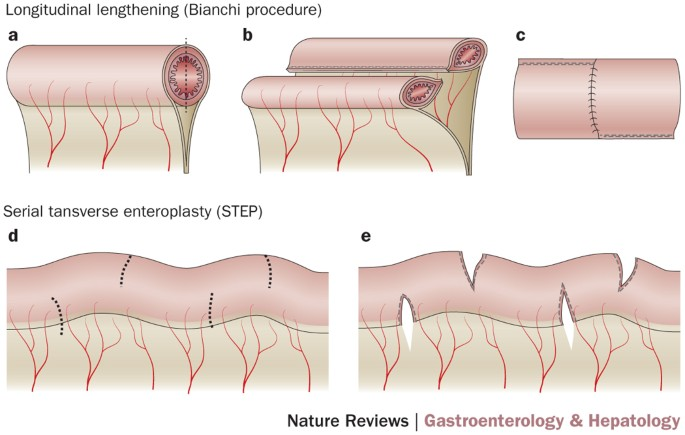
- Bianchi technique – bowel is divided along its long access, re-tuberalised and then re-anastomosed.