Section: Surgical Oncology Curriculum: Curriculum, page 70
Indications and Patient Selection
- Fall into four groups:
- Cirrhosis (waitlists usually based off MELD score)
- Acute Fulminant Liver Failure
- Metabolic Liver Disease
- Primary Hepatic Malignancy
- Most common indication is Chronic Liver Failure
- Hep C in USA
- Hep B in Asia and endemic countries
- Primary biliary cirrhosis
- Primary sclerosing cholangitis
- NASH
- Biliary Atresia most common indication in children
- Children account for ~ 10–15% of all liver transplants
- Acute fulminant liver failure requiring transplantation on an urgent basis accounts for approximately 10%
- Usually viral or drug-induced (e.g. paracetamol OD)
- Metabolic diseases
- Wilson’s Disease, Oxalosis and α1-Antitrypsin Deficiency
- Primary hepatic malignancy is more common in cirrhosis, esp. virally induced
- May be best treated by transplantation because tumour resection may leave insufficient functional liver tissue behind
- Cholangiocarcinoma has a high recurrence rate and is seldom an indication for transplantation
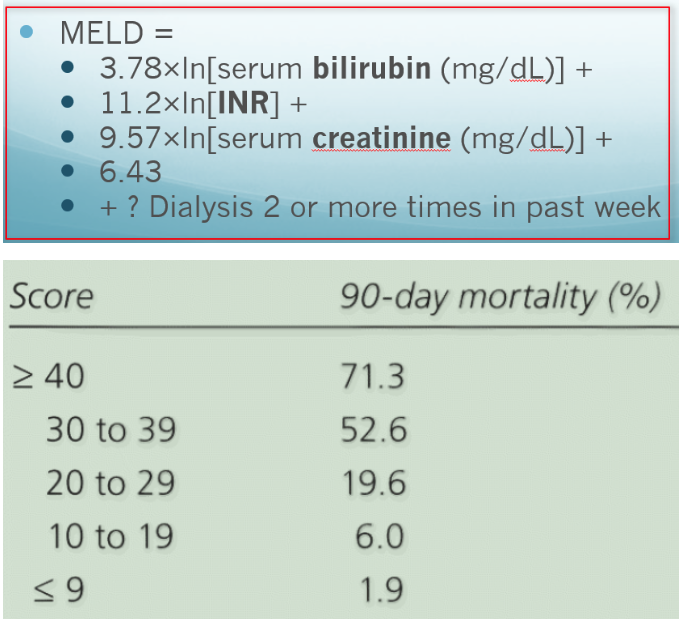
MELD Score
- Model for End-stage Liver Disease
- Statistical model that predicts 3 month mortality in patients with cirrhosis
- Developed to predict who would benefit from TIPSS (score < 14) or those who would benefit from direct to transplant (score > 24)
- Now used to prioritise liver transplants
- If a patient has dialysed twice in the last week - the value for the serum creatinine should be 4
- NOT designed for HCC pts
- HCC patients
- The MELD score will not appropriately prioritise HCC patients (will under-predict there mortality)
- Decompensation/derangement may happen late in the cancer disease progression
- Pts may not get prioritised for transplantation early enough
- Priority points now given to HCC patients (Modified MELD)
- In the UK they have modified the MELD to include sodium in the formula - called the MELD-NA
- Is likely more accurate
- Is likely more accurate
Technique of liver transplant
Recipient Liver resection
- Transverse abdominal incision with a midline extension
- Diseased liver is mobilised
- Because of portal hypertension, the recipient hepatectomy is often the most difficult part, esp. if previous surgery
- CBD divided as close to liver as possible
- Mobilisation
- Dissect the intrahepatic vena and control it with a nylon tape.
- Divide the peritoneal attachments of the liver, starting with the left triangular ligament and proceeding to the falciform ligament, thus exposing the anterior surface of the supra-hepatic vena cava.
- Completely mobilising the retrohepatic vena cava from the posterior abdominal wall, ligating and dividing the right adrenal vein.
- Ligate the portal vein and hepatic artery - maximising the length of the vessels for subsequent re-implantation of the new graft.
- Occlusion of the vena cava and portal vein results in a reduction in cardiac output and may necessitate the use of veno-venous bypass
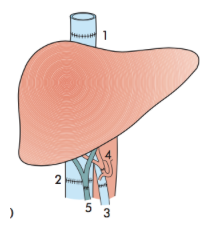
Liver implantation
- After placing the donor liver in position
- Supra- and infrahepatic caval anastomoses are performed
- The portal vein and the hepatic arterial anastomoses are then completed and the graft is reperfused
- Finally, biliary drainage is re-established
- Duct-to-duct anastomosis, end-to-end (without a T-tube)
- Roux-en-Y may be needed for biliary atresia or sclerosing cholangitis
- Many pts undergoing liver transplantation are ill and the surgery involved can be very demanding
- Optimal peri-operative management crucial for success and presents a major challenge
- Blood loss during and after the transplant procedure can be considerable
- Management of coagulopathy is particularly important
- Measured repeatedly and corrected appropriately with FFP, cryoprecipitate and platelets
Technical Complications
- Haemorrhage
- Haemostasis essential
- Liver may need packing and re-exploration
- Evacuation of haematoma required to avoid infection
- Hepatic Artery Thrombosis
- May occur spontaneously or as a result of acute rejection
- More common in children
- Presents – unexplained transaminase rise, fever, bile leak
- Doppler USS or angiography to diagnose
- Urgent re-transplantation usually required
- Portal Vein Thrombosis
- More insidious
- Doesn’t’t usually require re-transplantation
- Biliary
- Leaks uncommon
- Stenosis more common
- Usually occurs late
- Managed by endoscopic dilatation and stenting
Paediatric Liver Transplant
- Until recently, major factor limiting paediatric liver transplantation was the lack of donor livers of suitable size
- Development of techniques for using adult livers reduced in size by cut-down techniques has helped - Split liver techniques
- For small children the lateral segment of the left lobe is often used
- But the entire left lobe or the right lobe may also be used
Outcome After Liver Transplant
- Depends on underlying disease
- Best results are seen in patients with chronic liver disease
- Transplantation for acute liver failure
- Higher mortality rate in the early post-transplant period
- Because of multi-organ failure,
- But those who recover have very good long-term liver allograft survival
- Transplanted for tumour
- Very good early outcome
- Ultimately fare less well because of recurrence
- Liver transplantation following Hep B or C may develop graft failure as a result of recurrent viral disease
- But the availability of improved anti-viral therapy has helped reduce this problem
Liver Transplant for HCC
- Rationale
- Removed both detectable and undetectable tumour nodules from both lobes
- Simultaneously treats underlying cirrhosis
- Prevents underlying complications associated with Portal HTN and Liver failure
- Patient Selection
- Based on the fact that patients should have same survival post-op as patients for that have transplants for other reasons
- Low risk of tumour recurrence (low tumour burden)
- Milan Criteria
- A single tumor that is no larger than 5 cm in diameter
- Up to three tumors, each no larger than 3 cm in diameter
- No evidence of vascular invasion or extrahepatic disease
- University of California San Francisco Criteria (UCSF)
- Single tumour < 6.5cm or 2-3 tumours < 4.5cm
- With total tumour diameter < 8cm
- No vascular invasion
- No extra-hepatic spread
Management while on Transplant Waitlist
- Waitlist often long (can be > 12 months)
- Up to 25% may be subsequently excluded from transplant while waiting due to disease progression
- Potential ways to manage this
- Live-donor liver transplant
- No waitlist, faster
- But risk to donor, small grafts, difficulty with finding donor
- Amendments to liver allocation policies
- Priority MELD points given to those with HCC
- Treatment of tumour while waiting
- Resection, TACE, Ablation
- May avoid progression so stays within transplant criteria