Section: Surgical Oncology Curriculum: Curriculum, page 71
Overview
- Brainstem dead, heart-beating, deceased
- Non-heart-beating, deceased
- Living Donor
- Kidney
- Liver
- Other
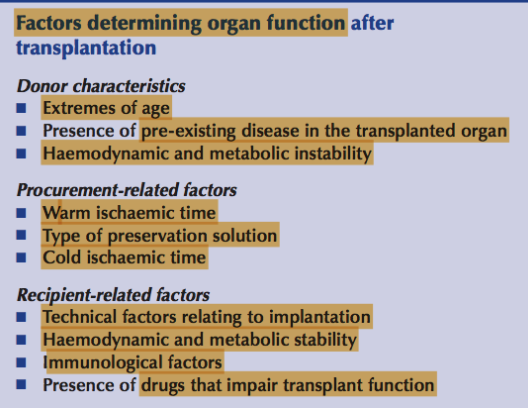
- Factors determining organ function after transplant
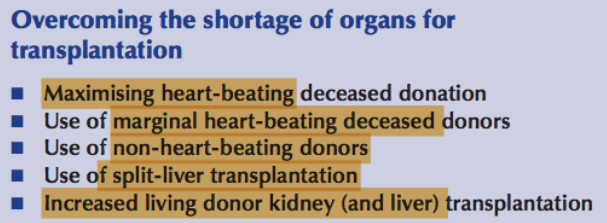
Brainstem Death, heart beating
- Most Common
Determination of Brainstem Death
- Severe brain injury causes
- Irreversible loss of the capacity for consciousness
- Irreversible loss of the capacity for breathing
- Usually equates to medical, legal and religious death
- Acceptance of the concept of brain death has had major implications for organ transplantation
- Allowed possibility of removal of viable organs from brain-dead pts before circulation failed
- In many countries brain death defined in terms of permanent functional death of the brainstem
- Spontaneous respiration is not possible in the absence of a functional brainstem
- Consciousness is possible in the absence of a functional brainstem
- Diagnosis considered only when preconditions met:
- Suffered major brain damage of known aetiology
- Deeply unconscious
- Require artificial ventilation
- Traumatic head injury and sudden intracranial haemorrhage are the most common causes
- Must ensure that muscle relaxant agents and drugs with known CNS depressant effects are not contributing
- Hypothermia, profound hypotension and metabolic or hormonal conditions must also be excluded
- When the necessary preconditions have been satisfied, formal clinical assessment of the brainstem reflexes can be undertaken
Formal Brainstem Death Assessment
- Should be performed on two separate occasions by two clinicians experienced in this area
- At least one of the two clinicians should be a consultant
- Neither should be connected with the transplant team
- Particular care is required in the diagnosis of brainstem death in neonates and infants
- The time that must elapse between the two sets of brainstem tests is not specified in guidelines and is determined on the basis of clinical judgment
- In UK, no requirement to perform electrophysiological or brain perfusion studies to aid diagnosis of brainstem death
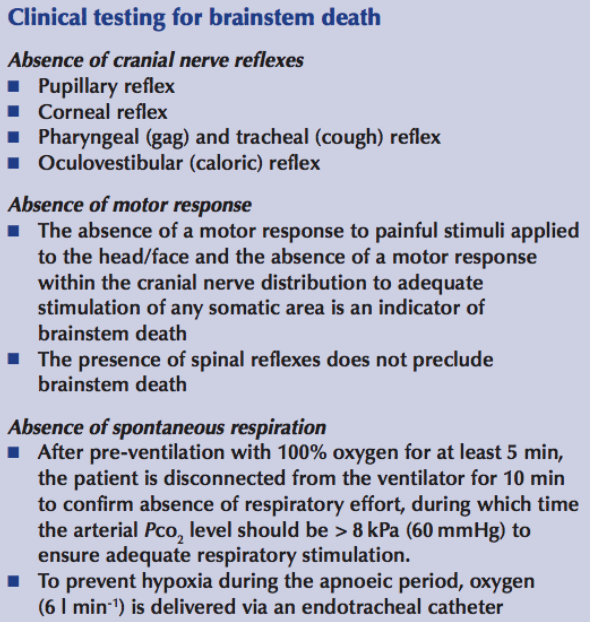
Non-Heart-Beating Donors
- Increasing use of kidneys and livers
- Attempt to address the shortage of organs for transplantation.
- Generally not suitable for other organs
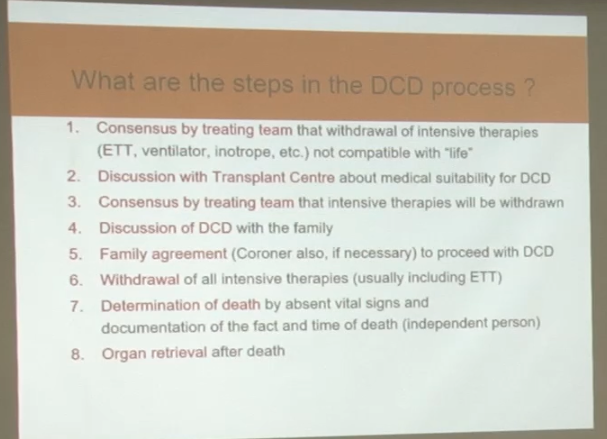
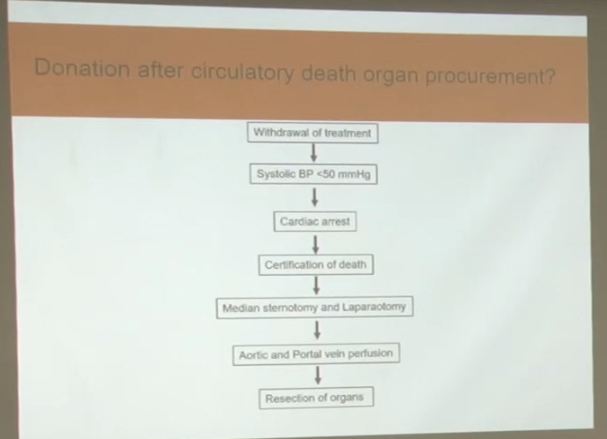
- Kidneys may be procured from patients who are dead on arrival at the hospital or who have died after withdrawal of support or following unsuccessful resuscitation
- Maastricht Classification
- Category 1: DOA at hospital
- Category 2: Unsuccessful resuscitation in hospital
- Category 3: ‘Awaiting cardiac arrest’ after withdrawal of support
- Category 4: Cardiac arrest while brain dead
- Maastricht Classification
- Can introduce double balloon aortic catheter to perfuse and cool the kidneys
- More common to wait 15 mins after diagnosis then rapidly transfer to OT
- Kidneys usually suffer a degree of ischaemic damage, and delayed graft function more common
- But overall graft survival results good
Living Donors
Kidney
- 25-30% of renal transplants
- Living donor transplants fare better than even well matched deceased donor grafts
- Essential to ensure full informed and free of coercion
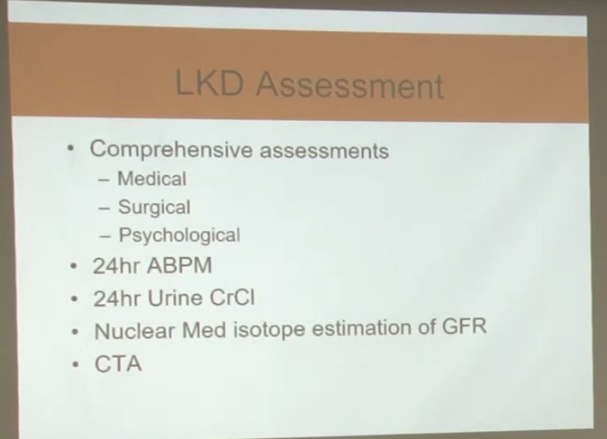
- Rigorous assessment to ensure suitability
- Imaging (MRA or CTA) to delineate arterial supply to kidneys
- Left kidney is preferred
- Due to longer left renal vein.
- Potentially easier to access surgically
- Need to beware of kidneys having multiple veins and/or arteries.
- Multiple arteries doesn’t preclude transplant
- But increases risk of vascular complications
- Left kidney is preferred
- Laparoscopic approach commonly used
- After removal, flushed immediately with chilled organ preservation solution (University of Wisconsin Solution)
- Mortality rate for live donation is < 0.05%
- 1/2 reported deaths are due to PE (essential to ensure prophylaxis)
- Major complication rate ~ 2%
- Long term, a slight elevation in proteinuria and a small rise in blood pressure seen
- 35% of potential living donor transplant recipients will be ABO blood group incompatible
- Could consider “paired donation”
- Could consider “paired donation”
Other Organs
- More controversial
- Has been used for joint kidney and pancreas
- Ethical issues complex Liver
- Becoming more common
- Adult to child
- Using left lateral segments
- Adult to adult
- Using right lobe
- Donor procedure
- Mortality rate 0.2%
- One of main complications is bile leak
Evaluation of Deceased Donor
- Assess general suitability of potential organ donor
- Particularly
- Transmissible infectious agents
- Malignancy
- Medical history
- Risk factors for HIV, such as IVDU
- Contraindications to Donation
- Presence of HIV infection and Creutzfeldt–Jakob disease (CJD)
- Hepatitis B (could consider it, Hep C can be cured post transplant)
- Active systemic sepsis
- Malignancy within past 5 years
- Exception of:
- Primary tumours of CNS
- Non-melanotic skin tumours
- Carcinoma in-situ of the Cervix
- Exception of:
- Donor organs should be free from primary disease
- If there are no general contradictions to organ donation
- Consideration is then given to organ-specific selection criteria
- Acceptable donor age ranges (more guideline than fixed)
Organ Specific
- Kidney donors
- Reasonable urine output
- Relatively normal serum urea and creatinine levels
- Although acute terminal elevations are acceptable
- Liver donors
- Should not have hepatic disease
- Although impaired LFTs are common in deceased donors and do not necessarily preclude donation
- Heart donors
- Normal ECG and, in doubtful cases, Echo
- Lung donors
- CXR and gas exchange should be satisfactory
- Bronchial aspirates should be free from fungal and bacterial infection
- Elevations of blood glucose and serum amylase are not uncommon in deceased donors
- Do not preclude pancreas donation
Acceptable Donor Age Ranges
- Kidney
- 2 years to no upper age limit
- Liver
- No age limit
- Heart
- 1 – 65 yrs
- Lung
- 5 – 65 yrs
- Pancreas
- 10 – 60 yrs
Organ Procurement
- Aimed at preserving the functional integrity of the organs
- Brainstem death produces profound metabolic and neuroendocrine disturbances leading to cardiovascular instability
- Careful monitoring and management of fluid balance
- Inotropic support is given and there may be a role for the use of tri-iodothyronine (T3) and argipressin
- Procurement may be a multi-team approach
- Heart and Lungs
- Liver
- Kidney
Renal Transplant
Pancreas Transplant
Liver Transplant
Intestinal transplant
Thoracic Organ Transplant
- Heart
- Heart transplantation is now considered an effective treatment for selected patients with end- stage cardiac failure
- Most common indications:
- IHD
- Idiopathic Cardiomyopathy
- Others include valvular heart disease, myocarditis and congenital heart disease
- Considered only in pts with end-stage heart disease that failed to respond to all other measures
- And when predicted survival is < 12 months
- Limited to < 65 yrs, who do not have irreversible damage to other organ systems
- Pre-op assessment rigorous
- Pulmonary Vascular resistance mandatory
- Outcomes
- Heart transplant
- 1-year graft survival 85%
- 5-year graft survival 70%
- Results after heart–lung and lung transplantation less good
- 1-year graft survival 75%
- 5-year survival 40%
- Heart transplant