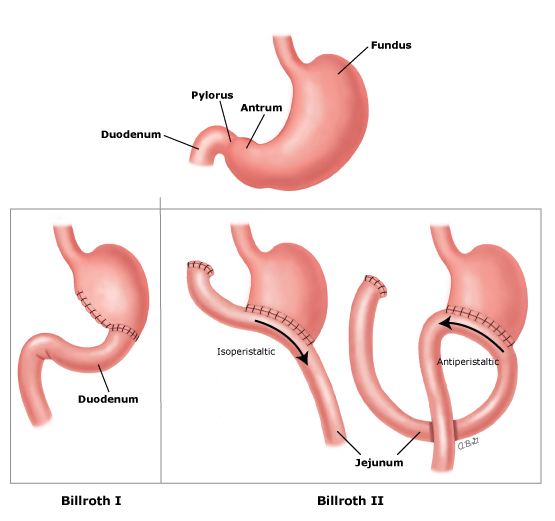
- Anastomoses the remnant stomach to the proximal jejunum in an end-to-side fashion.
- This reconstruction preserves jejunal but not duodenal continuity
- Used when a Billroth I reconstruction is not possible, such as with more extended distal gastrectomy (ie, more than the antrum is resected).
- The Billroth II reconstruction has an afferent limb from the duodenum and an efferent limb extending distally.
- For a Billroth II reconstruction, the jejunal anastomosis can be performed in an antecolic or retrocolic, isoperistaltic, or antiperistaltic fashion
Post-Gastrectomy Syndromes
- Following Billroth II reconstruction, patients can expect to suffer from alkaline reflux gastritis and some dumping
- Unlike Billroth I reconstruction, Billroth II also leads to some degree of malabsorption, particularly of fat-soluble vitamins, because of loss of duodenal continuity.