Peptic perferation

  • Lavage, lavage, lavage
  • Leave NGT
  • Main repair strategy is patch
  • If > 50% of lumen
    • May require pyloric exclusion or distal gastrectomy
      • Options for management of duodenal stump
        • Options that require duodenal transection
          • Nissen closure- Management of the Difficult Duodenal Stump , page 2
          • Bancroft closure - Management of the Difficult Duodenal Stump , page 3
          • Duodenostomy - Management of the Difficult Duodenal Stump , page 3
        • T-tube (controlled fistula) - placed through the hole
      • Options for management of stomach
        • Distal gastrectomy with Roux-en-Y or Billroth II reconstruction
        • Pyloric exclusion
          • Absorbable suture or non-cutting linear stapler across pylorus
          • Over period of weeks the sutures/staples will give way and normal anatomy restored
          • Gastric continuity
      • Place many drains

Duodenum Trauma

  • General
    • Relatively well-protected like the pancreas
    • If it’s injured then very likely for other things to be injured too
    • Doesn’t present with peritonitis making dx hard
  • Mechanism of Injury
    • Penetrating (more common and seldom isolated)
    • Blunt (associated pancreatic injury, steering wheel/handle bar/chance # of L1/L2)
  • Presentation
    • Dependent on location of injury and where it drains
    • Retro | Lesser Sac | Greater Sac
  • Signs of duodenal injury at surgery
    • Retroperitoneal haematoma
    • Peri-duodenal air bubbles
    • Peri-duodenal haematoma
    • Bile staining of tissues
  • Investigation
    • CT
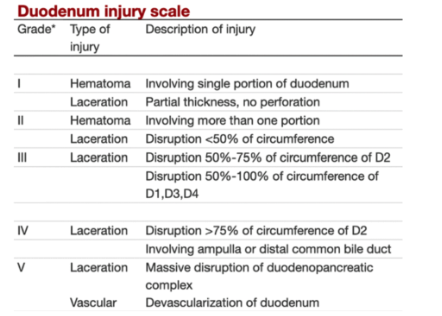
    • Laparotomy Duodenal Injury Scale

Operative management

  • Operative Possibilities
    • Simple suture repair
    • Duodenal diversion
    • Suction drainage peri-duodenal
    • Damage control preceded Whipple’s
  • Surgical Approach
    • Key factors
      • Proximity to ampulla
      • Injury characteristics - Simple vs complex
      • Circumference of involved duodenum
      • Associated injuries - Biliary tree, pancreas, vascular
    • Can’t really dissect D2 away from pancreas - closely apposed and inter-reliant on blood supply
    • D3 exposure via Right medial visceral rotation - Cattell Brasch and SB mesentery mobilisation
    • D4 exposure by mobilising ligament of Treitz
    • Intramural haematoma
      • Leave alone if possible
      • Can cause duodenal obstruction but should settle with time
      • If doesn’t - warrants exploration
    • Options
      • Laceration and perofation
        • Simple suture closure of simple wounds
          • Closure of longitudinal duodenotomy transversely if length <50% is of circumference
      • Complete transection
        • Primary anastomosis often possible if mobility permits (D1,D3,D4)
        • May need reconstruction
          • Proximal to ampulla - antrectomy and Bilroth II
          • Distal to ampulla - R&Y duodenojejunal anastamosis and closure of distal duodenum
          • D2 - R&Y end-to-side duodenojejunal anastamosis
      • Duodenal diversion with gastrojejunostomy
        • Consider this in high risk repairs to divert gastric content and improve chance of healing + make a leak easier to manage
      • Other options
        • Duodenal Diverticulation - this is dated
          • This is Bilroth II gastrectomy + closure of duodenal injury + placemnet of a decompressive catheter into the duodenum (also described is performing a truncal vagotomy and biliary drainage at the same time to decrease the fluid in the repair)
        • Diversion
        • Triple tube decompression
        • Pyloric excl
        • Whipple
    • Consider cholangiogram if close to ampulla/bile duct