• 5th cranial nerve

Origin

  • Three sensory nuclei (mesencephalic, principal sensory, spinal nuclei of trigeminal nerve) One motor nucleus (motor nucleus of the trigeminal nerve)
  • Extending from the midbrain to the medulla.
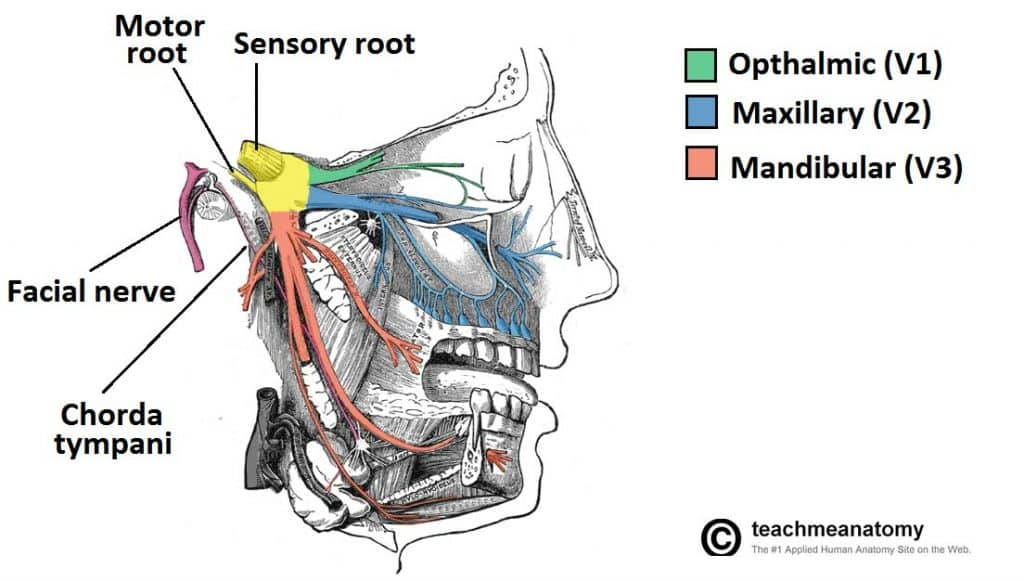
  • Merge to form a sensory root. The motor nucleus continues to form a motor root.
  • In the middle cranial fossa, the sensory root expands into the trigeminal ganglion.
  • The trigeminal ganglion is located lateral to the cavernous sinus, in a depression of the temporal bone. This depression is known as the trigeminal cave.
  • The peripheral aspect of the trigeminal ganglion gives rise to 3 divisions: ophthalmic (V1), maxillary (V2) and mandibular (V3).
    • Mandibular is the only root with motor

Divisions

Opthalmic nerve

  • Travels lateral to the cavernous sinsus
  • Exits the superior orbital fissure
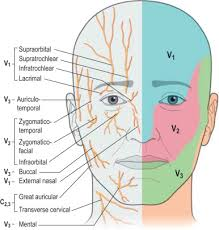
  • 3 terminal branches: frontal, lacrimal and nasociliary, which innervate the skin and mucous membrane of derivatives of the frontonasal prominence derivatives:
    • Forehead and scalp
    • Frontal and ethmoidal sinus
    • Upper eyelid and its conjunctiva
    • Cornea
    • Dorsum of the nose
  • Give parasympathetic to Lacrimal gland

Maxillary nerve

  • Travels lateral to the cavernous sinsus
  • Exits the foramen rotundum
  • 14 terminal branches, which innervate the skin, mucous membranes and sinuses of derivatives of the maxillary prominence of the 1st pharyngeal arch:
    • Lower eyelid and its conjunctiva
    • Cheeks and maxillary sinus
    • Nasal cavity and lateral nose
    • Upper lip
    • Upper molar, incisor and canine teeth and the associated gingiva
    • Superior palate
  • Give parasympathetic to Lacrimal gland and Nasal glands

Mandibular nerve

  • Exits via the foramen ovale entering the infra-temporal fossa
  • Mandibular nerve gives rise to four terminal branches in the infra-temporal fossa
  • Sensory supply:
    • Mucous membranes and floor of the oral cavity
    • External ear
    • Lower lip
    • Chin
    • Anterior 2/3 of the tongue (only general sensation; special taste sensation supplied by the chorda tympani, a branch of the facial nerve)
    • Lower molar, incisor and canine teeth and the associated gingiva
  • Motor Supply
    • Muscles of mastication; medial pterygoid, lateral pterygoid, masseter, temporalis
    • Anterior belly of the digastric muscle and the mylohyoid muscle (these are suprahyoid muscles)
    • Tensor veli palatini
    • Tensor tympani
  • Parasympathetic Supply
    • Submandibular gland anatomy and Sublingual Gland
      •  Post-ganglionic fibres from the submandibular ganglion (derived from the facial nerve), travel with the lingual nerve to innervate these glands.
    • Parotid Gland
      • Post-ganglionic fibres from the otic ganglion (derived from the glossopharyngeal nerve, CN IX), travel with the auriculotemporal branch of the V3 to innervate the parotid gland.