What is pyoderma gangrenosum?
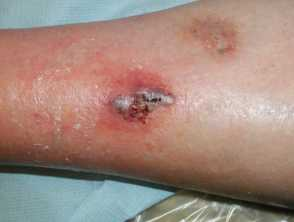
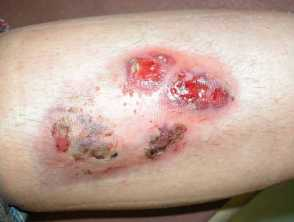
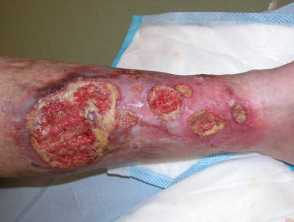
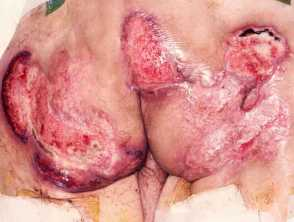
Pyoderma gangrenosum (PG) presents as a rapidly enlarging, very painful ulcer. It is one of a group of autoinflammatory disorders known as neutrophilic dermatoses.
The name pyoderma gangrenosum is historical. The condition is not an infection (pyoderma), nor does it cause gangrene.
It is characterised by a full-thickness ulcer with blue/purple undermined borders and by pathergy.
Who gets pyoderma gangrenosum?
Pyoderma gangrenosum is a rare disease that affects males and females of any age but is more common in those aged over 50 years. It frequently is associated with an internal disease or condition. Its known associations include:
- Inflammatory bowel disease (ulcerative colitis and Crohn disease)
- Rheumatoid arthritis
- Myeloid blood dyscrasias including leukaemia
- Monoclonal gammopathy (usually IgA)
- Chronic active hepatitis
- Granulomatosis with polyangiitis
- PAPA syndrome
- Behçet disease]
- Use of levamisole-adulterated cocaine
- Miscellaneous less-common associations.
About half of those affected by pyoderma gangrenosum have none of the associated risk factors.
Pyoderma gangrenosum associated with inflammatory bowel disease
IBD-associated pyoderma gangrenosum has the following characteristics:
- Pyoderma gangrenosum represents the second-most common cutaneous manifestation of IBD (1–3%).
- It is more commonly a complication of ulcerative colitis compared to Crohn disease
- IBD-associated pyoderma gangrenosum is associated with clinically mild IBD, erythema nodosum, and female sex.
- Underlying bowel disease is active in over half of the patients at the time of an episode of pyoderma gangrenosum.
- Pyoderma gangrenosum is most often located on the lower extremity and can be periostomal.
- Ulcerative and pustular types of pyoderma gangrenosum may arise.
What causes pyoderma gangrenosum?
Pyoderma gangrenosum is an autoinflammatory disease (excessive response to an internal antigen) due to some form of neutrophil dysfunction. T lymphocytes and cytokines are involved. There may be a genetic predisposition.
Drugs are occasionally implicated as triggers of pyoderma gangrenosum, especially cocaine, isotretinoin, propylthiouracil, and sunitinib (a protein kinase inhibitor).
Injury to the skin is a common trigger (the pathergic response), and a surgical trigger is well known, and often misinterpreted as a wound infection.
Daignosis
Maverakis criteria
Criteria published after a Delphi consensus exercise in 2018 supersede the Su criteria with a single major criterion required to diagnose pyoderma gangrenosum (a neutrophilic infiltrate). The addition of four or more of the eight minor criteria yields a sensitivity of 86% and a specificity of 90% for pyoderma gangrenosum.
Major criterion
- Histopathology of ulcer edge must show a neutrophilic infiltrate.
Minor criteria
- Exclusion of infection
- Pathergy
- History of inflammatory bowel disease or inflammatory arthritis
- History of papule, vesicle, or pustule ulcerating within four days
- Peripheral erythema, undermining border, and tenderness at the ulcer site
- Multiple ulcers, at least one on the anterior lower leg
- Cribriform or wrinkled paper scars at the site of the healed ulcer
- Decreased size of the ulcer within one month of initiating immunosuppressive medication.
In UC: 1–10% of patients with UC
- plaques or pustules that break down and form painful ulcerations with undermined borders and necrotic centres
- Legs are the most commonly affected area, though it can oc- cur anywhere, including peristomally.
- Can be dependent or Independent on activity of colitis