Sub-section: Adrenal Section: Endocrine
Definition
- Tumors derived from Chromaffin cells
- Neural crest origin
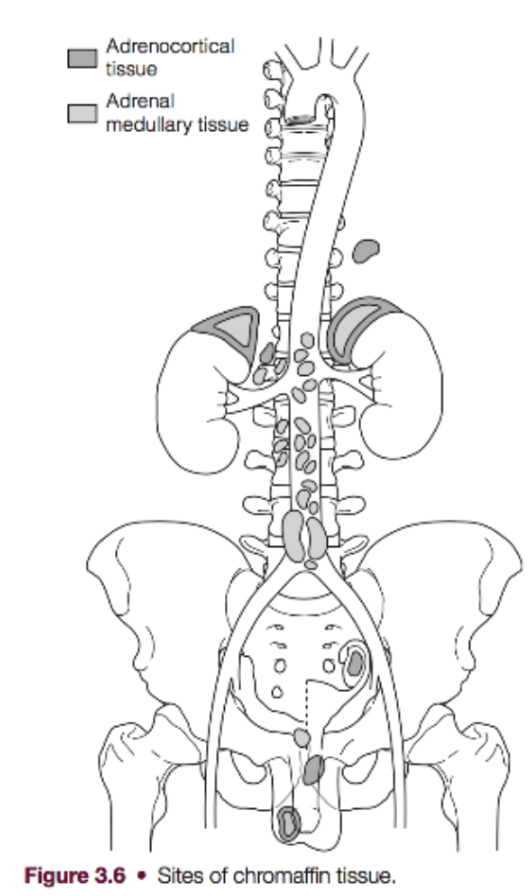
- Pheochromocytoma from Adrenal Medulla
- Paragangliomas from Autonomic Ganglia
Incidence
- 3-8 per million per year
- Middle age most common (40-50)
- Hereditary forms can occur at younger age
- Very rare in children
- 0.2% of hypertensive patients
- M = F
- Traditionally the “10%” tumour - not true anymore
- 10% bilateral
- 10% extra-adrenal
- 10% familial
- 10% malignant
Clinical Presentation
- 5% found as incidentalomas (“pre-symptomatic”)
- Symptoms due to excessive catecholamine secretion
- Classic Triad
- Headaches
- Palpitations
- Diaphoresis (sweating)
- Pallor, nausea, weight loss, tiredness, anxiety
- Characteristically paroxysmal, intermittent, non-specific + overlap with other conditions
- Classic Triad
- Diagnosis difficult and delayed
- Signs
- Hypertension (in 90%)
- But only 0.5% of patients with hypertension and suggestive symptoms actually end up having phaeochromocytoma
- Diabetes mellitus
- Pheochromocytoma crisis (massive catecholamine release)
- Sudden death, arrhythmia, heart failure, multi-organ failure, CVA
- Can be precipitated by anaesthesia, trauma, biopsy, haemorrhage, tumor manipulation
- Hypertension (in 90%)
Aetiology
- Majority sporadic
- Up to 1/3 carry germ line mutations, main ones include:
- RET gene mutation (MEN 2 syndrome A/B)
- Phaeochromocytomas occur in half of MEN 2 pts
- VHL gene mutation (in Von-Hippel-Lindau disease)
- Phaeochromocytomas in up to 1/3
- CNS hemangioblastoma
- Renal cell cancer
- Cysts in kidney, testes, pancreas
- NF1 gene mutation (in Neurofibromatosis Type 1)
- Paraganglioma syndrome (SDH B, SDH C)
- Paraganglioma/ Phaeochromocytoma syndrome
- Particularly high risk of malignancy
- Family hx important as new diagnosis may be first indication of familial syndrome
- Hereditary gene mutations more likely to be young (< 50), multiple tumors, bilateral, extra-adrenal
- RET gene mutation (MEN 2 syndrome A/B)
Biochemical Workup
- Plasma metanephrines
- Single blood test, good initial screen to R/O Phaeochromocytoma
- Highly sensitive (95-98)
- Specificity only (85-89%)
- Plasma catecholamine measurement poor indicator
- Levels vary episodically, can be elevated for other reasons
- Due to rare nature of phaeochromocytoma, false positive to true positive ratio is 30:1
- 24hr Urinary Metanephrines and Catecholamines
- More cumbersome than single blood test
- Gives more stable measurement over time
- Use to confirm diagnosis if plasma metanephrines raised
- Many confounding medications
- Discontinue sympathomimetics, phenoxybenzamine, acetaminophen, psychotropic drugs
- If still equivocal – Clonidine suppression test
Localisation
- No role for adrenal venous sampling (high false positive)
- No role for biopsy – may precipitate severe HTN or make operating more difficult
Cross-sectional Imaging
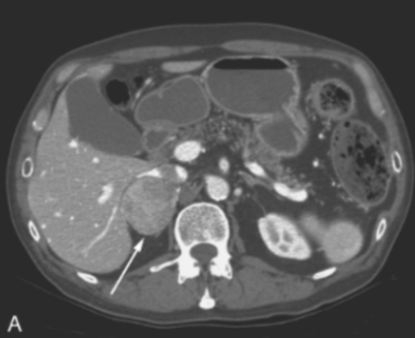
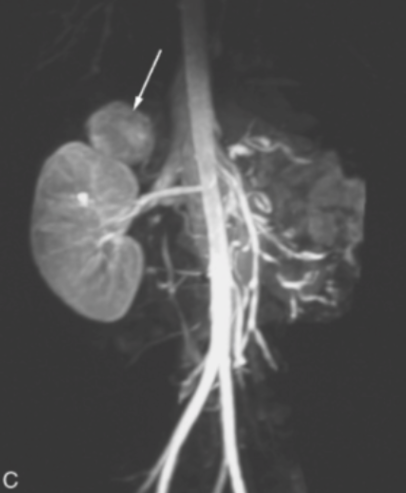
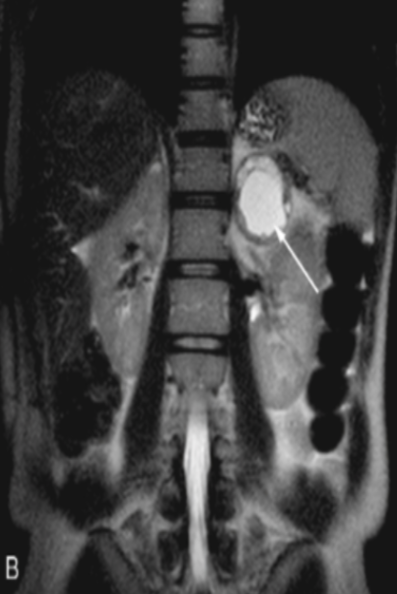
- MRI – more sensitive
- CT – often yields more anatomic definition for operative planning
- Specificity for both only 70%
- Due to high prevalence of adrenal incidentalomas
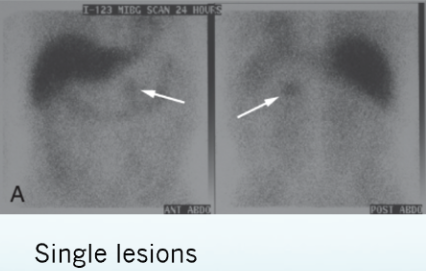
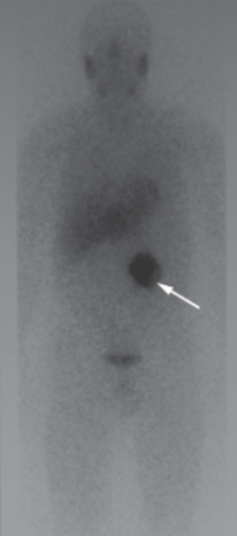
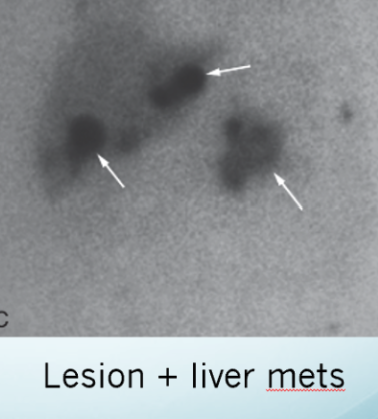
MIBG Scintigraphy
- Use next if multifocal disease suspected or if tumour can’t be seen on CT/MRI
- MIBG = Meta-IodoBenzylGuanidine – Radioactive tracer
- Noradrenaline analogue
- Highly specific, but sensitivity only 77-90%
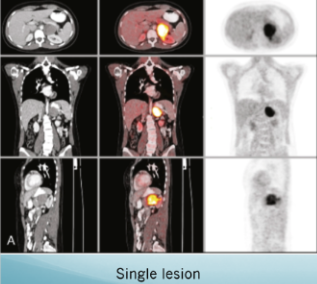
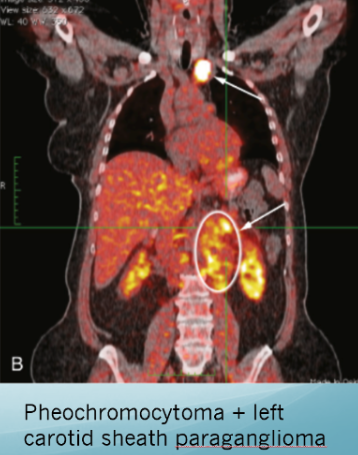
DOTA-TATE or FDG PET
- Highly sensitive, superior to MIBG
Peri-op Medical Management
- Aim to counteract haemodynamic changes
- Intra-operative hypertension
- Post-operative hypotension
Pre-op elective management
- Phenoxybenzamine
- Long-acting non-selective, non-competitive α–adrenergic receptor antagonist
- Start low and increase over 2-4 weeks
- Alternatives
- Doxazosin, Urapidil
- CCB’s (nicardipine)
- β-blockers for tachycardia/arrhythmia
- Only after α–blockade
- Unopposed α- action can precipitate hypertensive crises and pulmonary oedema!
Unopposed Alpha Stimulation
- Acute increase in blood pressure and coronary vasoconstriction after administration of a beta-blocker
- Normal mechanism - stimulation of:
- Alpha-1 receptors
- Smooth muscle contraction and vasoconstriction
- Beta-1-receptors
- Increases cardiac conduction, HR, and contractility
- Beta-2-receptors
- Smooth muscle relaxation
- Vascular tone is usually mediated by a balance of alpha-1 contraction and beta-2 relaxation
- Alpha-1 receptors
- Normal mechanism - stimulation of:
- Non-selective beta-blockade will
- Inhibit beta-2 relaxation effects (with ongoing alpha-1 stimulation)
- ⇒ Vasoconstriction and hypertensive crisis, with coronary artery vasoconstriction
- Inhibit beta-1 effects
- Causes increased end diastolic pressure, increased cardiac fibre length
- Increases BP and ventricular contraction (Frank-Staling law)
- Inhibit beta-2 relaxation effects (with ongoing alpha-1 stimulation)
Intra-operative Planning
- Arterial line and central lines to detect and correct potential hypertensive episodes
- Avoid undue handling of tumor
- If hypertensive episode, use:
- Sodium nitroprusside (short acting vasodilator)
- Nicardipine (CCB)
- Phentolamine (α–adrenergic receptor antagonist)
- PLUS Beta-blockers for tachycardia/arrhythmia
Post-operative Management
- Excess catecholamines cause vasoconstriction and state of hypovolaemia
- Once tumor devascularised, fall in catecholamines
- Leads to peripheral arteriolar vasodilation and large increase in venous capacitance
- Can lead to cardiovascular collapse
- Aggressive volume replacement/inotropes may be needed
- Consider HDU/ICU post-op
- Monitor BSLs
- Hypoglycemia due to withdrawal of lipolytic, glycolytic, and glycogenolytic effects
Surgical Management
- Procedure of choice is Laparoscopic Adrenalectomy
- Paragangliomas may need open resection
- Tumours tend to be highly vascular and adhere to adjacent structures
- Laparoscopy contraindicated when imaging evidence of local invasion
GAPP score
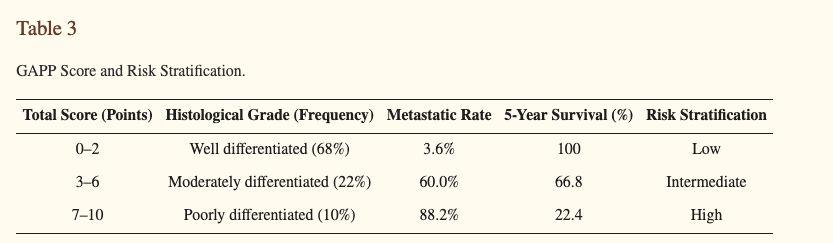
- The Grading of Adrenal Pheochromocytoma and Paraganglioma (GAPP) is a tool for risk stratification for predicting metastasis and the prognosis of patients.
- Currently, all Paragangliomas/Pheochromocytoma are believed to have some metastatic potential and are assigned malignant tumors (ICD-O/3) by the WHO Classification of Endocrine Organs (2017, 4th edition). Therefore, the previous categories benign and malignant PPGL have been eliminated in favor of risk stratification approach.
- PASS
- Phaeos only
- Dated now - not used
- GAPP
- Phaeos and paragang
- Histology and clinical
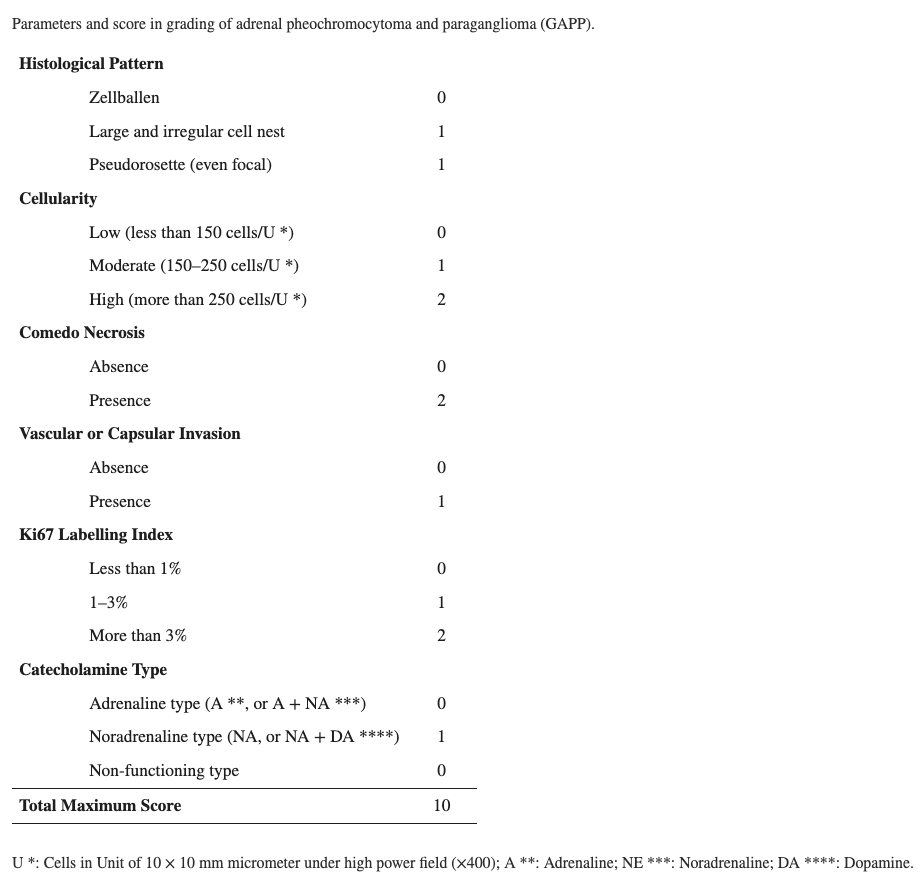
- This allows risk stratification as below
Malignant Phaeochromocytoma
- All have malignant potential ! - re classified
- 2.5-40% are malignant, depending on genotype
- 5yr survival 20-45%
- Incidence higher if:
- Larger
- Extra-adrenal (paragangliomas)
- Paraganglioma syndrome B mutation carriers
- Histopathologic features don’t differentiate benign or malignant
- Diagnosis of malignancy based on metastatic disease
- Must be to locations which neuroectodermal tissues NOT normally found!
- Axial skeleton, LNs, Liver, Lung, Kidney
- Must be to locations which neuroectodermal tissues NOT normally found!
- Diagnosis of malignancy based on metastatic disease
- Imaging
- DOTATE
- If unresectable
- Consider α- and β- blockade
- Tumor debulking can give symptom relief
- Palliative radiotherapy, chemotherapy, RFA, TACE may have roles
- Therapeutic MIBG can produce symptomatic and hormonal improvement + some tumour regression
Pheochromocytoma in Pregnancy
- Rare but dangerous
- Significant mortality for mother and infant
- α- blockade, elective 3rd trimester C-section
- Vaginal delivery contraindicated
- Early post-partum adrenalectomy