Section: Hepatobiliary Sub-section: Pancreas Curriculum: Curriculum, page 90
Definition
- At presentation – only 15% have resectable disease.
- 4th most common cause of cancer death.
- Adenocarcinoma accounts for 95% of pancreatic malignancies.
- Can also get NETS, mesenchymal tumours are rare.
Differential diagnosis
- Lymphoma
- Autoimmune pancreatitis
- Focal chronic pancreatitis.
- Pseudo papillary neoplasm.
- Metastatic disease – RCCs or melanoma.
Risk factors
- Modifiable
- Smoking
- Obesity
- Diabetes
- Occupational exposures to asbestos and pesticies
- Radiation
- Chronic pancreatitis
- ETOH abuse.
- Non-modifiable
- FHx or inherited germline mutation
- Peutz-Jeghers syndrome (SK11)
- Li-Fraumeni syndrome
- Fanconi’s syndrome
- Familial adenomatous polyposis (APC)
- Lynch syndrome (MMR pathway)
- Von Hippel Lindau Syndrome
- BRCA1/BRCA2
- CDKN2A (familial atypical mole and melanoma syndrome)
- PALB2 (familial breast cancer syndrome)
- ATM (familial breast cancer syndrome)
- PRSS1 and SPINK1 of hereditary pancreatitis
- MEN syndromes
- Age.
- FHx or inherited germline mutation
Pathology
- Ductal adenocarcinoa 80%
- IPMN with an associated invasive carcinoma – 2 to 3 percent
- MCN with an associated invasive carcinoma – 1 percent
- Solid pseudopapillary neoplasm – <1 percent
- Acinar cell carcinoma – <1 percent
- Pancreatoblastoma – <1 percent
- Serous cystadenocarcinoma – <1 percent
Precursor lesions
- Stepwise progression
- From pancreatic ductal intraepithelial neoplasia to pancreatic cancer
- Mutation are similar to the ones in the conventional colorectal cancer pathway i.e. KRAS, TP53, SMAD4.
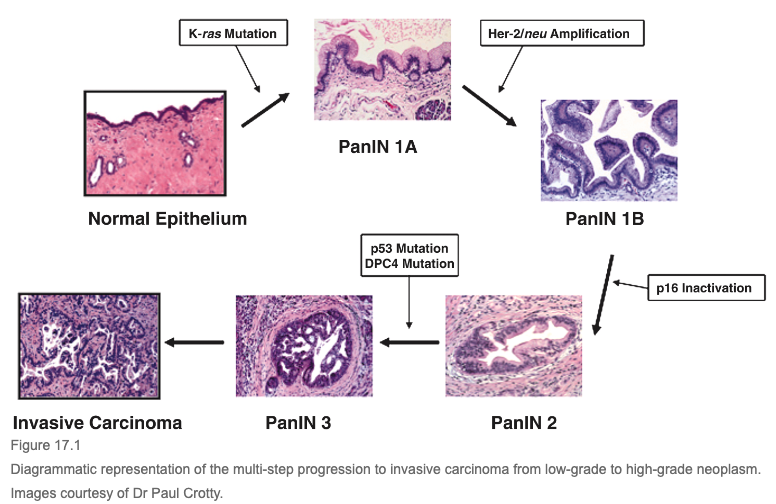
- intraepithelial neoplasia (PanIN) - progress from 1→3 then IC
- adenoma–carcinoma sequence
Notable genes
- KRAS
- 90%
- oncogene – mutated lead to it being activated
- TP53, p16/CDKN2A and SMAD4
- Loss of tumour suppressor genes
Histology
- vary from well-differentiated duct-forming carcinomas (that may mimic non-neoplastic glands) to poorly differentiated carcinomas, with epithelial differentiation demonstrable only on immunolabelling.
Clinical
History
- Early satiety
- Obstructive jaundice (± pain)
- Unexplained weight loss
- Endoscopy-negative epigastric/back pain
- Late-onset diabetes
- Signs of malabsorption without defined cause
Examination
- Courvoisier’s sign (palpable gallbladder with painless jaundice)
- Virchow’s node (left supraclavicular node associated with upper gastrointestinal malignancy)
- Thrombophlebitis migrans (non-specific paraneoplastic)
- Sister Mary Joseph nodule (umbilical metastatic lesion via the falciform ligament)
- Hepatomegaly may reflect hepatic metastases
- Blumer’s shelf (rectally palpable rectovesicle or rectovaginal mass)
Investigations
CA 19-9
- Used as a prognostic marker and to helps assess response to treatment.
- Only 65% of patients with resectable disease have an elevation
- Can be elevated in chronic pancreatitis
- Is indicative of occult metastatic disease
- Can be elevated in patients with biliary obstruction thus needs to be rechecked once obstruction is relieved.
- 10% of patients don’t secrete CA19-9.
- A preoperative serum CA 19-9 level ≥500 IU/ml indicates a worse prognosis after surgery
CT findings
- Double duct signs is suggestive.
- Usually present as a hypodense poorly defined mass.
- Pancreatic atrophy, loss of glandular contour are other signs.
- Often don’t enhance well on arterial imaging and then will become isodense on delayed imaging.
- You should assess SMA, coeliac axis, SMV, PV, SMV/PV confluence, regional lymph nodes, any evidence of distant disease.
MRI
- MRI does not give much more information than a pancreatic protocol CT
- Better for relationship to biliary and pancreatic ducts and vascular structures.
- Is better at detecting liver metastasis < 1cm.
EUS
- Is not mandatory in patients who have resectable disease but is probably preferred.
- Is mandatory in patients who will receive neoadjuvant treatment (as it allows you to obtain tissues diagnosis)
- If very good for picking up small lesions (<2cm)
- Can have false negative (i.e. can miss the tumour)
Staging laparoscopy
- Is done routinely for lower oesophageal and stomach cancers.
- Not routine but often will be done for high risk tumours i.e. ascites, high CA-19-9, large tumours (>3cm), small indeterminate liver or peritoneal lesions on CT.
- Up to 30% of patients with pancreatic cancer undergo a non-therapeutic laparotomy thus there is still a role for diagnostic laparoscopy and IOUS.
- Looking for
- Peritoneal nodules
- Hepatico-duodenal ligament is inspected for nodal disease.
- Lesser sac is opened by incising the gastrocolic omentum to inspect for tumour, and biopsies of the primary may be undertaken.
- The role of peritoneal cytology taken during laparoscopic staging not well defined,
- It may improve staging accuracy.
Preoperative biliary decompression
- Area of debate
- Has been shown to be associated with post-operative complications
-
250, cholangitis, secondary features or undergoing neoadjuvent treatment then yes
Stage
TMN
TNM is often not used
- T1 - tumour < 2cm
- T2 - tumour 2-4cm
- T3 - tumour >4cm
- T4 - tumour involving coeliac axis or SMA
- N1 - metastasis in 1-3 regional nodes.
- N2- metastasis in 4+ nodes.
Staging continued
- Often divided into resectable, borderline resectable, locally advanced unresectable, and metastatic.
Resectability
Assessing resectability (Use ABC)
- A – anatomy of the tumour, which vessels involved etc.
- B – biology of the tumour i.e. levels of CA 19-9, evidence of lymphadenopathy, evidence of metastatic disease
- C – condition of the patient – performance status and co-morbidities.
Three groups
- Resectable
- Borderline resectable
- Locally advanced unresectable tumours
The National Comprehensive Cancer Network Guidelines Version 2.2022 Pancreatic Adenocarcinoma summarises resectabilty criteria:
Resectable
- No arterial tumor contact
- No contact or <180 contact with no contour irregularity for SMV and PV
Borderline resectable
- Can have distortion, narrowing, and even occlusion of SMV or PV as long as there is suitable vessel proximally and distally to allow reconstruction.
- Contact of <180 degrees) of SMA or coeliac trunk
- If adjacent organs are involved are they resectable.
Locally advanced unresectable tumours.
- Encasement of arteries (>180 degrees)
- Occlusion of vein with no option of reconstruction.
Currently patients with resectable disease generally proceed directly to surgery followed by adjuvant chemotherapy. Even patients with T1 disease, have a high rate of developing metastatic disease thus there is an argument that a significant amount of patients with resectable pancreatic cancer already have metastatic disease at time of diagnosis. Currently, there are no good RCT’s comparing neoadjuvant chemotherapy versus adjuvant chemotherapy.
Resectable
Neo-adjuvant treatment
- Resectable
- Guidelines are conflicting
- Currently not the standard of care
- Reasonable option although limited evidence
- Possible benefits
- Improved selection of patiets
- Higher R0
- Early treatment of micrometastases
- Great chance to have peri-operative chemotherapy
- Possible benefits
- Dutch PREOPANC-1 trial
- The 2020 initial results showed BR benefit specifically; resectable subgroup was negative
- The 2022 long-term results showed statistically significant ITT benefit (p=0.025) and a consistent effect across both subgroups
- Prep-02/JSAP-05 (Japan, Lancet Gastroenterol Hepatol)
- Potentially resectable pancreatic cancer to two preoperative courses of gemcitabine versus upfront surgery
- Significantly longer median OS (36.7 versus 26.6 months).
- Significant OS benefit for NAT in resectable PDAC — but used gemcitabine + S-1 (not mFOLFIRINOX); S-1 not widely available outside Japan/Asia.
- Potentially resectable pancreatic cancer to two preoperative courses of gemcitabine versus upfront surgery
- NorPACT-1 trial (Lancet Gastroenterol Hepatol 2024)
- Neoadju mFOLFIRINOX (4 cycles neo + 8 adj) vs surgery then 12 cycles of mFOLFIRINOX adjuvant.
- No difference in overall survival : neoadjuvant FOLFIRINOX was not superior — median OS 25.1 months (NAT) vs 38.5 months (upfront surgery), HR 1.52, p=0.09>
- Neoadju mFOLFIRINOX (4 cycles neo + 8 adj) vs surgery then 12 cycles of mFOLFIRINOX adjuvant.
- PANACHE01
- Arm 1: mFOLFIRINOX × 4 cycles → surgery → adjuvant; Arm 2: FOLFOX × 4 cycles → surgery → adjuvant; Control: upfront surgery → adjuvant
- FOLFOX arm was discontinued after interim analysis — failed to meet H0 threshold for 1-year OS (71.4% vs prespecified threshold). Only mFOLFIRINOX met the primary feasibility/efficacy threshold
- mFOLFIRINOX confirmed feasible and safe in the neoadjuvant resectable setting
- 1-year EFS numerically favoured mFOLFIRINOX (51.4%) over upfront surgery (38.7%). 1-year OS was similar between mFOLFIRINOX (84.1%) and upfront surgery (80.8%) — not significantly different
- Trial was not powered for survival comparison
- Guidelines are conflicting
- Most common regime is modified FOLFIRINOX – fluorouracil, irinotecan, leucovorin and oxaliplatin
- This is the same protocol as given adjuvantly
NCCN, ESMO, and ASCO all support NAT selectively in resectable PDAC for high-risk biological features:
| High-risk feature | Rationale |
|---|---|
| CA19-9 >500 U/mL | Marker of systemic burden; predicts early recurrence |
| Suspicious but non-diagnostic regional lymph nodes | Occult nodal disease |
| Large primary tumour (>4 cm) | Higher systemic micrometastatic burden |
| Equivocal/indeterminate imaging findings | Possible occult vascular involvement |
| Extreme pain / excessive weight loss | Poor post-operative recovery predicted |
| ECOG PS requiring optimisation | Time needed to improve fitness |
On going studies: PREOPANC-3 and ALLIANCE A021806** — the two ongoing phase III RCTs that will finally answer whether perioperative mFOLFIRINOX is superior to adjuvant-only mFOLFIRINOX in resectable PDAC
Borderline resectable
Induction chemotherapy
- NAT is the standard of care for BR-PDAC — endorsed by NCCN, ESMO, and REDISCOVER International Consensus 2024
- Improves R0 resection rate
- Improves survival
- Evidence
- PREOPANC-1 (Lancet Oncol 2022)
- Neoadjuvant gem-CRT vs upfront surgery — statistically significant OS benefit in BR-PDAC subgroup (median OS 17.6 vs 13.2 months; HR 0.62, 95% CI 0.40–0.95)
- ESPAC-5 — BR-PDAC Arms (Lancet Gastroenterol Hepatol 2023)
- 1-year OS: NAT arms 77% vs immediate surgery 40% (p<0.001)
- All three NAT regimens (gem/cap, FOLFIRINOX, gem-CRT) outperformed immediate surgery
- Confirms NAT regardless of regimen is superior to upfront surgery in BR-PDAC
- PREOPANC-1 (Lancet Oncol 2022)
- Following induction therapy, medically fit patients without disease progression and with a decrease in CA 19-9 should undergo surgical exploration, unless contraindicated
Neo-adjuvant chemoradiotherapy
- Often given in combination with “induction” chemotherpay
- There are some studies looking at giving neoadjuvant radiotherapy for downstaging.
- The PREOPANC trial gave chemoradiotherapy.
- Higher R0 rate in borderline resectable and progression free-survival
- Most common regime is modified FOLFIRINOX – fluorouracil, irinotecan, leucovorin and oxaliplatin
Locally advanced
Induction chemotherapy
- Locally advanced
- A small amount of patients will locally advanced tumours will have downstaging allowing respectability
Adjuvant chemotherapy
- CONKO-1 trial in 2013 showed a survival advantage for patients with resectable pancreatic cancer when given gemcitabine chemotherapy.
- ESPAC-3 trial showed Gemcitabine was equivlent to 5FU
- ESPAC-4 trial showed Gemcitabine and Capecitabine better then Gemcitabine mono-therapy
- PRODIGE-24 trial showed significant superiority for modified FOLFIRINOX versus Gemcitabine mono-therapy
- The overall survival rate at 3 years was 63.4% in the modified FOLFIRINOX group and 48.6% in the gemcitabine group.
- Of note, grade 3/4 toxicities occurred in 75.9% of patients receiving modified FOLFIRINOX compared to 52.9% of those who received gemcitabine
- Fit patient
- Les fit patients
- Gemcitabine and Capecitabine
- Gemcitabine and Paclitaxel
- Borderline
- Gemcitabine mono-therapy
Adjuvant Radiotherapy
-
May be some role in patients without R0 resecetion or LN postive
-
Not recommend with FOLFIRINOX but can be added to Gemcitabine chemotherapy
-
Palliative
- Can be used in the palliative setting and has been shown to prolong survival.
Advance disease
Systemic treatment - same as adjuvant
- Fit patient
- Les fit patients
- Gemcitabine and Capecitabine
- Gemcitabine and Paclitaxel
- Borderline or bilirubin >1.5x normal
- Gemcitabine mono-therapy
- The efficacy of treatment should be typically evaluated every 8-12 weeks and should be based on clinical status, CA 19-9 trajectory and imaging
- Patient should undergo BRCA genetic testing - better response to platinum based chemotherapy
Complications after surgery
- Pancreatic leak/pancreatic fistula.
- If patient is unwell, associated with a poor outcome.
- Risk factors include having a soft pancreas, narrow duct, or significant intra-operative blood loss.
- Bleeding and pseudoaneurysm
- Often associated with a pancreatic leaks
- Bile leak
- Delayed gastric emptying
- There is controversy on whether you should preserve or remove the pylorus – a Cochrane review showed no difference.
- Thought to decrease postoperative dumping, marginal ulceration, and bile reflux gastritis
- There is controversy on whether you should preserve or remove the pylorus – a Cochrane review showed no difference.
- Diabetes
- Exocrine dysfunction.
- Dumping syndrome.
Risk of mortality after a pancreatic resection is 1-2%.
Palliative treatments
Biliary treatments
- ERCP and stenting.
- PTC and stenting.
- Axios
- Typically a self-expanding metal stent is used.
- Surgical option
- Cholecysto-jejunostomy
- Choledocho-jejunostomy
Gastric outlet obstruction
- Endoscopic treatment with a duodenal stent or AXIOS
- If this is done it can make accessing the ampulla difficult so need to think about this before.
- Laparoscopic gastrojejunostomy
Operations
- R0 if margin >1mm
- Lymphadenectomy is recommended and should involve the removal of ≥16 lymph Pancreatic resections
Controversies in Pancreaticoduodenectomy
Vascular Reconstruction
- Reasonable to do SMV/PV reconstruction — UpToDate considers this a standard approach if reconstructable and R0/R1 resection is achievable
- Higher morbidity and mortality with arterial reconstruction — not recommended
- Divestment in adventitial/sub-adventitial plane may maximise chance of clear margin — severe diarrhoea is a common side effect
Pylorus Preserving vs Classical Whipple
- Preserving the pylorus may reduce dumping syndrome and bile reflux, but the pylorus may be involved with tumour or have poor blood supply
- Preserving the pylorus may worsen problems with delayed gastric emptying (DGE)
- No trials showing superiority of one approach (Sabiston)
Other Attempts to Reduce DGE
- Separate Roux limb for GJ
- Braun enterostomy
Pancreaticojejunostomy vs Pancreaticogastrostomy
- Gastrostomy may reduce leak/fistula rate — not confirmed in trials
Somatostatin Analogues to Reduce Fistula
- Perioperative octreotide or pasireotide (longer-acting) thought to reduce rates of fistula
- Trials report mixed results
- Generally discouraged/abandoned
Extent of Lymphadenectomy
- Popular in Japan to resect aortocaval nodes
- Japanese data suggest improved survival, but other trials report no benefit and increased morbidity
- Extended lymphadenectomy involves clearing hilar and retroperitoneal nodes from coeliac axis to IMA and between both renal hilae
Laparoscopic Whipple
- LEOPARD-II trial suggests much higher morbidity and mortality
- Other trials more positive
- Performed in multiple centres worldwide but robotic is becoming more popular
Antecolic vs Retrocolic Duodenojejunostomy
- Antecolic may improve gastric emptying
Drain vs No Drain
- Little evidence to suggest much benefit from omitting a drain
- Drain considered standard of care
Separate Roux Limb for PJ
- No proven benefit (Heidelberg study)