Section: UGI Sub-section: Gastric
Definition, Incidence, Aetiology and Clinical
- Mass that projects above the level of the surrounding mucosa
- Usually benign epithelial elevations of the gastric lining
- Incidence:
- Incidence ≈ 1%
- Most common benign lesion of the stomach
- Aetiology
- Mostly unknown
- Fundic-gland polyps
- ? PPIs
- May increase risk due to glandular hyperplasia and decreased luminal flow
- ? PPIs
- Hyperplastic polyps
- Due to inflammation / mucosal damage (e.g. H pylori)
- Clinical
- Usually asymptomatic
- Usually incidental finding seen at 2-3% of gastroscopies
- Occasionally bleed
- Occasionally prolapse through pylorus → Pain & vomiting
Classification
- Epithelial:
- Fundic Gland Polyps (46%)
- Hyperplastic polyp - Overgrowth of normal epithelium
- Adenomatous (6%) → Associated with FAP & adenocarcinoma
- Heterotopic (e.g. Ectopic pancreatic mucosa)
- Hamartomatous – e.g. Peutz-Jeghers or Cowden’s syndrome
- Neuroendocrine
- Carcinoid
- Lymphohistocytic
- Inflammatory
- Lymphoid Hyperplasia
- Mesenchymal
- GIST, Leiomyoma, Lymphoma
Pathology
Fundic Gland Polyps
- Exclusively in fundus & body
- Hyperaemic, sessile, with smooth contour
- 3 main contexts
- Sporadic
- No clinical consequence
- 2-3mm sessile polyps
- Familial
- FAP (APC mutation) or sporadic (β-catenin mutation, found in 10% of population)
- Dysplasia only found in FAP associated fundic gland polyps
- FAP (APC mutation) or sporadic (β-catenin mutation, found in 10% of population)
- Chronic PPI use
- Get chronic acid suppression
- Up-regulation of Gastrin
- Parietal Cell Hypertrophy (Glandular Hyperplasia)
- Cystically dilated glands (non-neoplastic)
- Sporadic
- Risk of dysplasia
- Sporadic lesions (<1 percent),
- Reported up to 41 percent in fundic gland polyps that arise within the context of an inherited syndrome

Hyperplastic Polyps
- Composed of epithelial and stromal components
- Typically located in the Antrum
- < 2cm diameter
- Sessile or pedunculated
- Usually occurs in the setting of Chronic Gastritis (H. pylori)
- Polyps regress with H. Pylori eradication
- Low risk of dysplasia with mutation in p53
- Usually only larger polyps > 2cm
- Risk of malignancy increased if > 1cm or pedunculated
- Surrogate markers for increased cancer risk
- Synchronous/metachronous gastric cancers found in up to 6% of patients
- Like LCIS in Breast Cancer
- Esp. with Chronic Gastritis (H. pylori related)
- Synchronous/metachronous gastric cancers found in up to 6% of patients
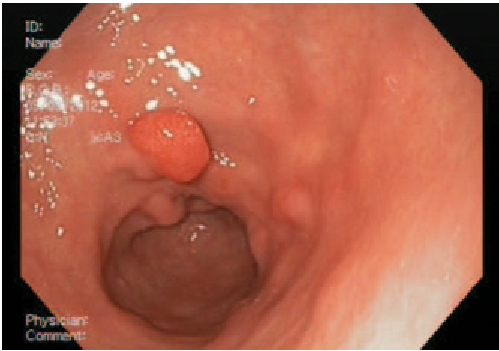
Harartomas
- Hamartomas, Inflammatory, Heterotropic Polyps
- Negligible malignant potential
- Association with familial polyposis syndromes
- Associated with increased risk of Gastric ca.
- Peutz-Jeghers syndrome
- Juvenile polyposis
- Cowden’s syndrome
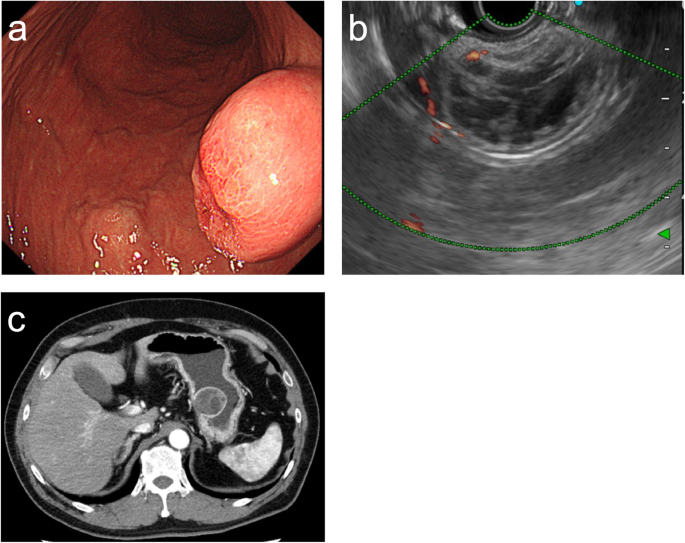
Adenomas
- Typically occur in the presence of Chronic Atrophic Gastritis
- Can be flat or polypoid
- Usually < 2cm
- Usually solitary
- Usually antral, sessile, solitary, eroded
- Associated with Adenocarcinoma
- Malignant potential 10%-20%
- Classification:
- Intestinal type
- Patients > 50yrs
- M > F 3:1
- Precursors to gastric adenocarcinoma
- Increased risk with size
- 50% adenoma > 2cm harbour adenocarcinoma
- Non-intestinal type
- Rare
- Intestinal type
Management
- Excise if
- Symptomatic
-
1cm
- Adenomatous
- If > 2cm, should biopsy polyp to exclude malignancy
- May need gastrectomy
- Follow-up scope needed post-removal of adenomatous polyps