- Types of rings
- A - normal smooth muscle contraction in the esophagus
- B - mucosal structure precisely at the squamocolumnar junction that is smooth and thin (≤5 mm in axial length). Owing to its location, a B ring is covered with squamous mucosa proximally and columnar epithelium distally
- Esophageal rings are usually mucosal but in rare cases may be muscular due to hypertrophy of an A ring.
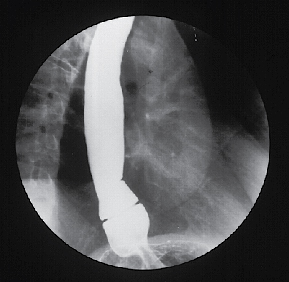
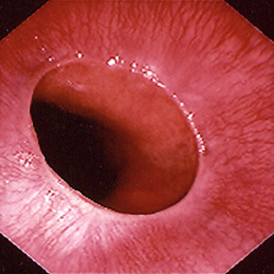
- Schatzki ring, the most common type of esophageal ring, is a narrow mucosal B ring that is less than 12.5 mm in diameter
- Aetiology
- Hiatus hernia
- Schatzki rings are almost always associated with a hiatal hernia. In a study of 167 patients with a Schatzki ring, a hiatal hernia was detected in 97 percent
- Lies precisely at squamocolumnar mucosal GEJ
- Does not have a component of true oesophageal muscle
- Aetiology not understood
- ? Persistent apposition of two mucosal layers & fibrosis of submucosa.
- Almost always accompanied by a small hiatal hernia -? fibrosed proximal margin of sliding HH.
- Schatzki rings are almost always associated with a hiatal hernia. In a study of 167 patients with a Schatzki ring, a hiatal hernia was detected in 97 percent
- Eosinophilic oesophagitis
- Schatzki rings have also been associated with eosinophilic esophagitis
- However, more often patients with eosinophilic esophagitis have multiple proximal esophageal rings, long strictured segments, linear furrows in the mucosa, and eosinophilic abscesses that appear as white papules.
- Hiatus hernia
- Symptoms
- Often asymptomatic
- Episodic dysphagia (often large pieces of meat causing complete obstruction).
- Often spontaneously passes after a few minutes
- Investigations
- Barium swallow +/- endoscopy.
- Endoscopy
- Biospy ? eosinophilic esophagitis.
- Dilation in patients with eosinophilic esophagitis is usually reserved for patients with rings who have not responded to medical therapy.
- Biospy ? eosinophilic esophagitis.
- Management
- Endoscopic
- Dilation - Large caliber bougie (≥50 French) or balloon dilator (18 to 20 mm)
- Endoscopic
 Esophageal (Schatzki) ring seen on barium swallow