- Origin: Upper end of the Cisterna Chyli (at level of T12)
- Between the Aorta and Azygos Vein
- Course:
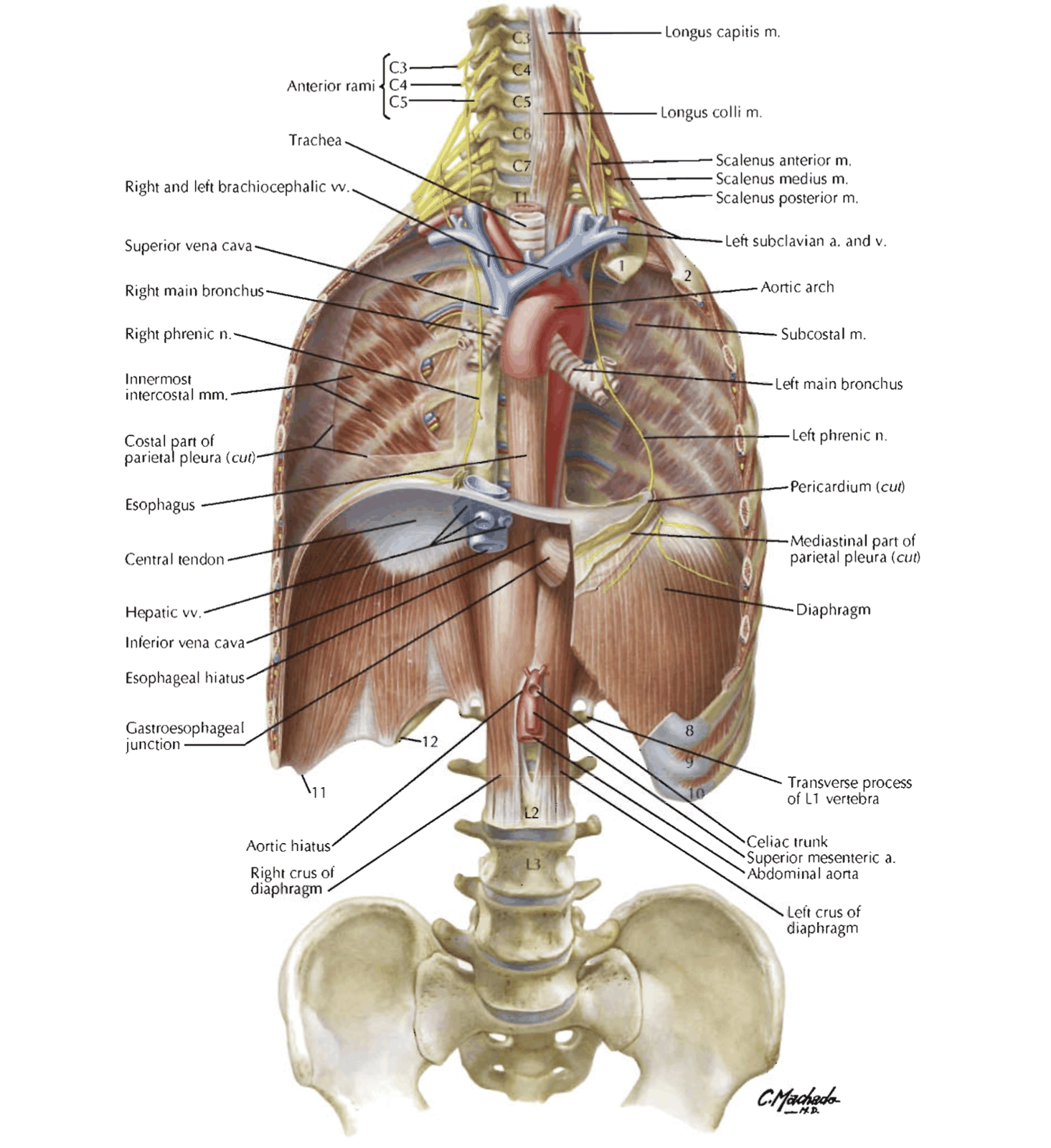
- Passes upwards, with these structures, between the Crura of the diaphragm
- Lies against the right side of the Oesophagus
- Crosses to the left at level of T5 passing behind the Oesophagus
- Termination: Point of confluence of the Left Internal Jugular Vein and Left Subclavian Vein
- NB: Thoracic Duct lies anterior to the Phrenic Nerve in the neck
- NB: Thoracic Duct arches laterally at its termination and lies posterior to the Vagus Nerve
- NB: Alternative Language: Thoracic Duct arches forwards lateral to the Vagus but Medial to the Phrenic Nerve in the neck
- Thoracic duct has several valves
- NB: Does not contain a valve at its termination
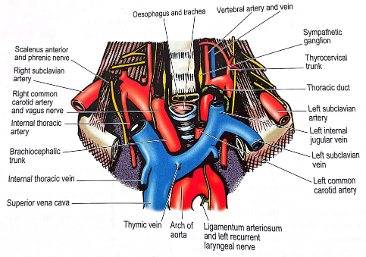
- NB: Does not contain a valve at its termination
Thoracic Duct Relations
- In superior mediastinum
- It lies to the left of the oesophagus in a more posterior plane
- As it ascends in thorax, it lies anterior to the right aortic Intercostal arteries and terminal parts of the Hemiazygos and Accessory Hemiazygos veins
- Lies posterior to Arch of the Aorta and the Left Subclavian Artery
- At root of neck:
- It arches forwards and to the left behind the Carotid Sheath and its contents
- Crosses over the dome of the pleura and the Left Subclavian Artery
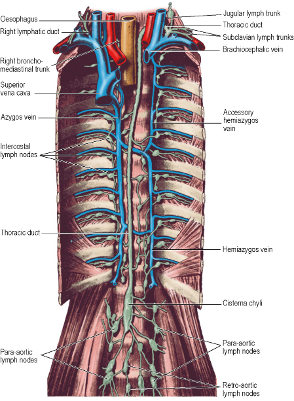
Thoracic Duct Lymph Sources - Lower half of the body - Posterior Mediastinal and Left Intercostal Nodes - Left Bronchomediastinal Trunk - Left Jugular and Subclavian Lymph Trunks Thus, drains lymph from all of the body EXCEPT the right upper limb and the right halves of the thorax, head and neck
Right Lymphatic Duct
- Drains the Right Intercostal Nodes and the Right Bronchomediastinal Trunk
- May receive the Right Jugular and Subclavian Lymph Trunks and terminate at the commencement of the Right Brachiocephalic Vein OR They may remain separate and open independently in the Jugulo-Subclavian junction
Abdominal Organ Lymphatics Overview
Lymphatic Drainage of Abdominal Organs Stomach
- All lymph eventually reach Coeliac Nodes after passing through various groups
Duodenum
- Drain via channels accompanying the Superior and Inferior Pancreaticoduodenal vessels to Coeliac and Superior Mesenteric Lymph Nodes
Jejunum and Ileum
- Drain via Mural and Intermediate Nodes in the mesentery to the Superior Mesenteric Nodes
Caecum and Appendix
- Drain to nodes associated with the Ileocolic Artery
Ascending, Transverse, Descending and Sigmoid Colon
- Drain to Superior or Inferior Mesenteric Nodes
Rectum
- Drainage is mainly upwards
- Lymphoid Follicles ⇒ Epicolic Nodes on the Rectal Surface ⇒ Pararectal nodes in the Mesorectum ⇒ Nodes along the Inferior Mesenteric Artery to Pre-Aortic Nodes
- Drainage from the lower Rectum to Internal Iliac Nodes along the Middle Rectal and Inferior Rectal Arteries
- Drainage along the Median Sacral Artery to Nodes in the hollow of the sacrum
- This drainage is minimal and unlikely to be a route of metastatic spread of cancer that has not breached the Mesorectal Fascia
Anal Canal
- Upper Canal ⇒ Join lymphatics of Rectum (as above)
- Lower Canal ⇒ Superficial Inguinal Nodes
Liver
- Drain into 3 or 4 nodes that lie in the Porta Hepatis (Hepatic Nodes)
- Hepatic Nodes also receive lymphatics from the Gallbladder
- Hepatic Nodes drain downwards alongside the Hepatic Artery to Pyloric Nodes as well as directly to Coeliac Nodes
- Lymphatics from the bare area of the liver communicate with extra-peritoneal lymphatics which perforate the diaphragm and drain to nodes in the Posterior Mediastinum
- Similar communications exist along the left triangular and falciform ligaments from the adjacent liver surfaces
Pancreas
- Lymphatics to the left of the neck drain to Pancreaticosplenic Nodes which accompany the Splenic Artery
- Lymphatics from the head drain from its upper part to the Coeliac group and from its lower part and Uncinate process into the Superior Mesenteric group of Preaortic Lymph Nodes
Spleen
- Drain to Pancreaticosplenic Nodes which then drain to Coeliac Nodes
Kidneys
- Drain to Para-aortic Nodes at the level of origin of the Renal Arteries (L2)
Adrenal Glands
- Drain to Para-aortic Nodes
Flow of Lymphatics from Organs to Cisterna Chyli
- Lymph vessels pass from follicles through the muscle wall to nearby nodes
- Nearby nodes also receive lymph from minute nodules on serosal surface
- Small and large intestines have a common pattern of 3 groups of nodes
- First group: Lie in peritoneum adjacent to margin of the gut
- i.e. Mural Nodes in the mesentery of the small intestine
- i.e. Paracolic Nodes of the large intestine
- Second group: Lie along the main blood vessels of supply
- a.k.a. Intermediate Nodes
- Third group: Lie at the origins of the Coeliac and Superior and Inferior Mesenteric Arteries
- a.k.a. Pre-aortic Nodes
- First group: Lie in peritoneum adjacent to margin of the gut
- Epicolic Nodes: Additional nodes on the external surface of the large intestinal wall (and occasionally within appendices epiploicae)