Tailored to each individual patient
- Tumour features / receptor status
- What surgery they have had
- Co-morbidities / age / Pt Preferences
- Nodal metastases is usually an indication for systemic therapy
- Different methods of sequencing chemo and radiotherapy do not appear to have major effect on survival/recurrence as long as both are commenced within 7mths (Cochrane 2006)
- Some data suggest that RT should be given after chemo
Radiotherapy
- Causes DNA damage which is repaired more slowly in tumour cells and therefore accumulates to cause cell death
Contraindications
- Previous radiotherapy
- Pregnancy
- Severe heart or lung disease
- Non-compliant patient
- Needs to be able to lie flat – dementia, orthopnoea etc.
- Active / Steroid-dependant connective tissue / collagen vascular disease
- e.g. Scleroderma, SLE
Side Effects
- Early
- Erythema/sunburn
- Oedema (local or arm oedema)
- Soft tissue necrosis
- Decreased arm mobility
- Late
- Skin – telangiectasia, pigmentation, fibrosis
- Shoulder stiffness
- Arm oedema
- Organs in close proximity
- Pneumonitis, oesophagitis, radionecrosis of ribs/bones, brachial plexopathy, radiation related heart disease, vasculitis, induced cancers
- Systemic
- Fatigue
Adjuvant After BCS
- Whole breast Radiotherapy
- Given to all patients after BCS
- Even if cPR after neoadjuvent therapy
- Regional nodal radiotherapy
- Can be consider in N2+ or high risk N1
- Includes treatment to supraclavicular, infraclavicular and internal mammary nodes
- Goal:
- To eradicate residual microscopic disease at site of primary tumour
- Treat other foci of invasive or in-situ Ca elsewhere in the residual breast tissue
- Confers survival & recurrence equivalent to Mastectomy
- Decreases local recurrence from 30% → 5% at 5yrs
- 35% to 8% for Locally Advanced Breast Ca
- Increases survival by 5% at 15yrs
Adjuvant After Mastectomy
- Post mastectomy radiotherapy (PMRT)
- Given if high chance of local recurrence
- After neoadjuvent therapy in:
- Stage III on presentation
- Incomplete pathological response
- After neoadjuvent therapy in:
- RT given to chest wall and to regional nodes
- Given if high chance of local recurrence
- Regional nodal radiotherapy
- After ALND
- Indicated in patients with positive LN N1+
- After SLNB
- To avoid ALND in patients with 1-2 positive LN (AMAROS trial)
- After ALND
Method:
- 3 field technique, minimized complications (affects skin, muscle, ribs, lung)
- Conventional versus hypofractionated schedules
- Conventional
- 50Gy = 5 x 2Gy (20mins) daily sessions for ≈ 5/52 = Standard Rx
- Hypofractionated schedules
- Equivalent tumor control and fewer toxicities, and is now preferred for many patients.
- 40Gy in 15 fractions - 3weeks
- Conventional
- Can include boost to chest wall if high risk
Other uses
- Axillary Irradiation
- Indications
- Surgical / pathological evidence of residual disease post-ALND
- Has not had axillary dissection (e.g. in elderly / if refused / after sampling) & LN Mets present
- ≥ 4 LN mets (extracapsular spread in itself NOT an indication)
- ? also survival benefit for T3/T4 tumours with +ve LN
- Indications
- Decreases local recurrence from 18 → 3%
- Complications:
- Increases arm swelling
- 20-40% surgery + RT
- 5-15% surgery alone
- Increases arm swelling
Radiation to Other Nodes
- Supraclavicular Nodes
- Indications:
- Apical LN +ve
- ≥ 4 +ve LN
- ± Breast Ca located in upper part of breast
- ? May be considered if 1-3LN +ve
- Indications:
- Internal Mammary Nodes
- Controversial because isolated internal mammary recurrence is rare; No RCTs
- ? may have a role in medial tumours with +ve axilla
Palliative Radiation Therapy
- Chest wall or axilla for local control
- If surgery not feasible
- Any site for local control if non-operative candidate
- Bony mets
- Short course 8 Gy in 1 fraction
- 70% chance of improved symptoms (i.e. decreased pain)
- Short course 8 Gy in 1 fraction
- Isolated metastases
- Bony mets
Adjuvant Chemotherapy
NPI and Tumours that will respond
-
Nottingham Prognostic Index (NPI) helps decide
-
Three elements make up final score (1+2+(0.2x3))
- Tumour size, lymph nodes stage, histological grade
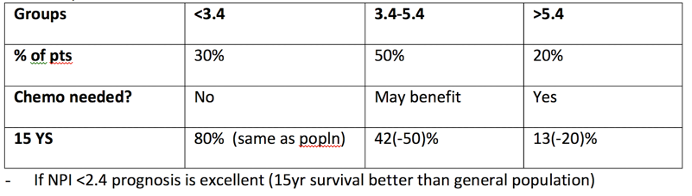
- Tumour size, lymph nodes stage, histological grade
-
Small, poorly differentiated, triple negative tumours most likely to respond to chemo
-
Node +ve disease gets highest benefit
-
If pt ER +ve then less benefit from chemo (esp. older pts)
-
ER -ve pts tumours tend to be more chemo sensitive, even in elderly pts
Indications for Adjuvant Chemotherapy
- NCCN 2024 guidlines summary
- Hormone receptor positive
- T1-T3, N0-N1
- Suggest Oncotype DX
- Low risk - endocrine therapy alone
- High risk - Chemotherapy + endocrine therapy
- N2-N3
- Endocrine therapy + chemotherapy
- In premenopausal women consider ovarian suppression
- T1-T3, N0-N1
- HER2 positive
- Adjuvant chemotherapy + Trastuzumab + endocrine therapy
- Triple negative
- Chemotherapy
- Hormone receptor positive
NCCN 2024 guidlines
- Hormone receptor positive
- HER2 negative (luminal A/B)
- Premenopausal T1-T3
- N0-N1
- Suggest Oncotype DX
- Low risk - endocrine therapy only
- High risk - Chemotherapy + endocrine therapy +/- ovarian suppression
- Suggest Oncotype DX
- N2/3 - Chemotherapy + endocrine therapy +/- ovarian suppression
- N0-N1
- Postmenopausal
- <0.5cm, N0 - endocrine therapy only
-
0.5cm or N1 - Oncotype DX
- Low risk - endocrine therapy only
- High risk - endocrine therapy + chemotherapy
- N2/N3 - endocrine therapy + chemotherapy
- Premenopausal T1-T3
- HER2 negative (luminal A/B)
- HER2 positive
- HER2 positive, hormone receptor positive
- Node positive
- Adjuvant chemotherapy + Trastuzumab + endocrine therapy
- Node negative
- <1cm - endocrine therapy alone vs all three
-
1cm - All three
- Node positive
- HER2 positive, hormone receptor negative
- Chemotherapy + Trastuzumab +/ Pertuzumab
- HER2 positive, hormone receptor positive
- Triple negative
- Chemotherapy (unless <0.5cm)
Chemotherapy Regime
- AC
- (Doxorubicin or Epirubicin) and Cyclophosphamide
- 4 cycles of 3-week duration (total 12 weeks)
- 3 months chemo, 3 weeks radiotherapy
- (Doxorubicin or Epirubicin) and Cyclophosphamide
- Addition of Taxane (Paclitaxel- weekly)
- NZGG suggests considering in all that you would give chemotherapy
- NB: Increased rate of febrile neutropenia
- NZGG suggests considering in all that you would give chemotherapy
- Highest benefit in
- Node +ve, ER-ve, HER2 +ve patients
- AC for 12 weeks then paclitaxel for 12 weeks (6/12 total)
Side Effects
- Anthracycline
- Myocardial damage and CHF
- Higher doses can cause Acute Myeloid Leukaemia/Myelodysplasia
- Taxane (Paclitaxel)
- Neuropathy
- Alkylating agents (Cyclophosphamide, Methotrexate, Cisplatin)
- Nausea & vomiting
- Alopecia
- Myelosuppression
- Anti-metabolites (5-FU)
- Hand-foot syndrome
- Chemo → only 50% menstruating at the end of Rx
- Only ≈ 20% maintain fertility
Endocrine Therapy
Indication
- Offered to all patients with ER/PR positive tumours >0.5mm in size
Treatment choice
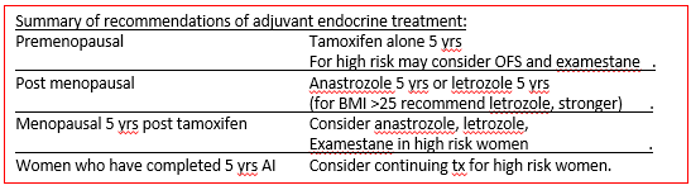
- Pre-menopausal
- Tamoxifen
- Aromatase inhibitors contraindicated
- If giving ovarian suppression therapy (typically offered in high risk patients receiving chemotherapy) then an AIs is a better option
- Post-menopausal
Receptors
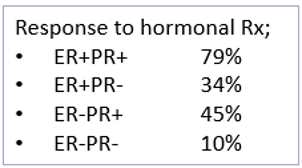
- Oestrogen receptor activation leads to induction of numerous genes – incl. Progesterone receptor
- Therefore PR positivity = Indicator of presence of functional ER
- Hence ER –ve but PR +ve display intermediate responsiveness to hormonal Rx
- Receptor measures done with IHC
-
10% stain = positive
- 60% ER or PR +ve
- Older more likely to be +ve
- Male almost always +ve
-
Tamoxifen
- Method of action ⇒ Selective Oestrogen Receptor Modulator (SERM)
- Competitive antagonist of ER receptor in breast
- Agonist on Endometrium, Bone and Lipids
Indications:
- Mainly used in pre-menopausal women
- Can be used in post-menopausal pts but Aromatase inhibitors usually better
- ER/PR +ve pts (± may benefit pts of unknown ER status) if Ca > 1cm
- OR > 0.5cm with unfavourable features – e.g. Poorly diff, LVI, Grade 3)
- NB: If pt is HER2 +ve & ER +ve → Tamoxifen may be ineffective, Aromatase inhibitor probably better
Dose
- 20mg Daily for 5-10 years
Duration
- Minimum of 5 years
- Can be extended to 10 years - balance of risk of recurrence and side effects
Timing
- Start after chemo/radiotherapy
- Anti-proliferative effects of Tamoxifen seem to make chemo slightly less effective
- No data re: radiotherapy sequencing
Efficacy
- EBCTG 1998 – Treatment 5 years
- Decrease risk of contralateral breast cancer by 40-50%
- EBCTG 2000 / Cochrane 2001:
- Decreased likelihood of recurrence by 15% (45 → 33%) at 15yrs (i.e. 41% RR↓)
- ↓ RR risk of mets by 15% in ER/PR +ve patients
- Absolute mortality reduction = 10% (<35yrs→26%) @ 15yrs (i.e. 34% RR↓), irrespective of age, menopausal status or chemotherapy
- In addition to chemo RR of recurrence = 10%
- N+ 11% absolute decreased mortality, N -ve 5% absolute decreased mortality
- Decreased likelihood of recurrence by 15% (45 → 33%) at 15yrs (i.e. 41% RR↓)
- Adding chemo to Tamoxifen is esp. beneficial in younger women
Other Benefits
- Prevents bone demineralization
- Beneficial effect on cardiovascular morbidity (lowers cholesterol)
Tamoxifen Side Effects
- Common: Hot flushes, irregular periods, vaginal dryness, fluid retention, weight gain
- Rare: Headache, dizziness, fatigue, nausea, rash, depression
- Other: Interacts with warfarin (enhances warfarin); hypercalcemia
Risks:
- Due to its partial oestrogenic effect
- DVT (same as COC or HRT: 1→2:1000; RR 3)
- Endometrial Ca (<1/100 over ten years): RR 2.5; usually stage 1, good prognosis
- Combined these two risks have a 10 yr mortality risk of 0.2%
- CF 30% reduction in breast cancer mortality
- Contraindicated if pregnant or breast feeding (or for 2 months after stopping Tamoxifen)
- Interacts with SSRIs (Paroxetine)
Aromatase inhibitors
- Non-steroidal - Arimidex (Anastrozole) 1mg Daily
- Non-steroidal - Femara (Letrozole) 2.5mg Daily - stronger than Anastrozole
- Steroidal - Exemestane (Vorozole)
Action
- Inactivate Aromatase enzyme
- Aromatase converts adrenal steroids (Androstenedione) to Oestrogens (Estrone) in Fat cells
- Net effect of AI’s is to suppress extra-gonadal production of oestrogen (in fat, liver, muscle)
- Contraindicated in pre-menopausal women
Unclear length of optimal therapy; currently up to 5yrs
- MA17 trial, ABCSG-6a and NSABP-B33 have all shown reduction in recurrence and prolonged survival benefit with 5 years of aromatase inhibitors following 5 yrs tamoxifen (total 10yrs endocrine treatment)
- Probably on-going benefit for up to 10 years and maybe even longer
Especially good if:
- ER +ve & PR -ve → Risk of a 2nd Breast Ca decreases by 40%
- Better than Tamoxifen, therefore, can be started instead of Tamoxifen in this group
- AIs show a survival benefit over other endocrine therapy in treatment of Advanced (metastatic) Breast Ca
- AIs + Herceptin in women with HER-2 +ve Advanced Breast CA → improved DFS, cf AIs alone (Austr Nat Br CA Guidelines 2008)
Aromatase Inhibitor Side Effects
- Reduces bone density (DEXA bone density at baseline)
- T score ≤ -2.5 → Start exercise & Bisphosphonate
- Ensure adequate levels of calcium and vit D
- T score ≤ -2.5 → Start exercise & Bisphosphonate
- Arthralgia / progression of underlying arthritis (irreversible)
- Cardiac events and hypercholesterolemia
- ? Deranged LFTs
Advantages over Tamoxifen:
- Less DVT risk
- Less hot flushes / vaginal sx (but more sexual dysfunction)
- Vaginal dryness should not be treated with oestrogen creams
- Can cause significant increases in systemic oestradiol
Ovarian suppression
- Only need to consider in pre-menopausal women
- Consider if High risk with ER/PR +ve tumours
- Definition of high risk usually if would get chemo
- – E.g. node positive, large size, high risk genomic analysis, < 35 etc
- < 50yrs: ↓s annual risk of death by 24% (EBCTG 1996)
- Definition of high risk usually if would get chemo
Two options
- Functional
- Ovarian Function Suppression usually given with an Aromatase inhibitors rather than Tamoxifen
- If low risk stick to Tamoxifen alone without Ovarian Function Suppression
- Ovarian Function Suppression usually given with an Aromatase inhibitors rather than Tamoxifen
- Ovarian Ablation (Bilateral Oophorectomy)
- Risks: cardiovascular morbidity and osteoporosis
- Methods: Surgical (lap or open)
Ovarian Function Suppression
- GnRH Analogues (LHRH Agonists)
- Suppress the production of oestrogen (chemical ovarian ablation)
- Stimulates production of oestrogen/testosterone in a non-pulsatile manner
- Disruption of feedback system resulting in overall down regulation of testosterone and oestrogen
- NB: Initial increase in production but after ~ 14-21 days there is a significant reduction in LH release
- Sex hormones are reduced to castrate levels
- Options
- Goserelin (Brand name - Zoladex)
- Leuprolide or Leuprorelin (Brand name - Prostop, Lutate)
- Triptorelin
Zoladex (Goserelin)
- Dose: 3.6mg S/C Monthly
Side Effects
- Amenorrhoea, nausea, headache
- Fully reversible
- Trials
- SOFT Trial
- Randomised to Tamoxifen alone, Tamoxifen + OFS or Exemestane + OFS
- TEXT trail
- Randomised to Tamoxifen + OFS or Exemestane + OFS
- Joint evaluation SOFT-TEXT
- In patients with a high risk of relapse gained benefit
- More pronounced in younger women
- Exemestane + OFS improved OS compared with Tamoxifen + OFS
- SOFT Trial
Trastuzumab
- Recombinant humanised monoclonal antibody specific to the human HER2 receptor
- Significant improved survival benefit in Metastatic Breast Ca
Mechanism:
- HER-2 growth factor receptor = Glycoprotein – plays critical role in tumour development
- Overexpressed in 15-20% of Breast Ca
- Independent marker of poor survival
- Tend to be high grade, high rate of nodal metastases, resistant to chemo & endocrine therapy
- Resulting in ↓ cell proliferation & formation of angiogenesis factors
- ↑s immune system recognition of the Ca cells → ↑ destruction of tumour cells via Ab-dependant cellular cytotoxicity
- Prevents formation of ‘p95’ (a cleaved form of HER-2 that ↑s cell signalling)
- Amplification measured by immunohistochemistry – score 1-3.
- If HER 2 score = 1 – negative – no Herceptin
- If HER 2 score = 2 – equivocal – do FISH to directly detect quantity of HER-2 gene copies on chromosome 17 (2 = normal)
- If +ve on FISH – Herceptin
- If HER 2 score = 3 – positive – Herceptin
- In NZ funded for 12-month course for Early and Advanced (Metastatic); must be 3+
- Give concurrently with chemotherapy
Adverse Effects
- Cardiomyopathy 1% with Herceptin alone, 2-3% when combined with anthracycline based chemo
- Do 3 monthly echocardiogram; consider stopping if LVEF ↓s by 10-15%
- Avoid combo with AC chemo if any pre-existing cardiac dysfunction (use Taxane instead)
Herceptin Indications
- Neoadjuvant
- Rx for HER-2 +ve T2+ or N1+
- Offered with pre-op chemo Adjuvant
- Rx for HER-2 +ve early breast
-
1cm +/- LN +ve
- No trials in node negative Ca < 1cm
-
- Considered in 0.6-1.0cm tumours which are poorly differentiated or unfavourable - e.g. LVI, Grade III
- Role as single agent (cf with chemo) not yet evaluated in RCTs
- Optimal duration uncertain – currently given for 12/12
- HERA study, NCCTG N9831& NSABP-B31 Trials:
- ↓LR / ↑DFS: after 12/12 (to 3yrs): 9-12% difference (86 vs. 77%)
- ↑OS at 2-4yrs: ≈ 4% difference (33% RR) (91 vs. 87%)
- 9 weeks
- FINHer Trial: v small numbers
- ↑DFS @ 3yrs by 11% (89 vs. 78%)
- HERA study, NCCTG N9831& NSABP-B31 Trials:
Palliative
- Rx – for HER-2 +ve mets
- Herceptin + Paclitaxel – first line
- Can be used as single agent Rx if other systemic therapy is inappropriate
- Continue until evidence of disease progression, in the absence of unacceptable toxicity
Bisphosphonates
- Zoledronic acid 4mg IV 6 monthly for 3-5 years
- Or oral clodronate 1600mg daily for 2-3 years
Mechanism of action
- Inhibits Osteoclastic Bone Resorption
- Prevent treatment induced osteoporosis, helps with bony pain
- Inhibits development of bony metastases
Adjuvant Effect (Anti-cancer benefits are small)
- May directly affect tumour cells via apoptosis and inhibiting tumour cell growth
- Small disease-free survival advantages seen in post-menopausal women
Indications:
- Osteoporosis (T-score ≤ -2.5) or history of fragility fracture
- Post-Menopausal women receiving adjuvant systemic therapy (with mod-to-high risk distant recurrence), regardless of bone-density, to reduce risk of recurrence
Side Effects
- Hypocalcaemia, renal toxicity, GI upset
- Rarely: Osteonecrosis of the Jaw (0.7%)