Section: Breast Curriculum: Curriculum, page 13
Definition
- Early stage breast cancer is operable breast cancer which typically initially undergoes upfront definitive surgery
- Typically T-T2 and N0-N1
- The NCCN 2024 guidelines include T3 in this group
Surgery - breast cancer
General Points
- Prophylactic Abx at induction
- DVT prophylaxis
- Mastectomy versus BCS + RT
- Overall survival and disease specific survival is equivalent
- Local recurrence rate equivalent
Breast Conserving Surgery (WLE + Radiotx)
Indications
- Indicated in a patient with resectable breast cancer and who will achieve good cosmetic outcome
Contraindications
- Oncolgical contraindications
- No appropriate reconstructive option
- Inflammatory Breast cancer
- Diffuse malignant microcalcifications on mammography
- Radiotherapy contraindications
- Pregnancy
- Prev Radiotherapy
- Connective tissue disorder
- Patient preference for mastectomy
- Carful consideration in patients with strong family of breast Ca / BRCA 1 or BRCA 2 carriers
Technique
- Margin
- Invasive - “No ink on tumour”
- DCIS - 2mm
- Orientate specimen ± X-ray
Mastectomy
Indications
- See Contraindications to WLE + Radiotx
+/- Reconstruction
- Delayed reconstruction if poor prognosis / high risk of radiotherapy
- Don’t delay adjuvant therapy by ↑ risk of wound complications
- Risk factors for recurrence: Axillary involvement, LVI, Grade 3, > 4cm
Neoadjuvant Therapy in Breast Cancer
Indications
As per the 2024 NCCN guidlines
- Early breast cancer
- T2+ or N1+ and HER2+/Triple negative
- Large primary tumor relative to breast size in a patient who desires breast conservation
- cN+ disease likely to become cN0 with preoperative systemic therapy
- Avoid ALND if SNB clear
- Locally Advanced breast cancer
- Patients with inoperable breast cancer
- Bulky or matted cN2 axillary nodes
- cN3 nodes
- cT4 tumors (note T3 included in early)
- Inflammatory breast cancer
- Patients with inoperable breast cancer
- Temporary Contraindications to Surgery
- Breast cancer during pregnancy
- In patients that surgery needs to be delayed
Neoadjuvant Chemotherapy
Benefits
- Downstage
- Facilitates breast conservation
- Can render inoperable tumors operable
- Prognostic information
- Allows for complete pathological response
- In patients with residual disease second line chemotherapy can be used
- Time
- Allows time for genetic testing
- Allows time to plan breast reconstruction in patients electing mastectomy
- Allows time for delayed decision-making for definitive surgery
Pre-treatment evaluation
- Tumor
- Clip
- Axilla
- Clip positive node
Post-treatment evaluation
- Re-examine
- Re-stage
- Surgery + SLNB vs TAD vs ALND - see management of axilla
Neoadjuvant Options
Hormone recetor postive, HER2 negative
- Less likely to respond to chemotherapy
- Can shrink cancers but less likely to have cPR especially in luminal A
- Chemotherapy vs endocrine therapy
- Less side effects in endocrine therapy
- Time to response slower in endocrine therapy
- Complete pathological response less likely with endocrine therapy
- Regime selection
- Pre menopausal → Chemotherapy
- Post menopausal
- Chemotherapy indicated in medically fit patients
- In patients who are medically unfit for chemotherapy then endocrine therapy is an option
- Chemotherapy
- Extrapolated from adjuvent setting
- AC - Anthracycline (Doxorubicin) and Cyclophosphamide followed or proceed by Paclitaxel
- Extrapolated from adjuvent setting
- Endocrine therapy
- Typically given in postmenopausal women only
- Aromatase inhibitors suggested over Tamoxifen
- AIs associated with a higher response rate
- Aromatase inhibitors suggested over Tamoxifen
- Typically given in postmenopausal women only
HER2 Positive
- Combination of chemotherapy and Trastuzumab
- Anthracycline based
- AC - Doxorubicin and Cyclophosphamide followed or proceed by Paclitaxel + Trastuzumab
- Anthracycline-free
- Pertuzumab is an option that can be added in conjuction with Trastuzumab
- ??funded for neoadjuent treatment in NZ - def funded in metastatic disease
Triple negative
-
- Anthracycline based
- Significant body of evidence suggesting efficacy
- AC - Doxorubicin and Cyclophosphamide + Taxane (Paclitaxel)
- Anthracycline based
- Pembrolizumab
- In stage II/III disease
- Also continue adjuvently
- In stage II/III disease
Management of the Axilla
Axilla – General Points
- 95% of breast lymph drained by axilla
- 50% symptomatic patients and 10-20% screened cancers are node positive
- Axillary LN status one of the most important prognostic actors in Breast Ca
- Average of 20 nodes

Axilla – Pre-op Evaluation
- Palpable node
- Proceed to USS guided FNA, then core biopsy if negative
- If decline biopsy → ALND
- Abnormal node on imaging
- Pre-op USS is effective way to screen axillary LNs
- Sensitivity 50%
- If NAD → SLNB
- If Abnormal node → FNA/Core →
- If +ve FNA →
- Either
- Neoadjuvent treatment
- ALND if undergoing primary surgery
- if luminal A/B → ?overtreatment, role of neoadjv?
- Either
- If -ve FNA → SNB
- If +ve FNA →
- Pre-op USS is effective way to screen axillary LNs
Sentinel Lymph Node Biopsy
Indications
- All patients with clinically negative nodes
- DCIS if mastectomy performed
- Or consider if suspicious features
Advantages
- Axillary dissection does not improve survival but provides local control and staging
- Adequate staging can be gained with SLNB
- Adequate local control can often be gained avoiding ALND with radiotherapy
- Decreased lymphoedema, pain, numbness, movement restriction
- Intra-op assessment can be done by frozen section → False negative rate of up to 20%!
- Touch prep cytology has sens of 90%
- Equivalent staging to level II clearance, with less morbidity
- Predicts status of remaining axillary LNs in > 95% of pts
- False negative rate 5-10 %
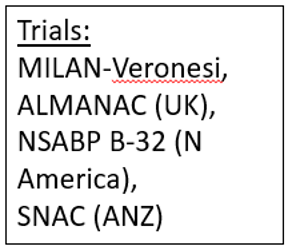
Five randomized clinical trials have been performed to evaluate the efficacy and safety of SLNB in early breast cancer patients
- The NSABP B32 trial (Krag et al., 2007)
- Compared ALND with SLND and only continue to ALND if positive node
- Showed that if a negative node you dont need a ALND
- Milan trial (Veronesi et al., 2006b)
- SNAC trial - Sentinel Node Biopsy versus Axillary Clearance (Gill, 2009)
- GIVOM trial (Zavagno et al., 2008)
- ALMANAC Trial - Axillary Lymphatic Mapping Against Nodal Axillary Clearance trial (Goyal et al., 2006)
SNB Technique
-
Technetium99 colloid
- t1/2 6hrs; injected on am of surgery, or on pm prior to am list
- SLN by radioisotope defined as containing ≥ 10 x background count
-
± 2-4 mL Patent Blue V dye after induction
- cf Methylene blue: faster & can lead to breast tissue necrosis
- Anaphylaxis 1:2000
- Intradermal / subareolar injections → Track to axilla in 15mins
- Peritumoral injection → Track to axilla ± internal mammary nodes
-
Combination of patent blue and radioactive colloid results in significantly higher success rates and lower false negative rates
- Compared to patent blue alone
-
Ideally get 1-3 LNs
- 1 x LN → Sensitivity 87%,
- 2 x LN → Sensitivity 97% (Sens 91% and False negative 4-10%)
- No advantage if > 3 LNs
-
In 4% (in SNAC trial) SLN not found → Axillary dissection required
-
False -ve ≈ 5%
- 8% in SNAC trial up to May 05
- ≈ 13% for tumours >3cm
- Axillary recurrence rate in SNB –ve 2.7%
- 8% in SNAC trial up to May 05
-
50% with +ve SNB have no other +ve nodes
Pathologic Analysis of Nodal Mets
- Subgroup based on size of largest contiguous tumour deposit in sentinel node (on H&E)
- Isolated Tumour Cells
- < 0.2mm tumour deposit in SLN
- pN0(i+)
- Prognostically = LN -ve pts
- Isolated Tumour cells give 5% risk of another node being +ve
- Micrometastases
- 0.2-2mm tumour deposit in SLN
- pN1mi
- Slightly worse prognosis vs. LN -ve pts
- Do not predict recurrence
- ACOSOG-20010 & European IBCSG 23-01 trials
- No survival benefit or recurrence benefit if axillary dissection done for Micrometastasis
- Micromets unlikely to have additional nodes involved
- 97.3% 5y survival and only 1.5% local recurrence
- Macrometastases
-
2mm tumour deposit in SLN
- Worse prognosis the greater the nodal involvement
-
- Extranodal Extension
- Invasive tumour cells or clusters outside of LN capsule
- Generally tumour present both subcapsular and adjacent extranodal fat
- More significant if extensive
- NB: ITCs in perinodal axillary channels are not classified as extranodal extension
- Occult Metastatic Disease
- Nodal disease not seen on H&E stain but picked up if doing IHC
- No significance in terms of surgical management and patient outcomes, still classed as pN0
- IHC not routinely performed
- Missed node
- Risk of a +ve (non-sentinel) node being missed is dependent on
- Size of micrometastases
- Extra-capsular spread
- ≈ 8-20% overall
- Risk of a +ve (non-sentinel) node being missed is dependent on
- Isolated Tumour Cells
SNB after Neoadjuvant Therapy
- Clinically node negative
- Negative - no further treatment
- Shows evidence of cPR - radiotherapy
- Postive - ALND
- Clinically node positive prior
- If remains positive
- ALND
- If clinically negative post treatment
- Target axillary dissection (TAD)
- ACOSOG Z1071
- Aim: to determine the false negative rate in SLN after neoadjuvent chemotherapy in patients with node positive disease
- Inclusion: T1-4, N1-2, M0
- SLNB alone
- False negative rate 12.6% (39 patients who had an ALND after negative SLNB)
- SLNB + clip removed in specimen
- False negative 6.8%
- Improved Axillary Evaluation Following Neoadjuvant Therapy for Patients With Node-Positive Breast Cancer Using Selective Evaluation of Clipped Nodes: Implementation of Targeted Axillary Dissection. Caudle AS et al
- Target axillary LND (TAD) has a false negative rate of 2% compared with SLNB FNR 10.1%
- Among patients shown to be N+ prior to preoperative systemic therapy, SLNB has a >10% false-negative rate when performed after preoperative systemic therapy, which can be improved by marking and removing the most suspicious biopsied node, using dual tracers, and by obtaining ≥3 sentinel nodes (targeted axillary lymph node dissection). (Caudle AS, et al. J Clin Oncol 2016;34:1072-1078.)
- ACOSOG Z1071
- If negative - radiotherapy
- If positive - ALND
- Residual cancer = Isolated Tumour Cells, Micromets, Macromets
- Target axillary dissection (TAD)
- If remains positive
- Uptodate authors recommend ALND in all patients with pretreatment N2-N3 independent of clinical response
Frozen Section During SNB
- Melanoma
- Sensitivity 50%, risk of positive LN = 20%
- Therefore 10% whom have frozen section will need ALND
- Breast
- Sensitivity 75%, Risk of positive LN = 40%
- Therefore – 30% whom have frozen section will need ALND
- Frozen section more useful in breast cancer than melanoma
- NB: False negative rate up to 20%
- Touch imprint cytology
- 30-100% sensitivity (poor for lobular)
- False-negative rates for intra-op assessment are up to 38%
- Path protocol:
- 2mm slices, H&E & CAM 5.2 stains: single slice thru each LN
Management after SNB
- No nodes positive, ITC, or occult mets → No ALND
- No diff in regional control, overall survival, or disease free survival
- Positive nodes
- 1-2 nodes
- Breast conserving surgery
- Z11 Eligible → Showed that patients with 1-2 LN did not need ALND
- Randomised to observation vs ALND
- Clinically negative nodes, T1 or T2, < 3 positive nodes on SNB
- Although in practice now criteria is expanding including from SENOMAC trial
- Undergoing breast conserving therapy followed by whole breast radiation
- Some patients had boost axilla radiation
- Similar LR, DFS and OS
- Z11 Eligible → Showed that patients with 1-2 LN did not need ALND
- Mastectomy
- AMAROS criteria → axillary radiotherapy
- T1-T2, unifocal, invasive breast cancer without palpable axillary lymphadenopathy
- After surgery randomised to radiotherapy (mastectomy = boost to axilla OR BSC = whole breast radiotherapy) or ALND
- Also included patients with mastectomy (and BCS) which showed axillary radiotherapy is a safe alternative to ALND
- Similar LR, DFS and OS
- Lower morbidity
- AMAROS criteria → axillary radiotherapy
- Breast conserving surgery
- 3+ nodes
- ALND
- 1-2 nodes
Next questions is can we admit radiotherapy - POSNOC trial
Axillary Lymph Node Dissection
- Rationale:
- Stages disease & dictates need for adjuvant treatment
- Provides local control of axilla - local recurrence < 1% (0.4%)
- Possible survival implications – unknown if ↑s survival
Indications
- Tumour larger than 5 cm
- Locally Advanced or Inflammatory Ca
- Clinically +ve Axilla
- +ve SNB (unless meets Z11 criteria)
Procedure
- Level II dissection is operation of choice
- Level III if macroscopic evidence of tumour at level II
- No improved DFS/OS after routine level III AD
- Up to 25% will have level III involvement if Level I involved
- Aim to remove 20 nodes for optimal staging
Complications
- Lymphoedema
- 15%
- Physical therapy, arm strengthening, and stretching; compression garments
- Limitations in postoperative shoulder and arm mobility
- Prolonged postoperative pain
- Cording
- Cording of the axilla and upper arm, is a self-limited, harmless condition
- Believed to be caused by thrombosis in subcutaneous veins and ligation of veins after axillary dissection
- Paraesthesia
- intercostal bracial nerve
- Upper inner arm
- intercostal bracial nerve
- Winged scapula - LTN
- Weakness of the arm with respect to extension, adduction and medial rotation - TDB/Lats
Management of Internal Mammary Nodes
- Identified on scintigraphy in 2-30%
- Isolated IMN in < 1% of cases
- SNB if identified by scintigraphy is considered optional (NCCN 2008)
- Diagnostic / staging rather than therapeutic role
- “Non-axillary SLN should be excised if they can be accessed & excised without ↑ed morbidity”
- No evidence for this statement
- No survival advantage
- 40% of medial tumours drain to internal mammary nodes
- But at least 50% drain to axilla as well
- Sampling IMNs may upstage 6-7% of pts
- But associated with high rate of complications
- 20-30% pneumothorax, haemothorax / effusion, bleeding problems, including potential thoracotomy
- May only change management in 3%
- But associated with high rate of complications
- Can irradiate – but again no survival advantage
- Summary → No proven benefit in removing IMN
Nodal Metastasis and the Occult Primary
-
1/300
-
70% with adenocarcinoma in the axilla will have breast cancer
-
Most seen on mammogram
-
MRI will detect 70% not seen on mammogram
-
Treatment is as per palpable axillary nodes in breast cancer
- If truly no identifiable breast cancer, you can discuss close observation of the breast
- Most women would feel more comfortable with mastectomy
- If truly no identifiable breast cancer, you can discuss close observation of the breast
-
Pathology/DDx
- Cat Scratch Fever – Bartonella – need to biopsy to diagnose
- Brucellosis – unsterilized milk or meat – blood culture or serology
- Other viral/ bacterial infection of the arm
- Lymphoma – fever, night sweats, >10% weight loss
- Melanoma
- Rheumatoid arthritis
-
Work-up
- Triple assessment, breast mammogram, USS of LN, FNA of LN
- If FNA is lymphoid → Flow cytometry of sample ± Core Bx
- If probable occult breast tumour → MRI
- If no answer - Excision Biopsy
- FRESH to lab
- Piece for micro (3-5mm) not in RPMI
- Piece for flow cytometry (at least 5mm) in RPMI
- Piece for cytogenetics (3-5mm) in RPMI
- Freeze some & process some in formalin for H&E staining
- FRESH to lab
- Flow cytometry can use immunohistochemistry (gives specific subtype of lymphoma & helps to narrow DDx for malignancies) – use the principle of antibodies binding to cellular antigens (CD20/CD3)
- Cytogenetics – Chromosomes, FISH
- CD4 & CD8 immunostains only work on frozen material
- Triple assessment, breast mammogram, USS of LN, FNA of LN
-
Management
- Where primary not found should have an axillary dissection, adjuvant systemic Rx and breast irradiated or kept under observation
Management of Axillary Recurrence
- Stage to detect metastatic disease
- Isolated/operable axillary mets
- Proceed to Level 3 clearance
- Isolated inoperable mets
- ? radiotherapy (if not previously had)
- And/or systemic treatment
Adjuvant Therapy for breast cancer
Tailored to each individual patient
- Tumour features / receptor status
- What surgery they have had
- Co-morbidities / age / Pt Preferences
- Nodal metastases is usually an indication for systemic therapy
- Different methods of sequencing chemo and radiotherapy do not appear to have major effect on survival/recurrence as long as both are commenced within 7mths (Cochrane 2006)
- Some data suggest that RT should be given after chemo
Radiotherapy
- Causes DNA damage which is repaired more slowly in tumour cells and therefore accumulates to cause cell death
Contraindications
- Previous radiotherapy
- Pregnancy
- Severe heart or lung disease
- Non-compliant patient
- Needs to be able to lie flat – dementia, orthopnoea etc.
- Active / Steroid-dependant connective tissue / collagen vascular disease
- e.g. Scleroderma, SLE
Side Effects
- Early
- Erythema/sunburn
- Oedema (local or arm oedema)
- Soft tissue necrosis
- Decreased arm mobility
- Late
- Skin – telangiectasia, pigmentation, fibrosis
- Shoulder stiffness
- Arm oedema
- Organs in close proximity
- Pneumonitis, oesophagitis, radionecrosis of ribs/bones, brachial plexopathy, radiation related heart disease, vasculitis, induced cancers
- Angiosarcoma
- Systemic
- Fatigue
Adjuvant After BCS
- Whole breast Radiotherapy
- Given to all patients after BCS
- Even if cPR after neoadjuvent therapy
- Tumour bed boost
- Given in higher risk patients
- Regional nodal radiotherapy
- Can be consider in N2+ or high risk N1
- Includes treatment to supraclavicular, infraclavicular and internal mammary nodes
- Goal:
- To eradicate residual microscopic disease at site of primary tumour
- Treat other foci of invasive or in-situ Ca elsewhere in the residual breast tissue
- Confers survival & recurrence equivalent to Mastectomy
- Decreases local recurrence from 30% → 5% at 5yrs
- 35% to 8% for Locally Advanced Breast Ca
- Increases survival by 5% at 15yrs
Adjuvant After Mastectomy
- Post mastectomy radiotherapy (PMRT)
- High risk features on presentation
- Stage III+
- Incomplete pathological response
- Positive margins
- High risk features on presentation
- Regional nodal radiotherapy
- Can be consider in N2+ or high risk N1 (TNBC, LVI, High grade)
- After SLNB
- To avoid ALND in patients with 1-2 positive LN (AMAROS trial)
Method:
- 3 field technique, minimized complications (affects skin, muscle, ribs, lung)
- Conventional versus hypofractionated schedules
- Conventional
- 50Gy = 5 x 2Gy (20mins) daily sessions for ≈ 5/52 = Standard Rx
- Hypofractionated schedules
- Equivalent tumor control and fewer toxicities, and is now preferred for many patients.
- 40Gy in 15 fractions - 3weeks
- Conventional
- Can include boost to chest wall if high risk
Radiation to Other Nodes
- Supraclavicular Nodes
- Indications:
- Apical LN +ve
- ≥ 4 +ve LN
- ± Breast Ca located in upper part of breast
- ? May be considered if 1-3LN +ve
- Indications:
- Internal Mammary Nodes
- Controversial because isolated internal mammary recurrence is rare; No RCTs
- ? may have a role in medial tumours with +ve axilla
Palliative Radiation Therapy
- Chest wall or axilla for local control
- If surgery not feasible
- Any site for local control if non-operative candidate
- Bony mets
- Short course 8 Gy in 1 fraction
- 70% chance of improved symptoms (i.e. decreased pain)
- Short course 8 Gy in 1 fraction
- Isolated metastases
- Bony mets
Adjuvant systemic therapy
NPI and Tumours that will respond
-
Nottingham Prognostic Index (NPI) helps decide
-
Three elements make up final score (1+2+(0.2x3))
- Tumour size, lymph nodes stage, histological grade
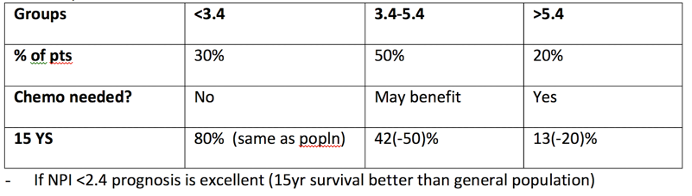
- Tumour size, lymph nodes stage, histological grade
-
Small, poorly differentiated, triple negative tumours most likely to respond to chemo
-
Node +ve disease gets highest benefit
-
If pt ER +ve then less benefit from chemo (esp. older pts)
-
ER -ve pts tumours tend to be more chemo sensitive, even in elderly pts
Indications for systemic therapy
For the exam
-
The discussion should be made on
- Patient wishes
- Tumour characteristics
- I use UK predict
- Size
- Grade
- Receptor status
- Ki-67
- Detected by screening, symptoms or unknown
- Number of positive nodes
- This gives me an idea of 5 and 10 year survival and the benefit from chemotherapy and endocrine
- I use UK predict
- I use OncoTypeDX if there is equivocal benefit to further guide treatment
-
I would discuss and prescribe endocrine therapy
-
Refer on for chemotherapy
-
NCCN 2024 guidlines summary
- Hormone receptor positive * Kate Rapson discusses with everyone *
- T1-T3, N0-N1
- Suggest Oncotype DX (could use NHS predict)
- Low risk - endocrine therapy alone
- High risk - Chemotherapy + endocrine therapy
- N2-N3
- Endocrine therapy + chemotherapy
- In premenopausal women consider ovarian suppression
- T1-T3, N0-N1
- HER2 positive
- Adjuvant chemotherapy + Trastuzumab +/- endocrine therapy
- Triple negative
- Chemotherapy
- Hormone receptor positive * Kate Rapson discusses with everyone *
NCCN 2024 guidlines
- Hormone receptor positive
- HER2 negative (luminal A/B)
- Premenopausal T1-T3
- N0-N1
- Suggest Oncotype DX
- Low risk - endocrine therapy only
- High risk - Chemotherapy + endocrine therapy +/- ovarian suppression
- Suggest Oncotype DX
- N2/3 - Chemotherapy + endocrine therapy +/- ovarian suppression
- N0-N1
- Postmenopausal
- <0.5cm, N0 - endocrine therapy only
-
0.5cm or N1 - Oncotype DX
- Low risk - endocrine therapy only
- High risk - endocrine therapy + chemotherapy
- N2/N3 - endocrine therapy + chemotherapy
- Premenopausal T1-T3
- HER2 negative (luminal A/B)
- HER2 positive
- HER2 positive, hormone receptor positive
- Node positive
- Adjuvant chemotherapy + Trastuzumab + endocrine therapy
- Node negative
- <1cm - endocrine therapy alone vs all three
-
1cm - All three
- Node positive
- HER2 positive, hormone receptor negative
- Chemotherapy + Trastuzumab +/ Pertuzumab
- HER2 positive, hormone receptor positive
- Triple negative
- Chemotherapy (unless <0.5cm)
Chemotherapy Regime
- AC
- (Doxorubicin or Epirubicin) and Cyclophosphamide
- 4 cycles of 3-week duration (total 12 weeks)
- 3 months chemo, 3 weeks radiotherapy
- (Doxorubicin or Epirubicin) and Cyclophosphamide
- Addition of Taxane (Paclitaxel- weekly)
- NZGG suggests considering in all that you would give chemotherapy
- NB: Increased rate of febrile neutropenia
- NZGG suggests considering in all that you would give chemotherapy
- Highest benefit in
- Node +ve, ER-ve, HER2 +ve patients
- AC for 12 weeks then paclitaxel for 12 weeks (6/12 total)
Side Effects
- Anthracycline
- Myocardial damage and CHF
- Higher doses can cause Acute Myeloid Leukaemia/Myelodysplasia
- Taxane (Paclitaxel)
- Neuropathy
- Alkylating agents (Cyclophosphamide, Methotrexate, Cisplatin)
- Nausea & vomiting
- Alopecia
- Myelosuppression
- Anti-metabolites (5-FU)
- Hand-foot syndrome
- Chemo → only 50% menstruating at the end of Rx
- Only ≈ 20% maintain fertility
Endocrine Therapy
Indication
- Offered to all patients with ER/PR positive tumours >0.5mm in size
Treatment choice
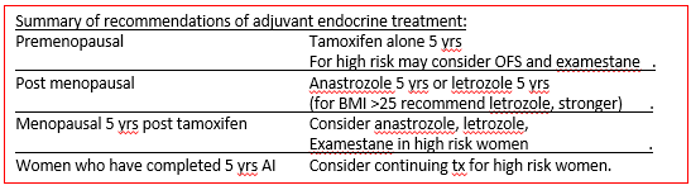
- Pre-menopausal
- Tamoxifen
- Aromatase inhibitors contraindicated
- If giving ovarian suppression therapy (typically offered in high risk patients receiving chemotherapy) then an AIs is a better option
- Post-menopausal
Receptors
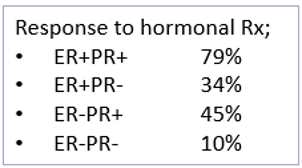
- Oestrogen receptor activation leads to induction of numerous genes – incl. Progesterone receptor
- Therefore PR positivity = Indicator of presence of functional ER
- Hence ER –ve but PR +ve display intermediate responsiveness to hormonal Rx
- Receptor measures done with IHC (Modified Allred score)
-
10% stain = positive
- 60% ER or PR +ve
- Older more likely to be +ve
- Male almost always +ve
-
Tamoxifen
- Method of action ⇒ Selective Oestrogen Receptor Modulator (SERM)
- Competitive antagonist of ER receptor in breast
- Decrease risk of breast cancer
- Agonist on Endometrium, Bone and Lipids
- Increases risk of endometrial cancer
- Competitive antagonist of ER receptor in breast
Indications:
- Mainly used in pre-menopausal women
- Can be used in post-menopausal pts but Aromatase inhibitors usually better
- ER/PR +ve pts (± may benefit pts of unknown ER status) if Ca > 1cm
- OR > 0.5cm with unfavourable features – e.g. Poorly diff, LVI, Grade 3)
- NB: If pt is HER2 +ve & ER +ve → Tamoxifen may be ineffective, Aromatase inhibitor probably better
Dose
- 20mg Daily for 5-10 years
Duration
- Minimum of 5 years
- Can be extended to 10 years - balance of risk of recurrence and side effects
Timing
- Start after chemo/radiotherapy
- Anti-proliferative effects of Tamoxifen seem to make chemo slightly less effective
- No data re: radiotherapy sequencing
Efficacy
- EBCTG 1998 – Treatment 5 years
- Decrease risk of contralateral breast cancer by 40-50%
- EBCTG 2000 / Cochrane 2001:
- Decreased likelihood of recurrence by 15% (45 → 33%) at 15yrs (i.e. 41% RR↓)
- ↓ RR risk of mets by 15% in ER/PR +ve patients
- Absolute mortality reduction = 10% (<35yrs→26%) @ 15yrs (i.e. 34% RR↓), irrespective of age, menopausal status or chemotherapy
- In addition to chemo RR of recurrence = 10%
- N+ 11% absolute decreased mortality, N -ve 5% absolute decreased mortality
- Decreased likelihood of recurrence by 15% (45 → 33%) at 15yrs (i.e. 41% RR↓)
- Adding chemo to Tamoxifen is esp. beneficial in younger women
Other Benefits
- Prevents bone demineralization
- Beneficial effect on cardiovascular morbidity (lowers cholesterol)
Tamoxifen Side Effects
- Common: Hot flushes, irregular periods, vaginal dryness, fluid retention, weight gain
- Rare: Headache, dizziness, fatigue, nausea, rash, depression
- Other: Interacts with warfarin (enhances warfarin); hypercalcemia
Risks:
- Due to its partial oestrogenic effect
- DVT (same as COC or HRT: 1→2:1000; RR 3)
- Endometrial Ca (<1/100 over ten years): RR 2.5; usually stage 1, good prognosis
- Combined these two risks have a 10 yr mortality risk of 0.2%
- CF 30% reduction in breast cancer mortality
- Contraindicated if pregnant or breast feeding (or for 2 months after stopping Tamoxifen)
- Interacts with SSRIs (Paroxetine)
Aromatase inhibitors
- Non-steroidal - Arimidex (Anastrozole) 1mg Daily
- Non-steroidal - Femara (Letrozole) 2.5mg Daily - stronger than Anastrozole
- Steroidal - Exemestane (Vorozole)
Action
- Inactivate Aromatase enzyme
- Aromatase converts adrenal steroids (Androstenedione) to Oestrogens (Estrone) in Fat cells
- Net effect of AI’s is to suppress extra-gonadal production of oestrogen (in fat, liver, muscle)
- Contraindicated in pre-menopausal women
Unclear length of optimal therapy; currently up to 5yrs
- MA17 trial, ABCSG-6a and NSABP-B33 have all shown reduction in recurrence and prolonged survival benefit with 5 years of aromatase inhibitors following 5 yrs tamoxifen (total 10yrs endocrine treatment)
- Probably on-going benefit for up to 10 years and maybe even longer
Especially good if:
- ER +ve & PR -ve → Risk of a 2nd Breast Ca decreases by 40%
- Better than Tamoxifen, therefore, can be started instead of Tamoxifen in this group
- AIs show a survival benefit over other endocrine therapy in treatment of Advanced (metastatic) Breast Ca
- AIs + Herceptin in women with HER-2 +ve Advanced Breast CA → improved DFS, cf AIs alone (Austr Nat Br CA Guidelines 2008)
Aromatase Inhibitor Side Effects
- Reduces bone density (DEXA bone density at baseline)
- DEXA for bone density on AI prior to commencing for baseline and every 2 yrs thereafter
- T score ≤ -2.5 → Start exercise & Bisphosphonate
- Ensure adequate levels of calcium and vit D
- Arthralgia / progression of underlying arthritis (irreversible)
- Cardiac events and hypercholesterolemia
- ? Deranged LFTs
Advantages over Tamoxifen:
- Less DVT risk
- Less hot flushes / vaginal sx (but more sexual dysfunction)
- Vaginal dryness should not be treated with oestrogen creams
- Can cause significant increases in systemic oestradiol
Ovarian suppression
- Only need to consider in pre-menopausal women
- Consider if High risk with ER/PR +ve tumours
- Definition of high risk usually if would get chemo
- – E.g. node positive, large size, high risk genomic analysis, < 35 etc
- < 50yrs: ↓s annual risk of death by 24% (EBCTG 1996)
- Definition of high risk usually if would get chemo
Two options
- Functional
- Ovarian Function Suppression usually given with an Aromatase inhibitors rather than Tamoxifen
- If low risk stick to Tamoxifen alone without Ovarian Function Suppression
- Ovarian Function Suppression usually given with an Aromatase inhibitors rather than Tamoxifen
- Ovarian Ablation (Bilateral Oophorectomy)
- Risks: cardiovascular morbidity and osteoporosis
- Methods: Surgical (lap or open)
Ovarian Function Suppression
- GnRH Analogues (LHRH Agonists)
- Suppress the production of oestrogen (chemical ovarian ablation)
- Stimulates production of oestrogen/testosterone in a non-pulsatile manner
- Disruption of feedback system resulting in overall down regulation of testosterone and oestrogen
- NB: Initial increase in production but after ~ 14-21 days there is a significant reduction in LH release
- Sex hormones are reduced to castrate levels
- Options
- Goserelin (Brand name - Zoladex)
- Leuprolide or Leuprorelin (Brand name - Prostop, Lutate)
- Triptorelin
Zoladex (Goserelin)
- Dose: 3.6mg S/C Monthly
Side Effects
- Amenorrhoea, nausea, headache
- Fully reversible
- Trials
- SOFT Trial
- Randomised to Tamoxifen alone, Tamoxifen + OFS or Exemestane + OFS
- TEXT trail
- Randomised to Tamoxifen + OFS or Exemestane + OFS
- Joint evaluation SOFT-TEXT
- In patients with a high risk of relapse gained benefit
- More pronounced in younger women
- Exemestane + OFS improved OS compared with Tamoxifen + OFS
- SOFT Trial
Trastuzumab
- Recombinant humanised monoclonal antibody specific to the human HER2 receptor
- Significant improved survival benefit in Metastatic Breast Ca
- Duration: 1 year
Mechanism:
- HER-2 growth factor receptor = Glycoprotein – plays critical role in tumour development
- Overexpressed in 15-20% of Breast Ca
- Independent marker of poor survival
- Tend to be high grade, high rate of nodal metastases, resistant to chemo & endocrine therapy
- Resulting in ↓ cell proliferation & formation of angiogenesis factors
- ↑s immune system recognition of the Ca cells → ↑ destruction of tumour cells via Ab-dependant cellular cytotoxicity
- Prevents formation of ‘p95’ (a cleaved form of HER-2 that ↑s cell signalling)
- Amplification measured by immunohistochemistry – score 1-3.
- If HER 2 score = 1 – negative – no Herceptin
- If HER 2 score = 2 – equivocal – do FISH to directly detect quantity of HER-2 gene copies on chromosome 17 (2 = normal)
- If +ve on FISH – Herceptin
- If HER 2 score = 3 – positive – Herceptin
- In NZ funded for 12-month course for Early and Advanced (Metastatic); must be 3+
- Give concurrently with chemotherapy
Adverse Effects
- Cardiomyopathy 1% with Herceptin alone, 2-3% when combined with anthracycline based chemo
- Do 3 monthly echocardiogram; consider stopping if LVEF ↓s by 10-15%
- Avoid combo with AC chemo if any pre-existing cardiac dysfunction (use Taxane instead)
Herceptin Indications
- Neoadjuvant
- Rx for HER-2 +ve T2+ or N1+
- Offered with pre-op chemo Adjuvant
- Rx for HER-2 +ve early breast
-
1cm +/- LN +ve
- No trials in node negative Ca < 1cm
-
- Considered in 0.6-1.0cm tumours which are poorly differentiated or unfavourable - e.g. LVI, Grade III
- Role as single agent (cf with chemo) not yet evaluated in RCTs
- Optimal duration uncertain – currently given for 12/12
- HERA study, NCCTG N9831& NSABP-B31 Trials:
- ↓LR / ↑DFS: after 12/12 (to 3yrs): 9-12% difference (86 vs. 77%)
- ↑OS at 2-4yrs: ≈ 4% difference (33% RR) (91 vs. 87%)
- 9 weeks
- FINHer Trial: v small numbers
- ↑DFS @ 3yrs by 11% (89 vs. 78%)
- HERA study, NCCTG N9831& NSABP-B31 Trials:
Palliative
- Rx – for HER-2 +ve mets
- Herceptin + Paclitaxel – first line
- Can be used as single agent Rx if other systemic therapy is inappropriate
- Continue until evidence of disease progression, in the absence of unacceptable toxicity
Bisphosphonates
- Zoledronic acid 4mg IV 6 monthly for 3-5 years
- Or oral clodronate 1600mg daily for 2-3 years
Mechanism of action
- Inhibits Osteoclastic Bone Resorption
- Prevent treatment induced osteoporosis, helps with bony pain
- Inhibits development of bony metastases
Adjuvant Effect (Anti-cancer benefits are small)
- May directly affect tumour cells via apoptosis and inhibiting tumour cell growth
- Small disease-free survival advantages seen in post-menopausal women
Indications:
- Osteoporosis (T-score ≤ -2.5) or history of fragility fracture
- Post-Menopausal women receiving adjuvant systemic therapy (with mod-to-high risk distant recurrence), regardless of bone-density, to reduce risk of recurrence
Side Effects
- Hypocalcaemia, renal toxicity, GI upset
- Rarely: Osteonecrosis of the Jaw (0.7%)
Follow-up
- RCTs have shown routine surveillance after primary surgery and adjuvant therapy does not improve survival
- Clinic
- Pt can be seen at 6/52 post-op for wound r/v
- If OK then can have a breast prosthesis (i.e. bra with one side filled to simulate a breast) fitted
- Post-op: 3 months for 1st visit then 6mths for 2nd visit then annually
- Imaging
- Yearly mammograms for 10yrs after surgery to max of 75yrs & regular clinical exam
- Thereafter screening mammography according to physiological age?
- Yearly mammogram is required on reconstructed breasts, including implants, immediate and delayed flaps (looking for microcalcifications & deep recurrence)
- F/up according to NPI (diff for different centres)
- F/up for 5 years if NPI > 5 (NSH)
- Otherwise for 2 years