Section: Surgical Oncology Curriculum: Curriculum, page 66
Definition
- Neoplastic disease lymphoid tissue and the Lymphatic system and form discrete masses (leukaemia – involve BM & peripheral blood)
Broad categorisation of lymphoma
- Hodgkin’s lymphoma (5 different types) – considered curable
- develops from a specific abnormal B lymphocyte lineage
- characterised by Reed-Sternberg cells
- Non-Hodgkin’s = NHL (30 types)
- Classified as low-grade of high-grade
- may derive from either abnormal B or T cells - distinguished by unique genetic markers
- E.g
- Diffuse Large cell B cell Lymphoma (DCBCL) = 30% of all lymphoma
- MALT (B cell) = 5% of all lymphoma
- E.g
Non-Hodgkins lymphoma
-
90% of lymphoma
-
B or T cells
-
Affects multiple nodes
-
80% B-cells
- 40% follicles
- 40% Diffuse
-
20% T-cells
- Always diffuse
Aggressive features
- Factors associated with increased proliferation
- Non cleaved vs cleaved
- Large vs small
- Immature vs mature
- Diffuse vs follicles
Hodgkins lymphoma
- Only B cells
- Single group of lymph nodes
- Contagious spread
- Reed-Sternberg cells
Aetiology
- Hodgkin’s: Unknown
- Familial clustering
- ?oncogenic virus? EBV
- NHL risk factors
- Congenital disorders: coeliac disease, Ataxia Telangiectasia, Wiskott-Aldrich syndrome
- Prior chemo or radiotherapy / immunosuppressive therapy
- BV, HIV, Helicobacter infection
- Hashimoto’s thyroiditis
- Sjogrens syndrome
Clinical
- Most pts present with enlarged, painless LNs
- Hodgkin’s
- Mediastinal masses → cough, dyspnoea
- 25% have systemic B Symptoms: weight loss, fever, night sweats
- NHL
- 1/3 of cases originate outside the LN’s – eg mucosa, BM, skin
- GI tract is the most common location
Pathology
- Reed-Sternberg large multinucleated (or bilobed nucleus) cells express large numbers of the surface antigen CD30 & CD15; usually negative for CD20
- NHL
- can originate from B cells (CD20), T cells or histiocytes
- NB most are B cell lymphomas (major exception = T cell lymphoma associated with Coeliacs disease)
Investigations
Imaging
- CT chest abdo pelvis
Biopsy
- Diagnosis
- Need adequate tissue for histologic, immunologic, and molecular biologic assessment.
- Excisional or incisional biopsy
- Multiple core needle
- FNA
- FNΑ is neither adequate to exclude a diagnosis of lymphοma (eg, due to limited diagnostic material, sampling issues, loss of fragile cells during processing) nor does it enable definitive classification (because it disrupts the nodal architecture)
- Need adequate tissue for histologic, immunologic, and molecular biologic assessment.
- Send
- Fixed in Formalin
- Histology
- Can also do if required
- Immunohistochemistry - can get information that you get form flow cytometry
- Fluorescence in situ hybridization (FIЅH) - can get information detected by conventional karyotype
- Fresh
- Flow cytometry
- Conventional Karyotyping
- Fixed in Formalin
Stage
- Ann-Arbor staging
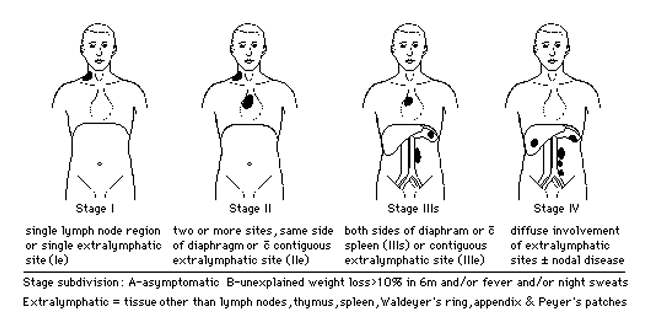
Management
- Hodgkin’s:
- Stage I / II → RTx
- Stage III / IV → RTx & chemotherapy ± BM transplant
- NHL
- High grade:
- Stage I / II → radiotherapy ± chemo (Doxyrubacin)
- Stage II-IV → CHOP (cyclophosphamide, doxyrubicin, vincristine, prednisone)
- Low grade: radiotherapy, if localised ± chemo
- High grade:
Prognosis / Natural Hx:
- Hodgkin’s lymphoma → 70% cured with modern therapy
- Relapse rates 20-30%
- NHL
- Low grade: difficult to cure; most pts die of their disease
- High grade: more aggressive, but often curable
- Relapse → poor prognosis (10% long-term survival)
Intestinal lymphoma
- Primary intestinal lymphoma = (HNL) lymphoma affecting intestine, which exhibits no evidence of liver, spleen or BM involvement at time of Dx (but regional LN may be present)
- Incidence:
- accounts for 30% of GI lymphoma
- Classification
- Western type – seen in Europe & North America: sporadic discrete lesion arises from B cells in MALT in small intestine that was previously normal
- Mediterranean type – B cell lymphoma that arises in association with diffuse plasma-cell infiltration of the small intestine mucosa (the plasma cells synthesize an abN IgA heavy chain)
- Primary lymphoma is also associated with
- Coeliac disease / Tropical Sprue- associated lymphoma → T cell lymphoma
- Occurs after 10-20 year history of symptomatic malabsorption
- HIV / AIDS → tends to be NHL of B-cell type
- Pts with congenital / therapy-induced immunodeficiency states
- lymphoid nodular hyperplasia
- Coeliac disease / Tropical Sprue- associated lymphoma → T cell lymphoma
- Aetiology
- Primary small bowel lymphoma (10%) – most commonly in the ileum
- Mostly (90%) secondary involvement of small bowel – ie secondary manifestations of nodal lymphoma
- Clinical
- May be asymptomatic
- May cause
- Obstruction
- Blood loss
- Perforation – in 10% of presentations
- (due to lack of stromal support; chemo can also reduce tumour bulk leading to perforation)
- Pathology
- Overall, most gut lymphomas are B-cell type (>95%); the rare T-cell tumours almost always occur in pts with pre-existing Coeliacs disease
- Ix
- CT
- Endoscopy
- Excisional Bx
- Mx
- Primary/ isolated / localised small intestinal lymphoma: surgery
- Diffuse / secondary lymphoma: Combination chemo
- Prognosis / Natural Hx:
- Primary GI lymphomas better prognosis than those arising in other sites
- 85% 10YS